« All news
March 9, 2025Features

Lucia Dlugoszewski: A Life in Sound

Written and annotated by Dustin Hurt
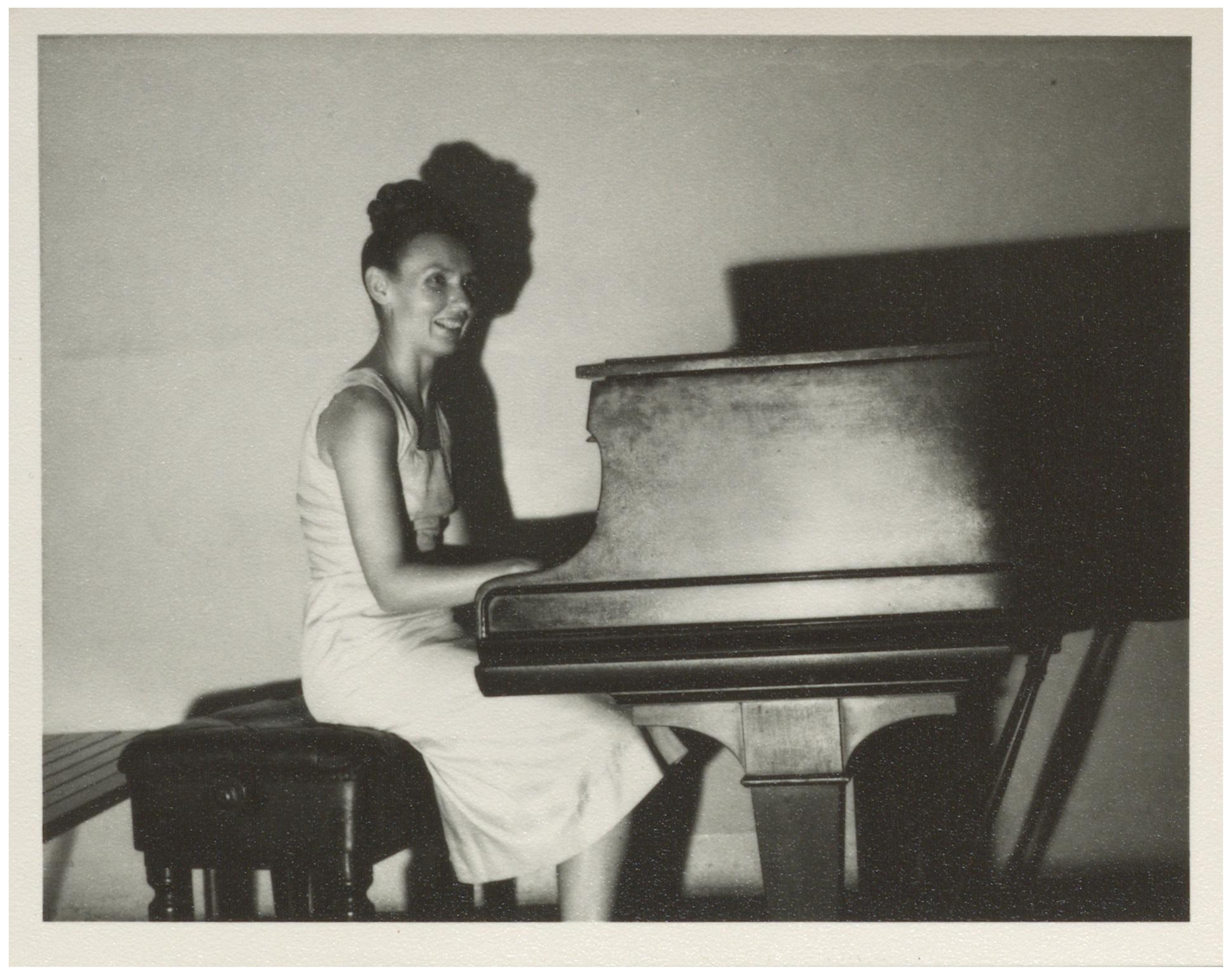
Lucia Dlugoszewski, early 1950s. Photographer unknown. From the Erick Hawkins and Lucia Dlugoszewski Papers, Music Division, Library of Congress, Washington, D.C. Used with permission of the Hawkins Dlugoszewski Foundation.

Dustin Hurt wrote this illustrated biography of composer Lucia Dlugoszewski (1925–2000) for Pure Lucia: The Life and Work of Lucia Dlugoszewski, Bowerbird’s retrospective in her centenary year. The photographs, scores, programs, posters and recordings alongside the text are drawn largely from the Erick Hawkins and Lucia Dlugoszewski Papers at the Library of Congress.

Mid-west Origins: Lucille Ruth Dlugoszewski

Born on June 16, 1925, in Detroit, Michigan, to Polish immigrant parents, Lucia Dlugoszewski (pronounced LOO-sha dwoo-goh-SHEF-skee) was immersed in the arts from a young age, playing piano, composing music, and writing poetry. She initially pursued studies in chemistry and pre-medicine at Wayne State University, but by the late 1940s, music had become her primary focus.  Her birth name was “Lucille”, but in her twenties she opted to use “Lucia” instead.

In 1949, she was awarded a fellowship that brought her to New York City, where she studied piano with Grete Sultan and explored composition and theory under the guidance of Edgard Varèse. During this period, she also became acquainted with John Cage, who played an early role in shaping her engagement with the avant-garde community.

By the early 1950s, Dlugoszewski was deeply embedded in New York’s experimental arts scene—mixing with painters, poets, dancers, theater artists, and filmmakers in the loft concerts and underground venues of downtown Manhattan.

She collaborated with key figures in experimental theater, including Judith Malina and Julian Beck’s Living Theatre, and composed music for avant-garde films such as Jonas Mekas’s Guns of the Trees and Marie Menken’s Visual Variations on Noguchi. She was briefly part of Cage’s circle and engaged with the techniques of Henry Cowell and others working with extended piano techniques. But by 1952, she had begun developing a distinctive artistic voice, expanding beyond these influences into something uniquely her own.
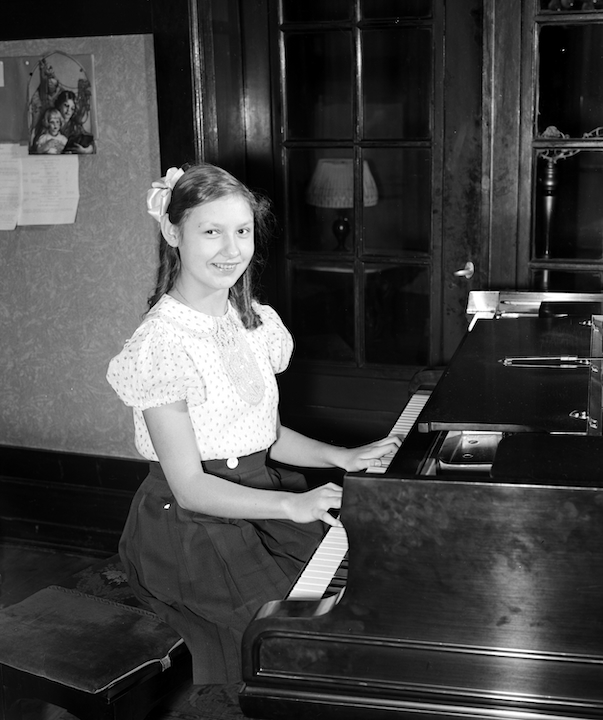
Lucille Dlugoszewski at the piano. Published in The Detroit News on January 14, 1939 (age 13). Credit: Walter P. Reuther Library, Archives of Labor and Urban Affairs, Wayne State University.
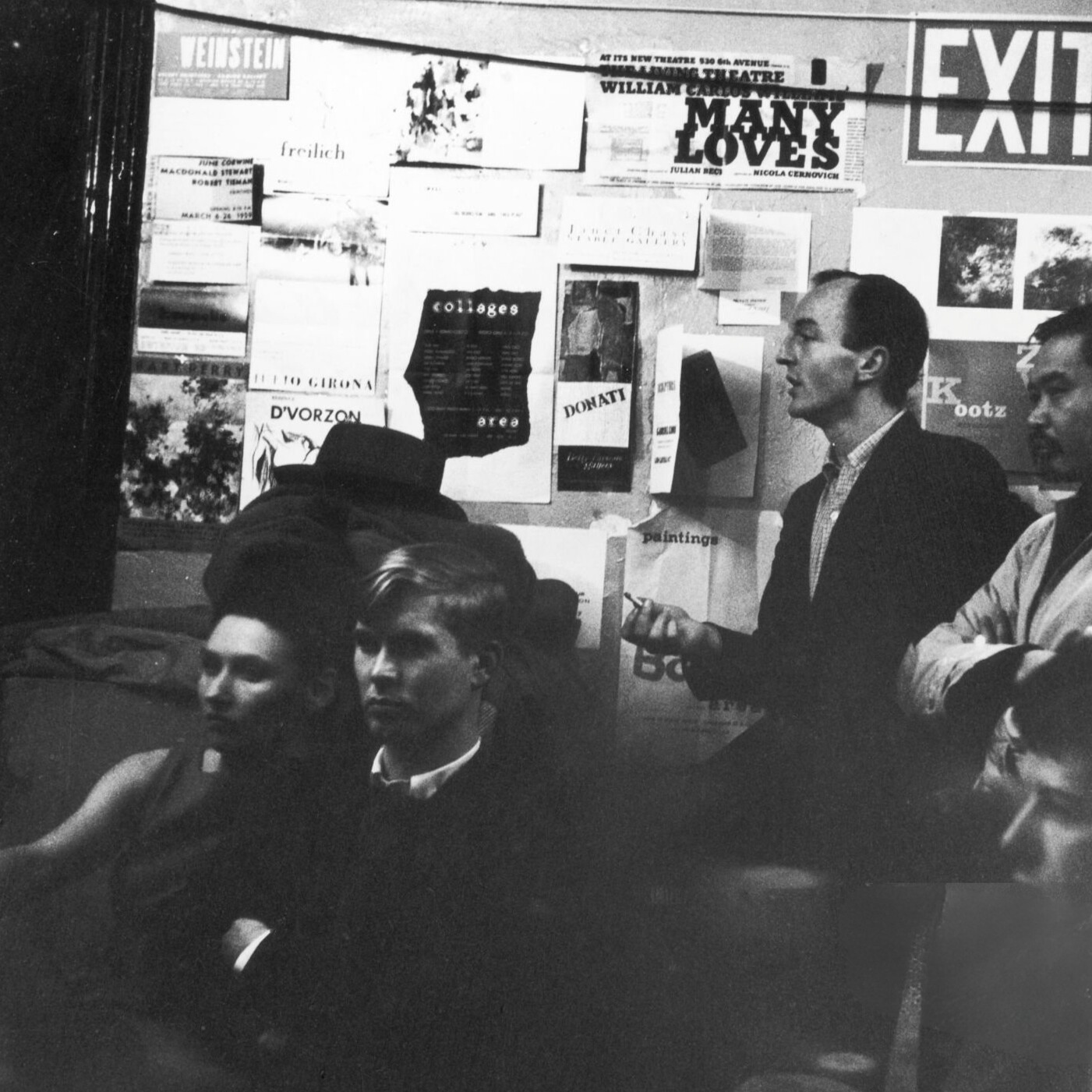
Attendees at an Artist’s Club Panel Discussion, New York, March 20, 1959. View of attendees at the panel discussion What is the New Academy? at the Artist’s Club, New York. From left: musi
Attendees at an Artist’s Club Panel Discussion, New York, March 20, 1959. View of attendees at the panel discussion What is the New Academy? at the Artist’s Club, New York. From left: musician Lucia Dlugoszewski (1931–2000) and writer Joseph LeSueur (1924–2001) (both seated), poet Frank O’Hara (1926–1966), and painter Matsumi Kanemitsu (1922–1992). Photo by Fred W. McDarrah/MUUS Collection via Getty Images.
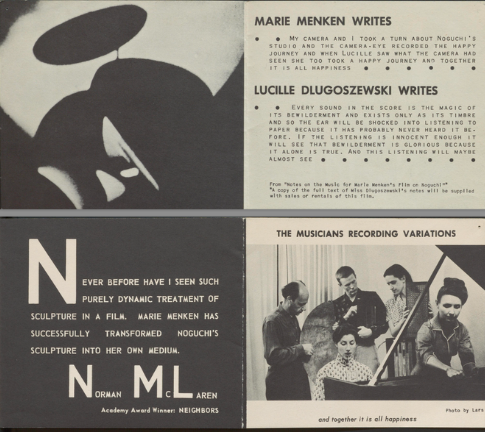
Marketing materials for “Visual Variations on Noguchi” (1954). Promotional materials for the film “Visual Variations on Noguchi, directed by Marie Menken (originally made in 1945) wi
Marketing materials for “Visual Variations on Noguchi” (1954). Promotional materials for the film “Visual Variations on Noguchi, directed by Marie Menken (originally made in 1945) with music by Lucia (Lucille) Dlugoszewski added in 1952/3. The film score was recorded at the famous Bebe and Louis Barron recording studio. . The film explores the sculptural work of Isamu Noguchi through experimental cinematography and sound. From the Erick Hawkins and Lucia Dlugoszewski Papers, Music Division, Library of Congress, Washington, D.C. Used with permission of the Hawkins Dlugoszewski Foundation.
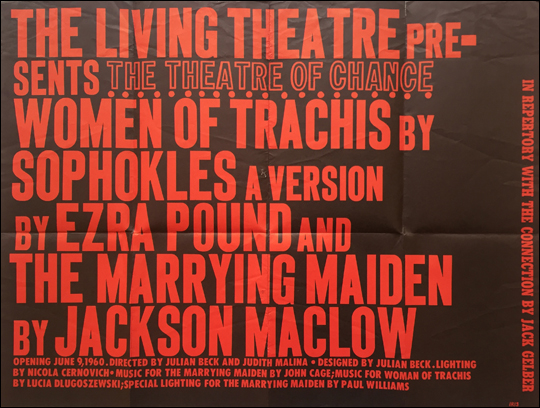
Poster for The Living Theatre production of Women of Trachis by Sophokles, in a version by Ezra Pound, with music by Lucia Dlugoszewski (1960). Designed by an artist identified as “Iris,”.
Poster for The Living Theatre production of Women of Trachis by Sophokles, in a version by Ezra Pound, with music by Lucia Dlugoszewski (1960). Designed by an artist identified as “Iris,”. Dlugoszewski described the score as a “non-stop evening structure of music” featuring flute and clarinet moving in space, Timbre Piano, Unsheltered Rattles, and four percussionists positioned throughout the performance environment. Image sourced from the internet.

New Frontiers: Timbre Piano and Invented Percussion

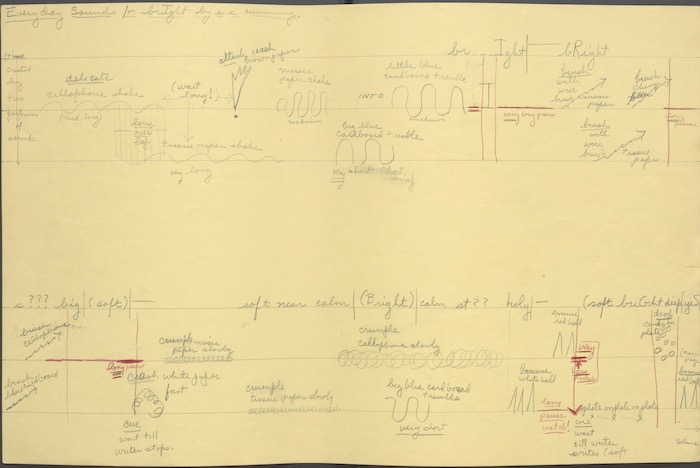
Dlugoszewski’s innovations in sound exploration took shape during these formative years. She developed what she called “Timbre Piano,” a performance practice centered on direct interaction with the strings and frame of the piano using mallets, objects, and other unconventional techniques. This approach differed from Cage’s prepared piano, which altered the instrument’s sound by inserting objects between the strings but largely retained the use of the keyboard for playing. Dlugoszewski’s fascination with sound extended beyond traditional instruments, focusing on what she called “everyday sounds.” She explored the sonic possibilities of materials like water pouring from one vessel to another, rice cascading onto a surface, and the subtle textures of paper tearing. This interest in everyday sounds paralleled the work of John Cage, whose 1952 piece Water Music also incorporated non-instrumental sound sources. However, while Cage often emphasized the theatrical or indeterminate aspects of these sonic elements, Dlugoszewski approached them for their pure sonic potential, integrating them seamlessly into her compositions.

Around 1958, Dlugoszewski began developing what she called an “orchestra of 100 invented percussion instruments.” This collection included ladder harps, tangent rattles, square drums, and many other one-of-a-kind instruments, designed and built in collaboration with sculptor Ralph Dorazio, a childhood friend. Her innovation was not just in creating new instruments but in conceptualizing them in sets—akin to the choirs of strings or winds in an orchestra. These percussion instruments were constructed in different sizes and materials, allowing for a wide range of timbral variation. She also developed unique performance techniques for them, expanding the expressive possibilities of percussion music. Initially, Dlugoszewski designed these instruments for herself as a solo performer, but over time, they became a defining feature of many of her compositions.
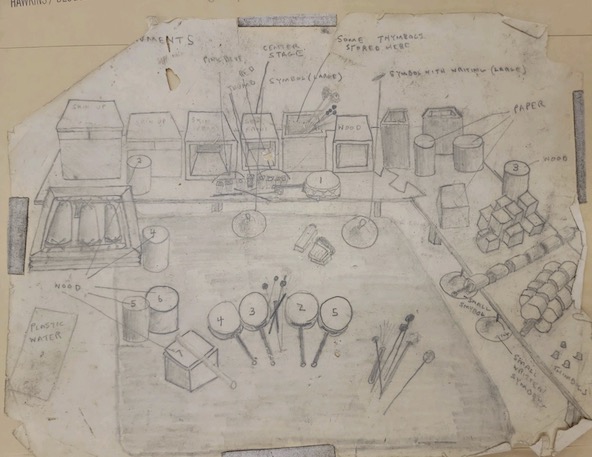
Sketch of percussion orchestra setup, possibly in Ralph Dorazio’s hand. From the Erick Hawkins and Lucia Dlugoszewski Papers, Music Division, Library of Congress, Washington, D.C. Used with perm
Sketch of percussion orchestra setup, possibly in Ralph Dorazio’s hand. From the Erick Hawkins and Lucia Dlugoszewski Papers, Music Division, Library of Congress, Washington, D.C. Used with permission of the Hawkins Dlugoszewski Foundation.
Excerpt from holograph of “Everyday Sounds for brIght by e. e. cummings” by Lucia Dlugoszewski. From the Erick Hawkins and Lucia Dlugoszewski Papers, Music Division, Library of Congress, W
Excerpt from holograph of “Everyday Sounds for brIght by e. e. cummings” by Lucia Dlugoszewski. From the Erick Hawkins and Lucia Dlugoszewski Papers, Music Division, Library of Congress, Washington, D.C.
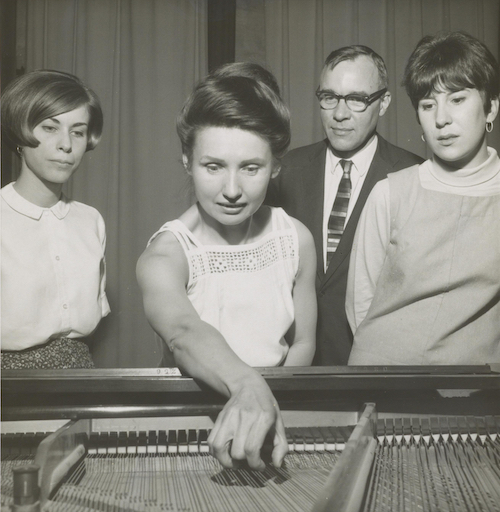
Lucia Dlugoszewski demonstrates the Timbre Piano to students of Cedar Crest College, Allentown, PA, April 1967. Photographer unknown. From the Erick Hawkins and Lucia Dlugoszewski Papers, Music Divisi
Lucia Dlugoszewski demonstrates the Timbre Piano to students of Cedar Crest College, Allentown, PA, April 1967. Photographer unknown. From the Erick Hawkins and Lucia Dlugoszewski Papers, Music Division, Library of Congress, Washington, D.C.
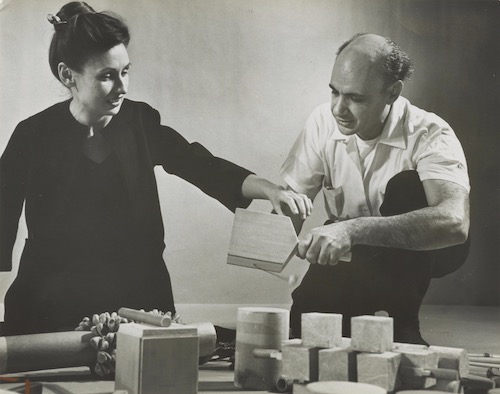
Lucia Dlugoszewski and Ralph Dorazio with a selection of percussion instruments. Photographer: Daniel Kramer, used with permission. From the Erick Hawkins and Lucia Dlugoszewski Papers, Music Division
Lucia Dlugoszewski and Ralph Dorazio with a selection of percussion instruments. Photographer: Daniel Kramer, used with permission. From the Erick Hawkins and Lucia Dlugoszewski Papers, Music Division, Library of Congress, Washington, D.C.

A 40-Year Creative Partnership with Erick Hawkins

Dlugoszewski and Erick Hawkins met in 1950, beginning what would become one of the longest choreographer-composer partnerships in history, lasting from 1951 until Hawkins’ death in 1994. As biographer Amy Beal has noted, their collaboration may be second in duration only to that of John Cage and Merce Cunningham, whose partnership spanned from 1942 to 1992. Together, they created over twenty works and toured extensively, performing across the United States and internationally for decades. Although deeply intertwined artistically, they chose to keep their personal relationship largely private. They married in 1962 but kept this fact hidden from all but their closest friends. It was not until Hawkins’ eulogy in 1994 that Dlugoszewski publicly acknowledged their marriage.

Rather than choreographing to pre-existing music, or composing to fit predetermined choreography, their creative process appears to have been highly collaborative and iterative. It seems that their work often began with prose writings outlining the philosophical ideas they wanted to express, followed by the creation of large-scale structural frameworks that were often complex and asymmetrical. At a certain stage, they would refine these structures into an agreed-upon system of counts and bars, which became the foundation for both the choreography and the music.
Lucia Dlugoszewski performs “Geography of Noon” (1964)
Archival footage of Dlugoszewski performing with the Erick Hawkins Dance Company during a 1964 UCLA residency. This excerpt features Dlugoszewski playing instruments of her own design and utilizing performance techniques she developed during this period. Notably, she performed live on stage as part of the dance. “Geography of Noon,” choreographed by Erick Hawkins with music by Dlugoszewski, premiered in 1964 and was recorded the same year. Performers include Hawkins, Ellen Marshall, Dena Medole, and James Tyler, with set design by Ralph Dorazio.
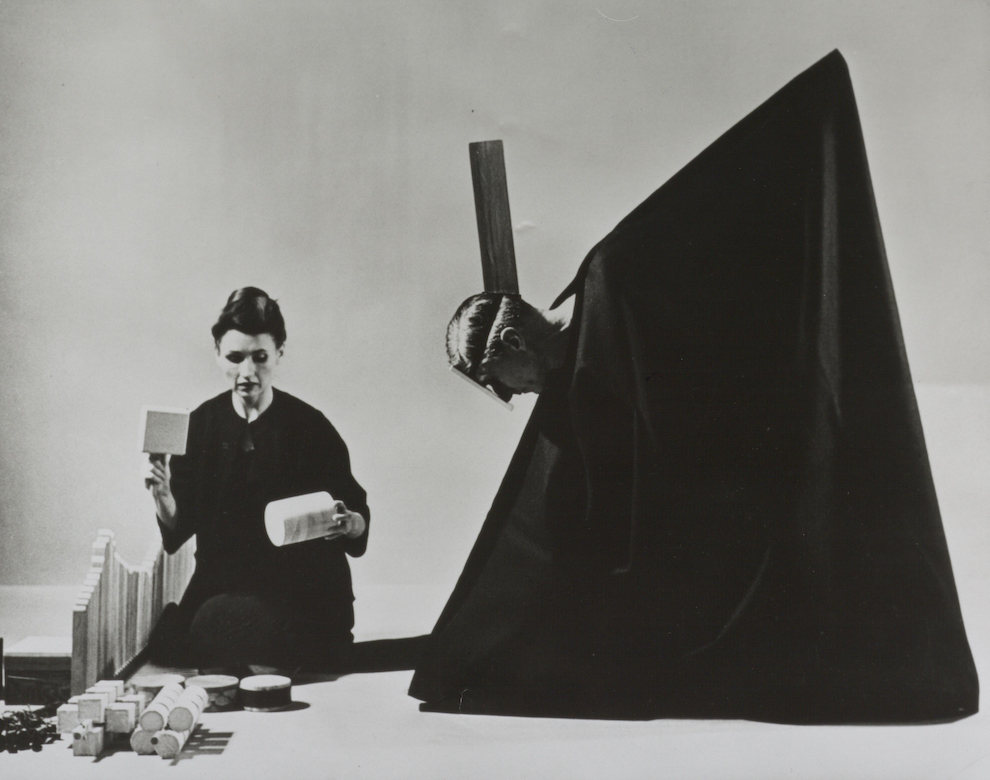
Lucia Dlugoszewski and Erick Hawkins, “8 Clear Places,” 1961. Photographed by Daniel Kramer. From the Erick Hawkins and Lucia Dlugoszewski Papers, Music Division, Library of Congress, Wash
Lucia Dlugoszewski and Erick Hawkins, “8 Clear Places,” 1961. Photographed by Daniel Kramer. From the Erick Hawkins and Lucia Dlugoszewski Papers, Music Division, Library of Congress, Washington, D.C. Used with permission.
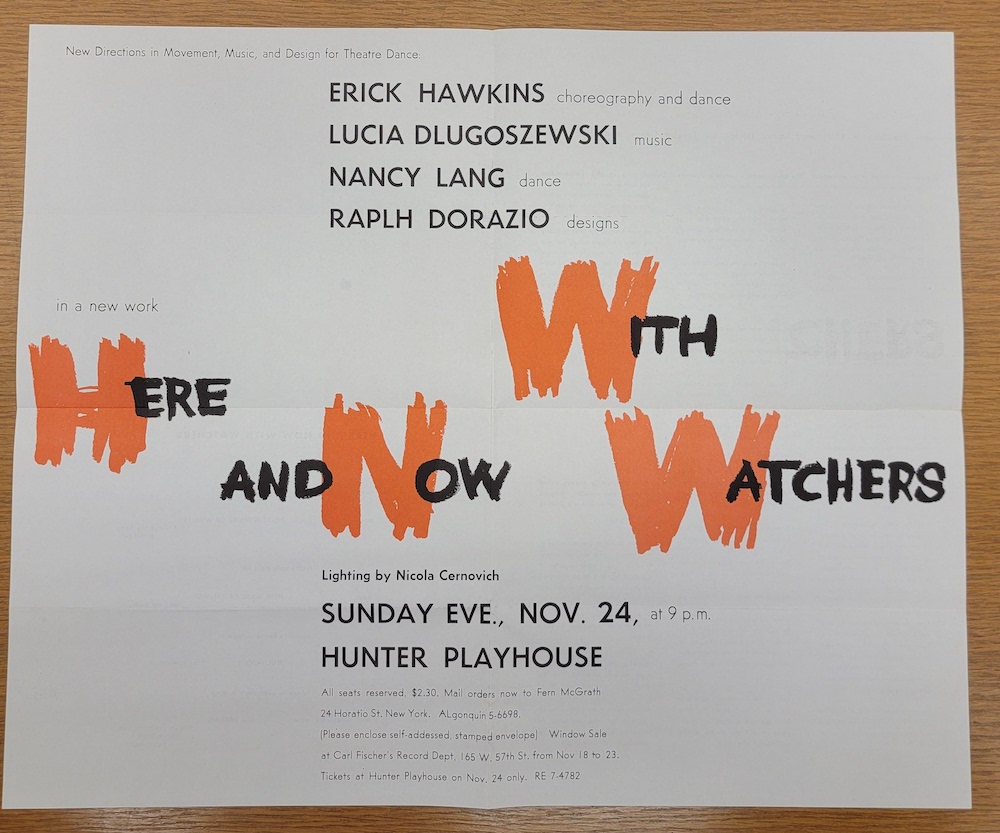
Poster for “Here and Now with Watchers,” 1957. Choreographed by Erick Hawkins with music by Lucia Dlugoszewski. Design by Ralph Dorazio. Performance at Hunter Playhouse, November 24, 1957.
Poster for “Here and Now with Watchers,” 1957. Choreographed by Erick Hawkins with music by Lucia Dlugoszewski. Design by Ralph Dorazio. Performance at Hunter Playhouse, November 24, 1957. From the Erick Hawkins and Lucia Dlugoszewski Papers, Music Division, Library of Congress, Washington, D.C. Used with permission of the Hawkins Dlugoszewski Foundation.
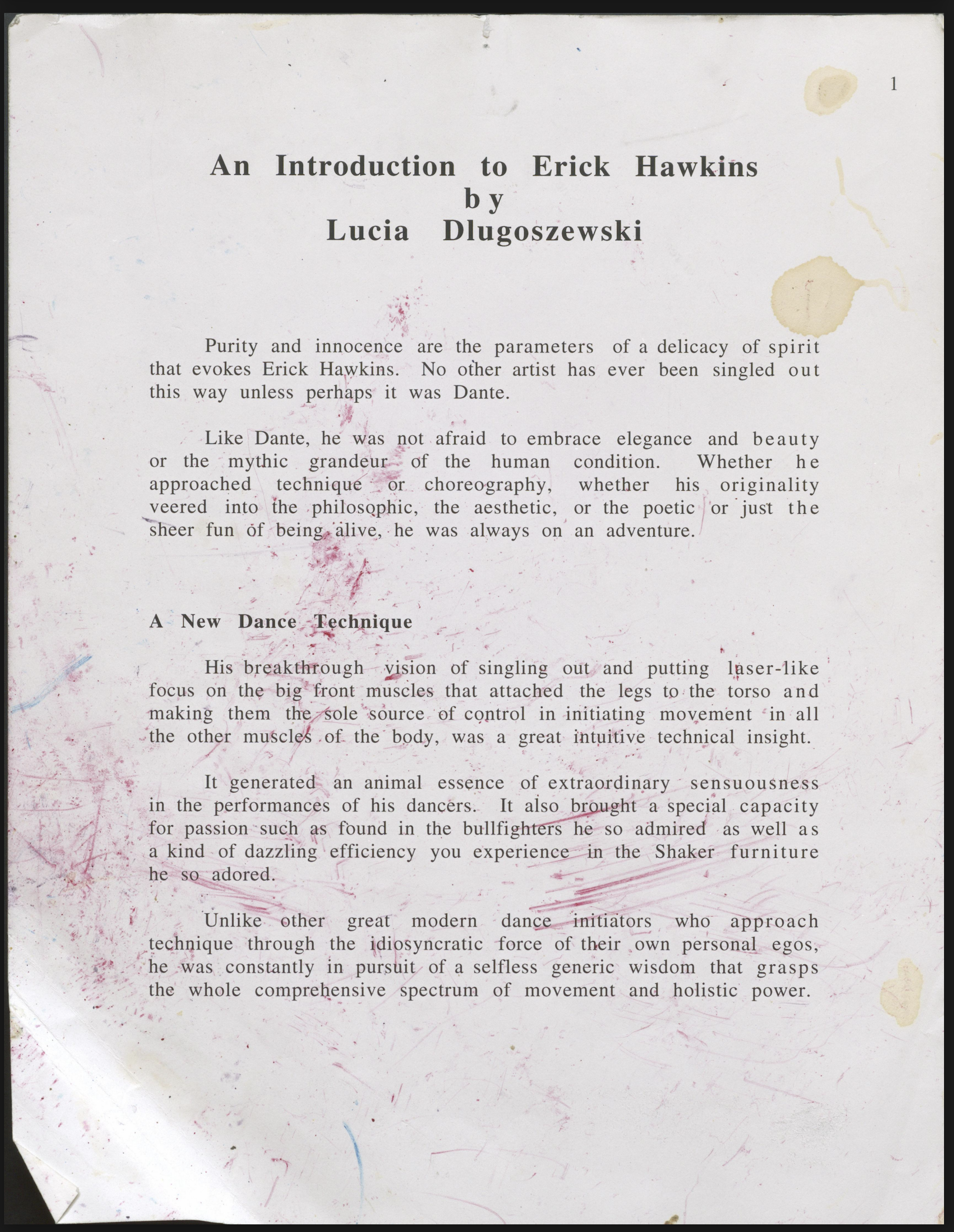
First page of a lengthy essay by Lucia Dlugoszewski introducing Erick Hawkins, discussing his artistic philosophy and innovative approach to dance technique. From the Erick Hawkins and Lucia Dlugoszew
First page of a lengthy essay by Lucia Dlugoszewski introducing Erick Hawkins, discussing his artistic philosophy and innovative approach to dance technique. From the Erick Hawkins and Lucia Dlugoszewski Papers, Music Division, Library of Congress, Washington, D.C. Used with permission of the Erick Hawkins and Lucia Dlugoszewski Trust.
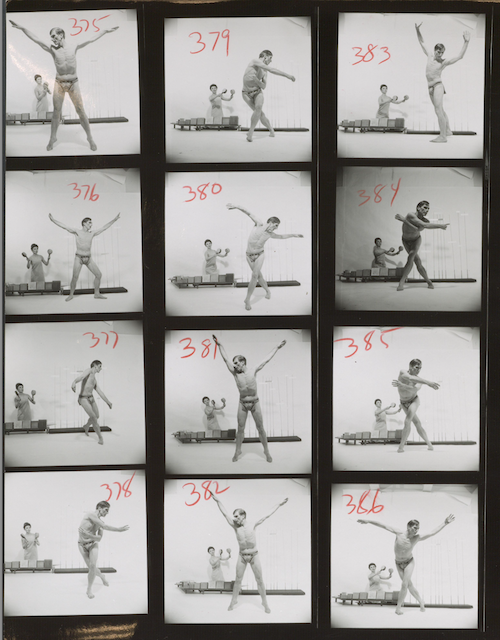
Contact sheet for photo shoot of “Geography of Noon”. Photographed by Daniel Kramer. Used with permission. Featuring Lucia Dlugoszewski and Erick Hawkins. From the Erick Hawkins and Lucia
Contact sheet for photo shoot of “Geography of Noon”. Photographed by Daniel Kramer. Used with permission. Featuring Lucia Dlugoszewski and Erick Hawkins. From the Erick Hawkins and Lucia Dlugoszewski Papers, Music Division, Library of Congress, Washington, D.C.
Erick Hawkins performs as “Innerfeet of Summer Fly” in 8 Clear Places, accompanied by Lucia Dlugoszewski on percussion. Photographer Michael Avedon. From the Erick Hawkins and Lucia Dlugos
Erick Hawkins performs as “Innerfeet of Summer Fly” in 8 Clear Places, accompanied by Lucia Dlugoszewski on percussion. Photographer Michael Avedon. From the Erick Hawkins and Lucia Dlugoszewski Papers, Music Division, Library of Congress, Washington, D.C.

Expanding Beyond Dance: The 1970s and Major Commissions

Though much of her early career was defined by dance, by the 1970s, Dlugoszewski was receiving major commissions and building a reputation in concert music. In 1973, she was commissioned by the Lincoln Center Chamber Music Festival to compose Fire Fragile Flight. Two years later, Abyss and Caress for trumpet and orchestra, commissioned for Gerard Schwarz, was premiered by the New York Philharmonic under Pierre Boulez. During this period, she also wrote Tender Theater Flight Nagiere for brass quintet and percussion and Angels of the Inmost Heaven for brass quintet, both composed for the American Brass Quintet. In 1980, the Library of Congress commissioned Amor Empty Elusive August, which was premiered by the Boehm Quintette. Space is a Diamond for solo trumpet and Abyss and Caress were among the few of her works published by Margun, suggesting a promising expansion of her career beyond dance. However, no additional works were ever published.

Space is a Diamond (audio)

Composed in 1970 and performed by Gerard Schwartz on trumpet, Lucia Dlugoszewski’s “Space is a Diamond” is a groundbreaking work that redefined the instrument’s expressive potential. The piece demands an extraordinary four-and-a-half-octave range and incorporates unconventional techniques, pushing both the performer and the trumpet to new limits.

Fire Fragile Flight (audio)

Composed and recorded in 1979, “Fire Fragile Flight” was performed by the Orchestra of Our Time under the direction of Joel Thome. With this recording, Dlugoszewski became the first woman to win the Koussevitzky International Recording Award. The work features an unconventional percussion section with four players on slide whistles, hanging bells, and inside-the-piano techniques. Inspired by the movement of falling leaves in early March in the Great Lakes region, the music incorporates “leap-points” that trigger whirling “startle-juxtapositions” of varying speed, evoking the flickering reflections that can make falling leaves appear to catch fire.
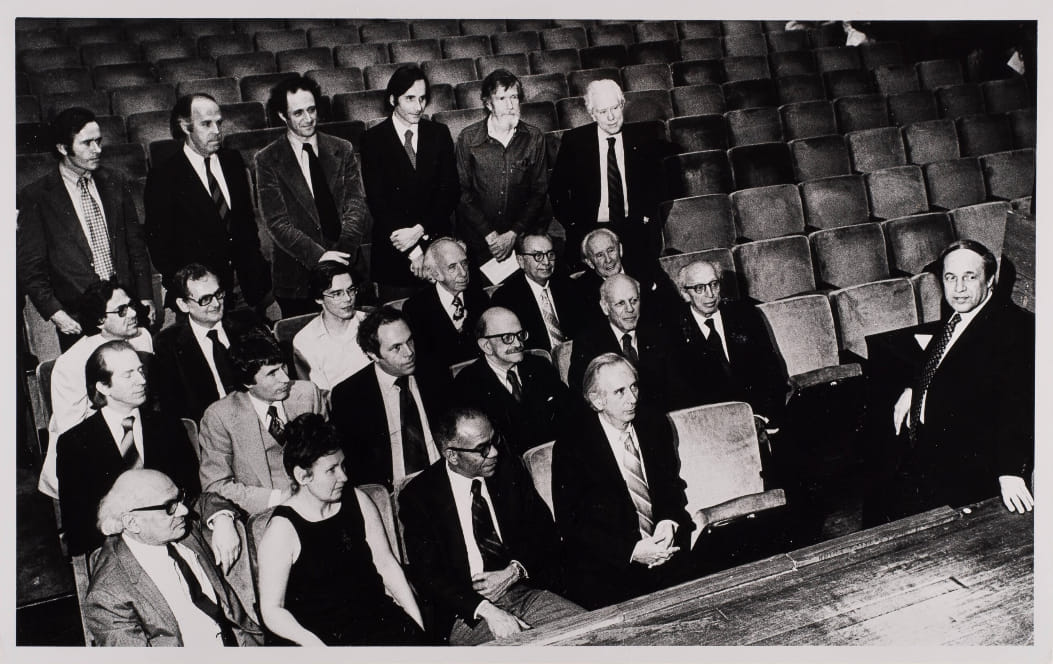
American composers gathered for Pierre Boulez’s farewell concert with the New York Philharmonic in May 1977. Among them, Lucia Dlugoszewski stands as the only woman in the group. From the New York Phi
American composers gathered for Pierre Boulez’s farewell concert with the New York Philharmonic in May 1977. Among them, Lucia Dlugoszewski stands as the only woman in the group. From the New York Philharmonic Archives
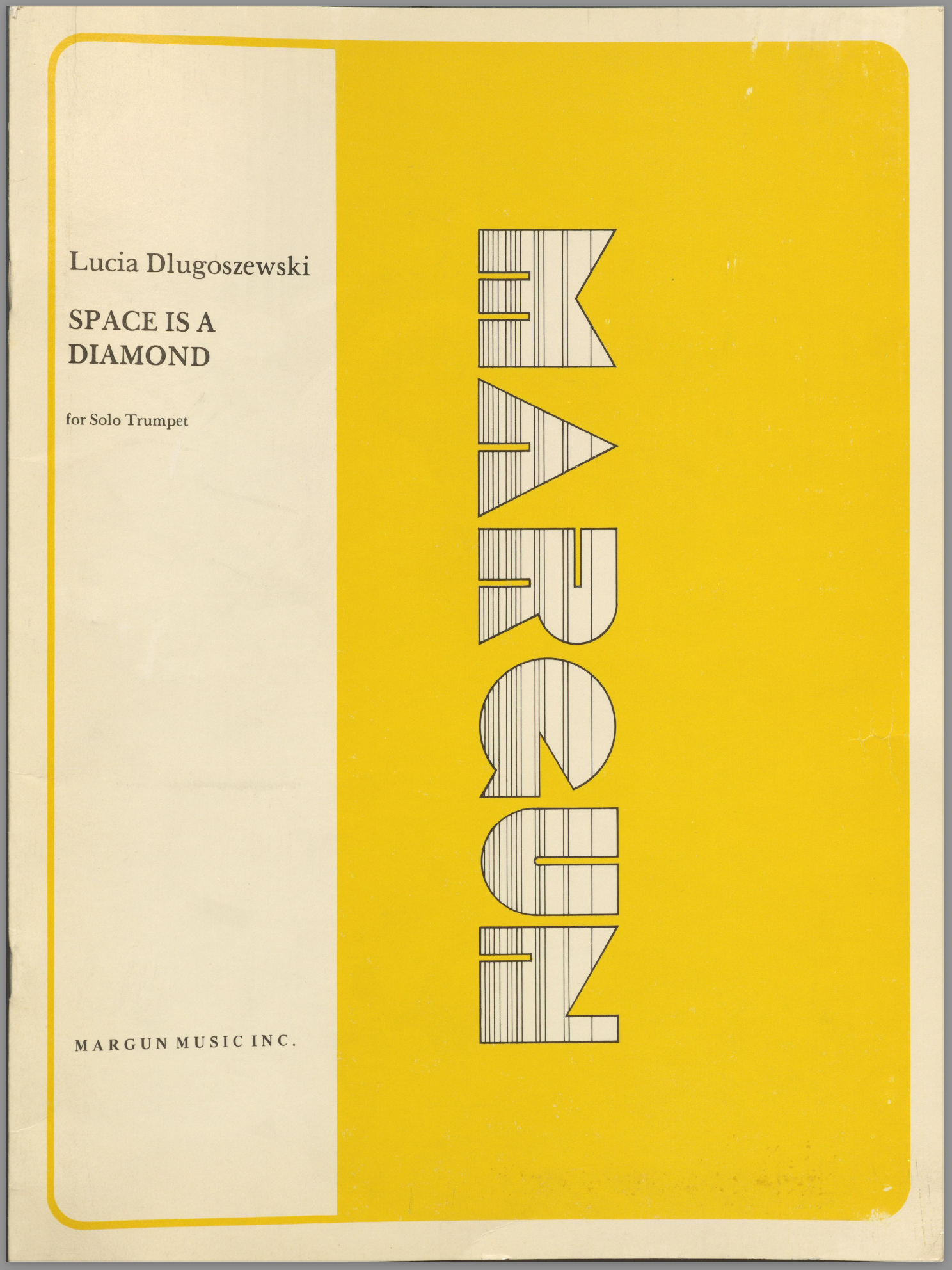
Cover of “Space is a Diamond” by Lucia Dlugoszewski, 1970. The only score by Dlugoszewski to be professionally engraved and published during her lifetime. Originally published by Margun Pu
Cover of “Space is a Diamond” by Lucia Dlugoszewski, 1970. The only score by Dlugoszewski to be professionally engraved and published during her lifetime. Originally published by Margun Publishing in 1970, it is now long out of print. From the Erick Hawkins and Lucia Dlugoszewski Papers, Music Division, Library of Congress, Washington, D.C.
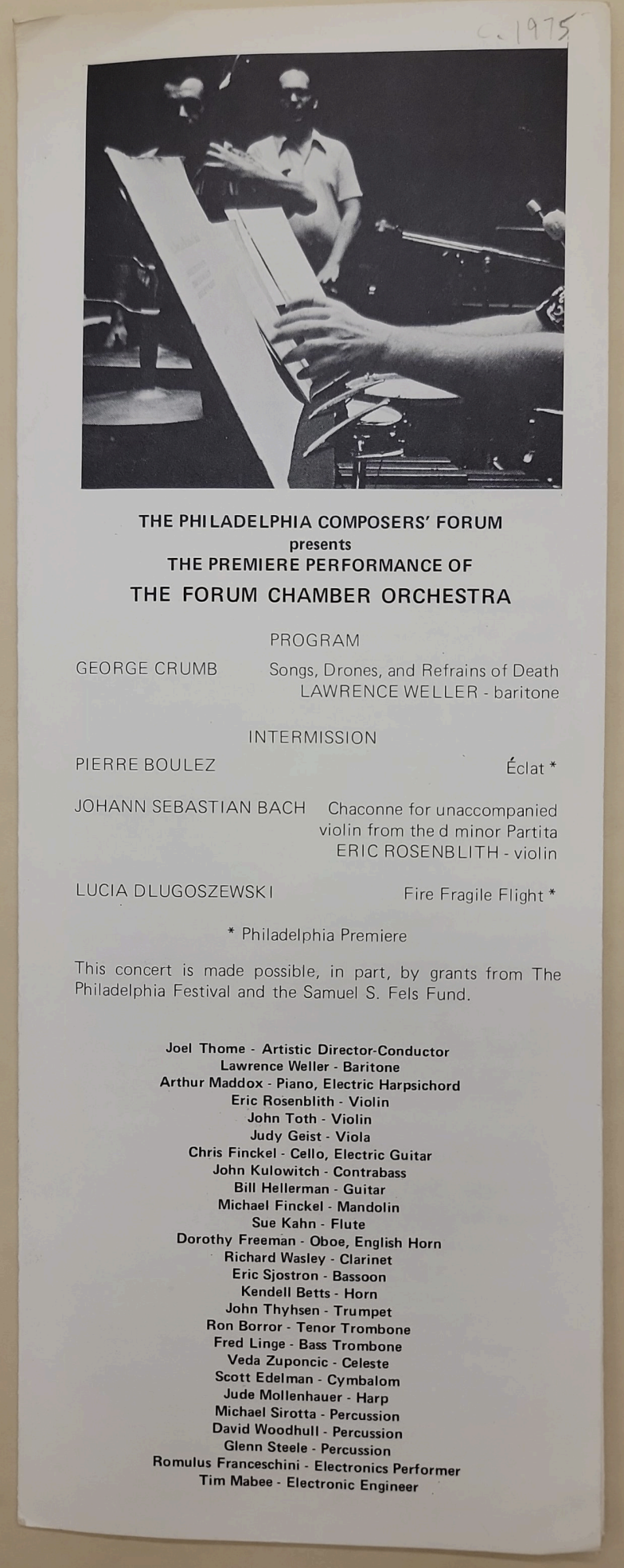
Concert program from the Philadelphia Composers’ Forum performance of Lucia Dlugoszewski’s “Fire Fragile Flight” at the Philadelphia Art Alliance, 1975. From the Erick Hawkins
Concert program from the Philadelphia Composers’ Forum performance of Lucia Dlugoszewski’s “Fire Fragile Flight” at the Philadelphia Art Alliance, 1975. From the Erick Hawkins and Lucia Dlugoszewski Papers, Music Division, Library of Congress, Washington, D.C. Used with permission of the Hawkins Dlugoszewski Foundation.
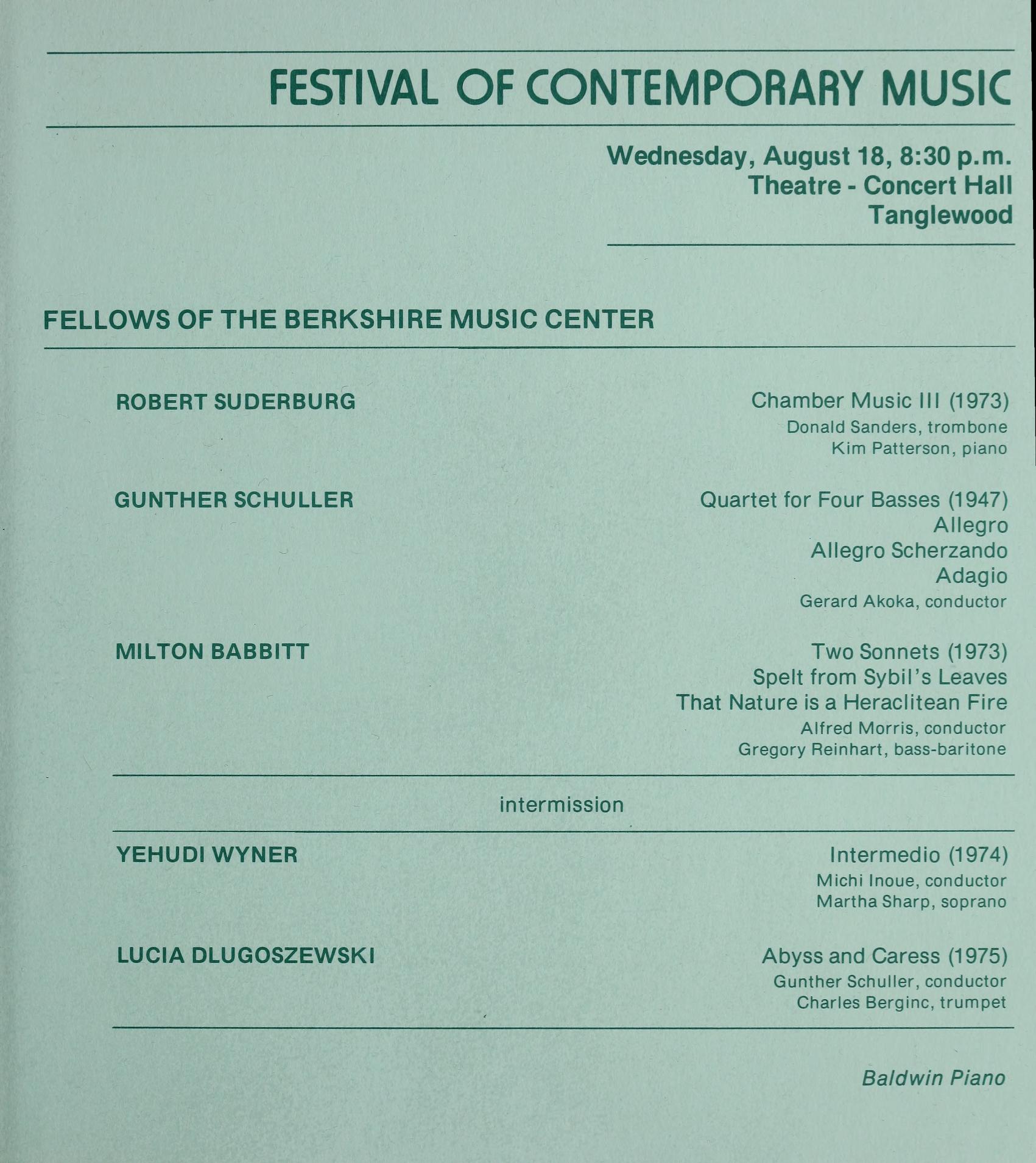
Program for the Festival of Contemporary Music, Tanglewood, August 18, 1976. Featuring performances by fellows of the Berkshire Music Center, including works by Robert Suderburg, Gunther Schuller, Mil
Program for the Festival of Contemporary Music, Tanglewood, August 18, 1976. Featuring performances by fellows of the Berkshire Music Center, including works by Robert Suderburg, Gunther Schuller, Milton Babbitt, Yehudi Wyner, and Lucia Dlugoszewski. Dlugoszewski’s “Abyss and Caress” (1975) was conducted by Gunther Schuller with Charles Berginc on trumpet. From the Boston Symphony Orchestra Archives.
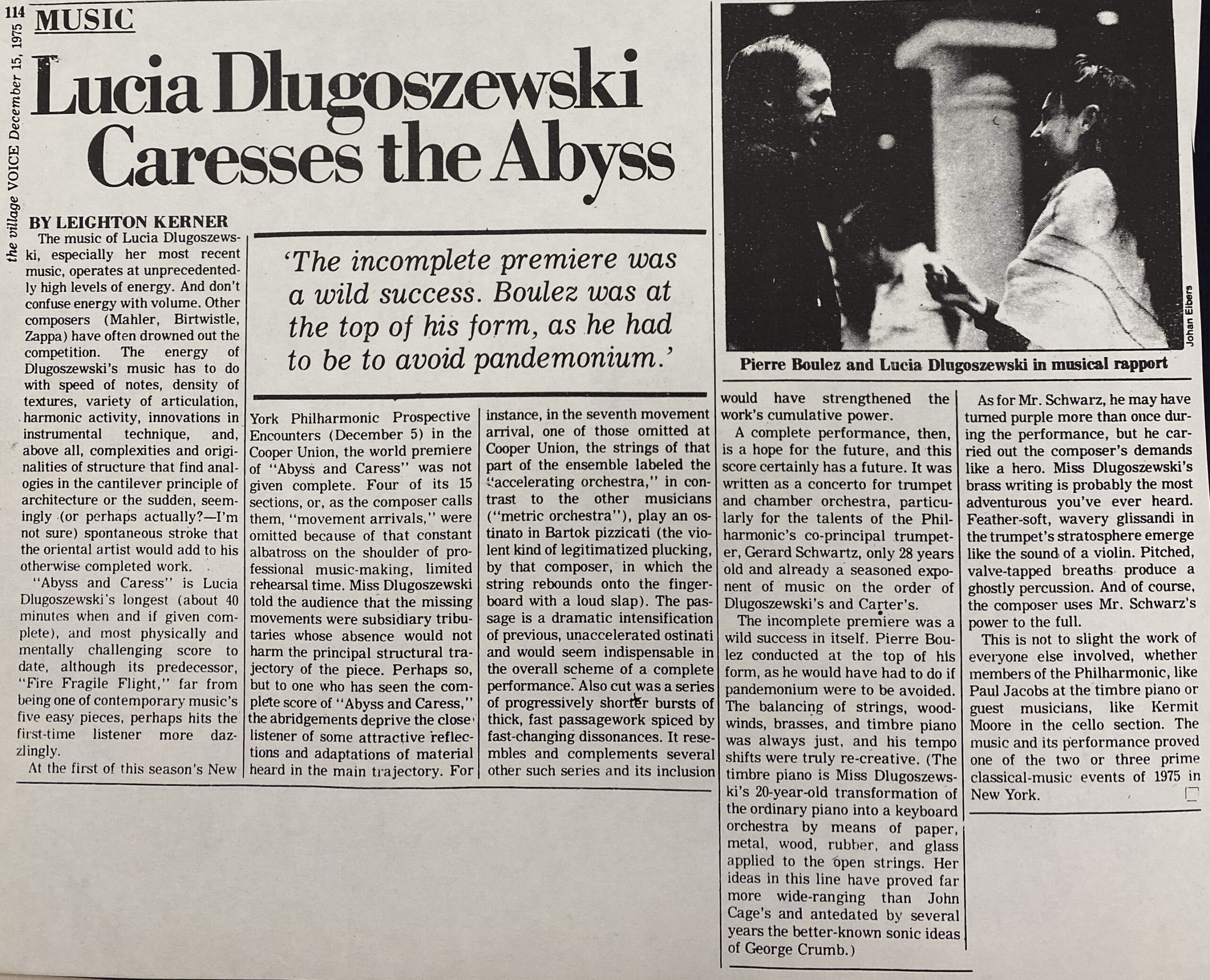
Review of “Abyss and Caress” by Lucia Dlugoszewski, published in The Village Voice, December 15, 1975. Written by Leighton Kerner, the article discusses the energy and complexity of Dlugos
Review of “Abyss and Caress” by Lucia Dlugoszewski, published in The Village Voice, December 15, 1975. Written by Leighton Kerner, the article discusses the energy and complexity of Dlugoszewski’s composition, its premiere under Pierre Boulez, and the role of trumpeter Gerard Schwarz. From the Lucia Dlugoszewski Papers, Music Division, New York Public Library for the Performing Arts.

Challenges of the 1980s and a Late-Career Resurgence

Seemingly on the edge of a breakthrough, the 1980s proved to be a difficult decade for Dlugoszewski. According to biographer Amy Beal, her output slowed in part due to long periods spent in Detroit caring for her aging mother, whose declining health required Dlugoszewski’s care for extended periods until her passing in 1988. The stress of balancing family responsibilities with creative work is evident in her journals, as well as in letters from commissioners expressing frustration over delayed scores. Soon after her return to New York, she quickly assumed a caretaker role for Hawkins, whose health was also in decline.

Despite these personal challenges, she composed several major chamber works in the late 1980s and 1990s, including what is often regarded as a major achievement in her catalog, Disparate Radical Stairway Other, a 1995 string quartet commissioned by Mikhail Baryshnikov’s White Oak Dance Project for Erick Hawkins’ dance piece Journey of a Poet.

As part of her creative process, Dlugoszewski often created long, scrolling graphic drawings referred to as “Maps,” which depicted the overall structure and key moments of many of her compositions. These Maps reveal an emphasis on timbre and dynamic variation rather than conventional rhythmic, melodic, or harmonic priorities. Intervallic relationships and the ratio of time played a central role in her thinking, with pitch often approached from a timbral perspective rather than a purely harmonic one.
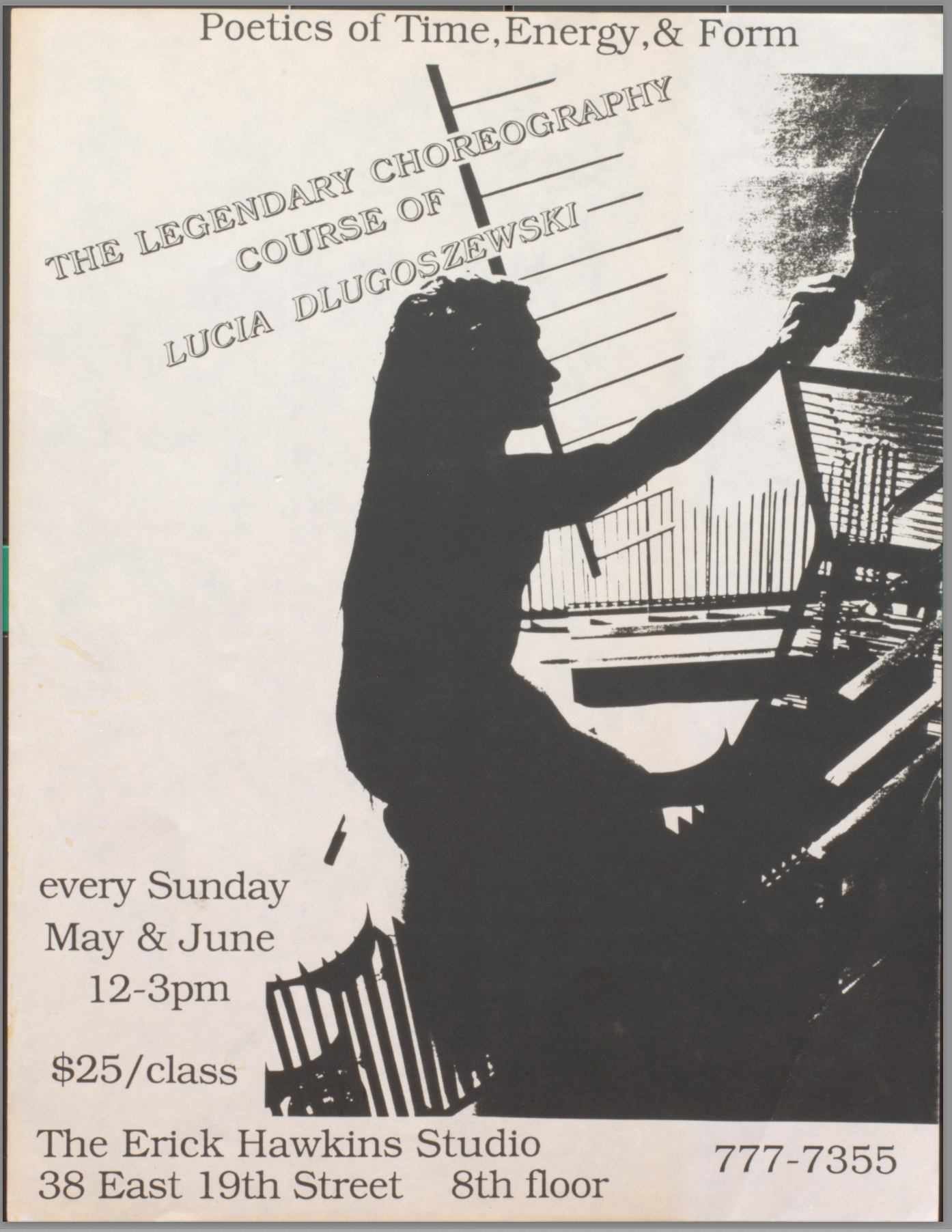
Poster for Lucia Dlugoszewski’s choreography class, c. 1995. From the Erick Hawkins and Lucia Dlugoszewski Papers, Music Division, Library of Congress, Washington, D.C. Used with permission of the Eri
Poster for Lucia Dlugoszewski’s choreography class, c. 1995. From the Erick Hawkins and Lucia Dlugoszewski Papers, Music Division, Library of Congress, Washington, D.C. Used with permission of the Hawkins Dlugoszewski Foundation.
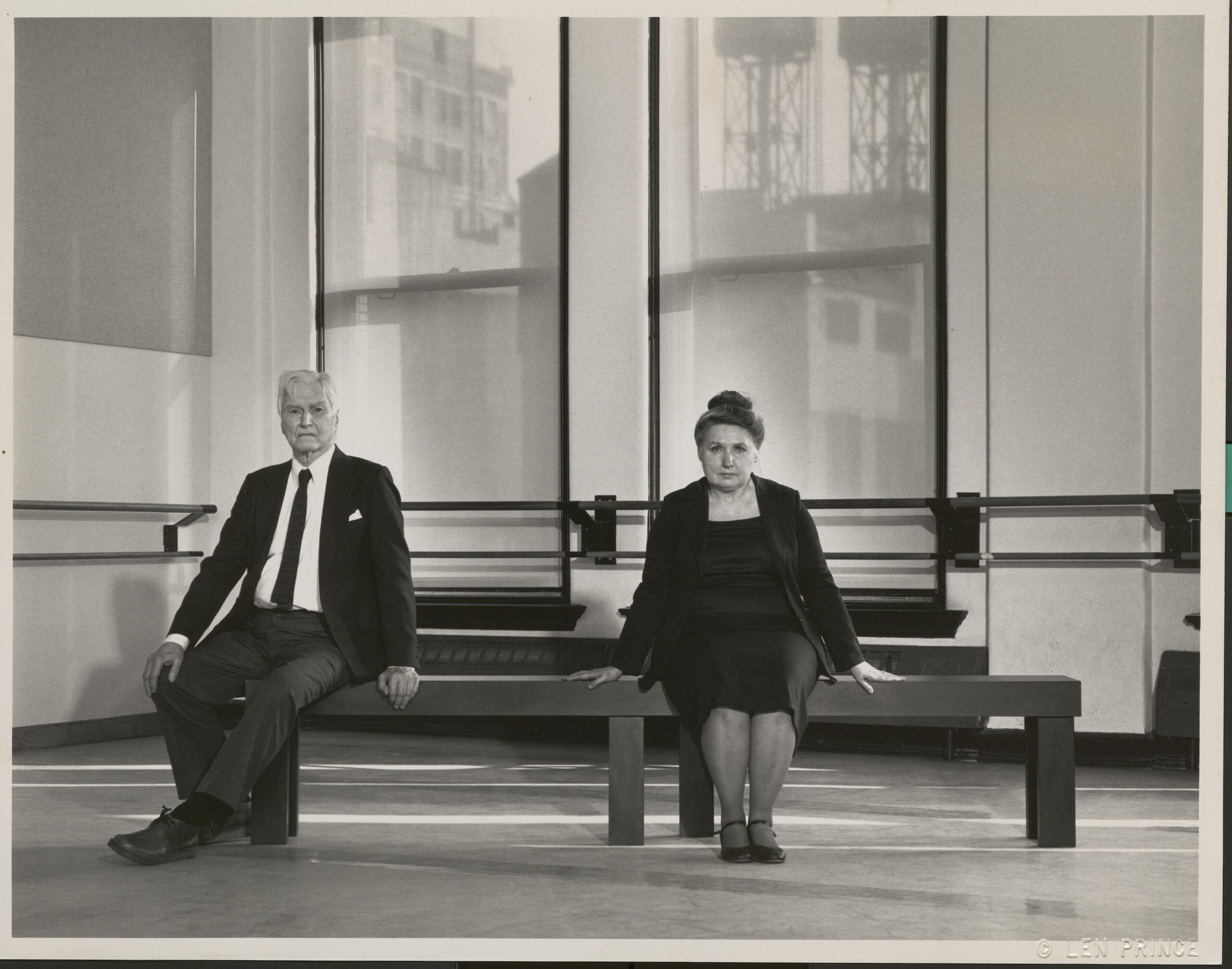
Erick Hawkins and Lucia Dlugoszewski, New York City, 1992. Photographed by Len Prince. From the Len Prince Photographs collection at The Rose Library at Emory University. Used with permission.

Disparate Stairway Radical Other (audio)

Dedicated to Mikhail Baryshnikov, Erick Hawkins (in memoriam), and Mary Norton Dorazio (in memoriam), this piece was commissioned by The White Oak Dance Project for “Journey of a Poet” by Erick Hawkins. Performed by the White Oak Ensemble—Conrad Harris and Margaret Jones on violin, David J. Bursack on viola, and Dorothy Lawson on cello.

Exacerbated Subtlety Concert (audio)

Composed in 1997 and recorded in 2000, “Exacerbated Subtlety Concert” is performed by Lucia Dlugoszewski on her timbre piano. This work explores similar techniques and sonic interests as earlier pieces but within a distinctly different instrumental context. Recorded on January 17, 2000, at the Summer Center, Concordia College in Bronxville, New York, this performance captures Dlugoszewski’s nuanced approach to timbre and texture through her unique performance practice.

Composite scan of a “Map” (a working diagram used in the compositional process) for “Disparate Radical Stairway Other” by Lucia Dlugoszewski. From the Erick Hawkins and Lucia D
Composite scan of a “Map” (a working diagram used in the compositional process) for “Disparate Radical Stairway Other” by Lucia Dlugoszewski. From the Erick Hawkins and Lucia Dlugoszewski Papers, Music Division, Library of Congress, Washington, D.C. Used with permission of the Hawkins Dlugoszewski Foundation.

Final Years and Legacy

After Hawkins’ death in 1994, Dlugoszewski became increasingly involved in the Erick Hawkins Dance Company. Named Artistic Director, she took on a more active role in its day-to-day operations. In addition to leading the company’s artistic direction, she became its principal choreographer, creating new works that honored Hawkins’ legacy while reflecting her own artistic vision.

On April 11, 2000, Dlugoszewski passed away in her Manhattan home at the age of 74. That same evening, the Erick Hawkins Dance Company premiered her full-length work Motherwell Amor at the 92nd Street Y. The piece, which she both choreographed and composed, was inspired by the paintings of Robert Motherwell, a close friend of Dlugoszewski and Hawkins. Though her absence was deeply felt, the company honored her legacy by carrying forward the performance as planned.
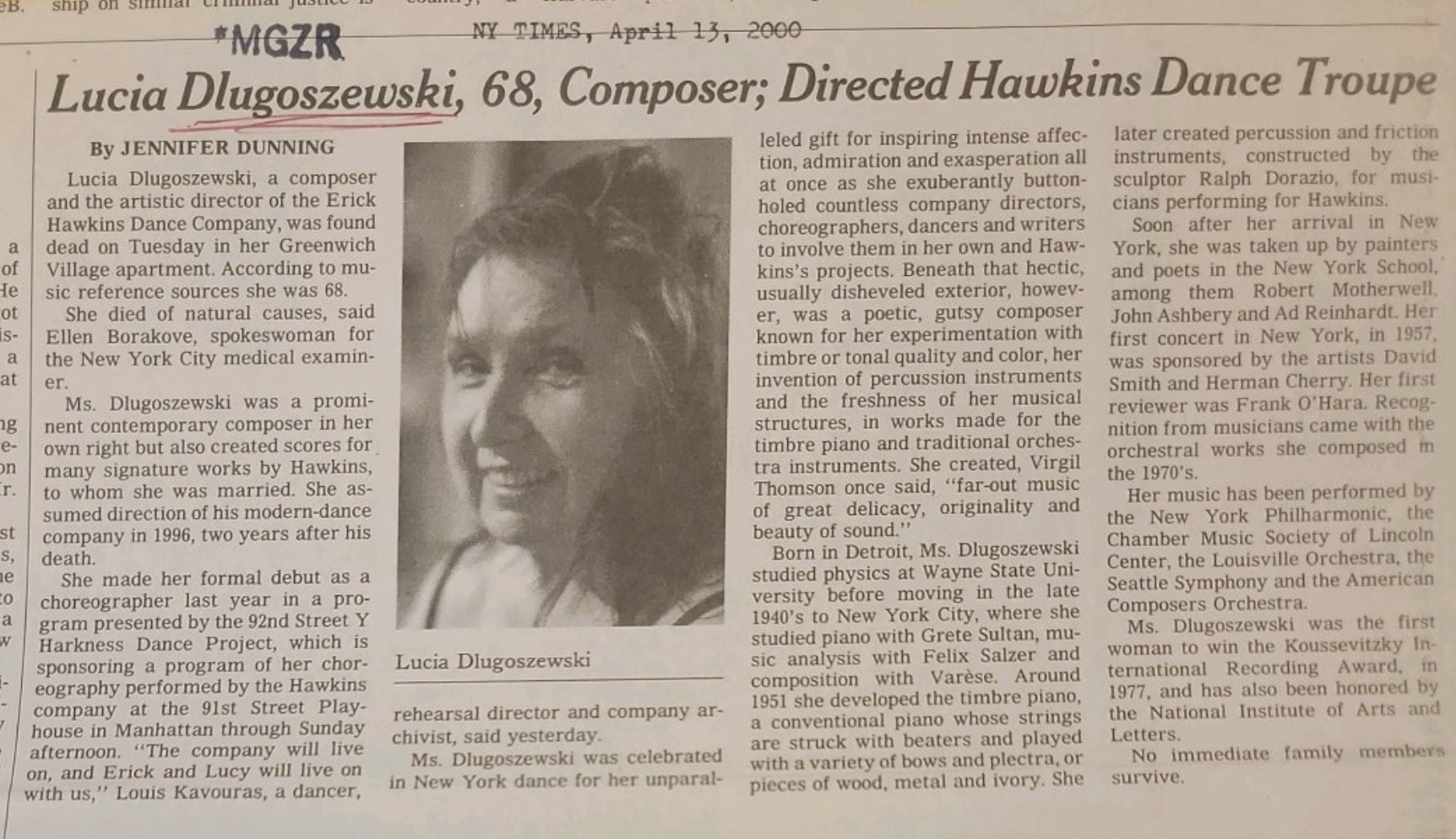
Obituary for Lucia Dlugoszewski by Jennifer Dunning, from The New York Times, April 13, 2000. From the Music Division, New York Public Library for the Performing Arts. (click to enlarge)
Lucia Dlugoszewski performs “Exacerbated Subtlety Concert”
Rare footage of Lucia Dlugoszewski performing in January 1998, presumably at the Erick Hawkins studio. This excerpt is taken from a longer video and captures Dlugoszewski in a live performance setting, showcasing her distinct approach to sound and instrumental technique.

More features

All features