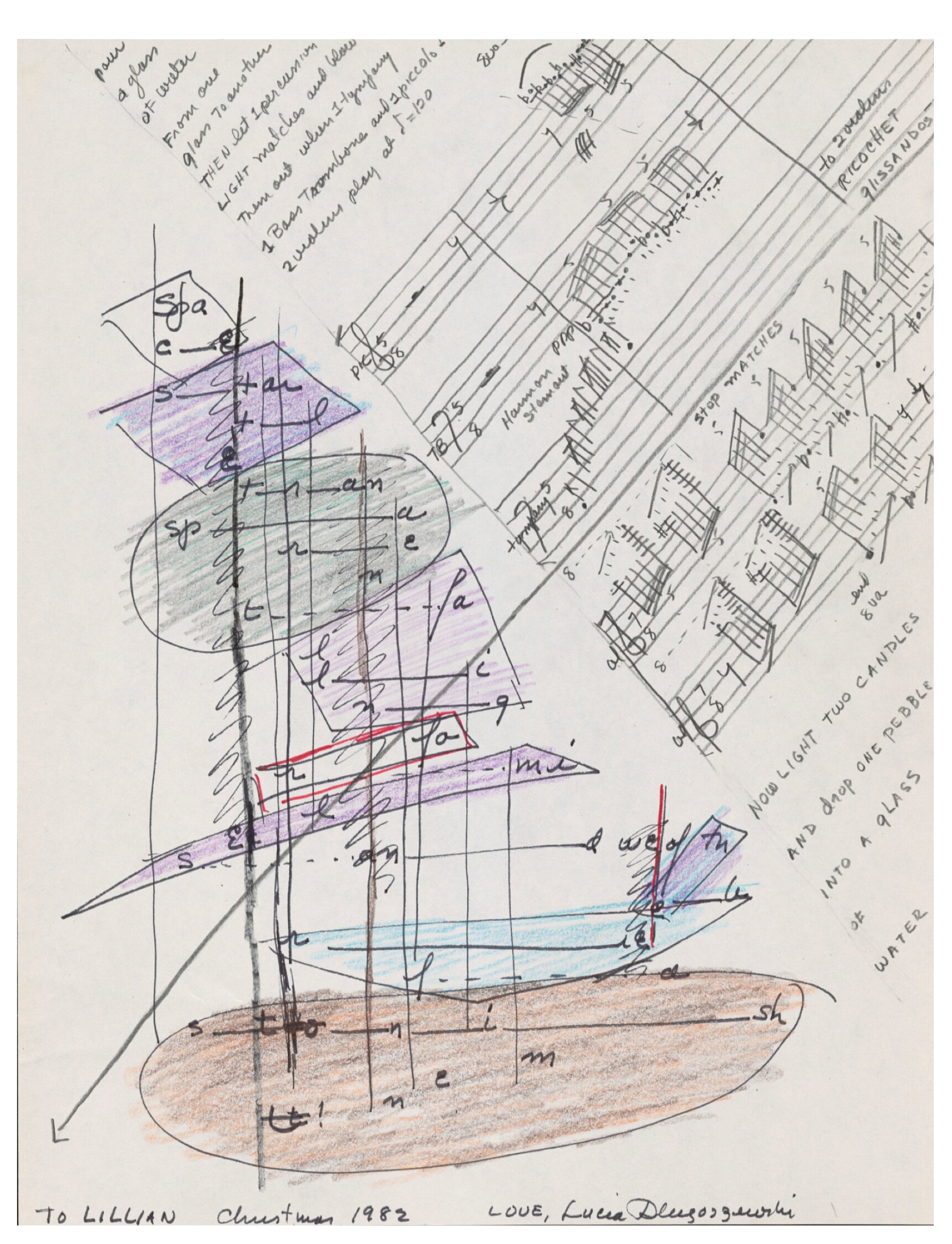
Pure Lucia, Night 1: Quidditas Suchness — Program Notes
Program notes written and annotated by Dustin Hurt
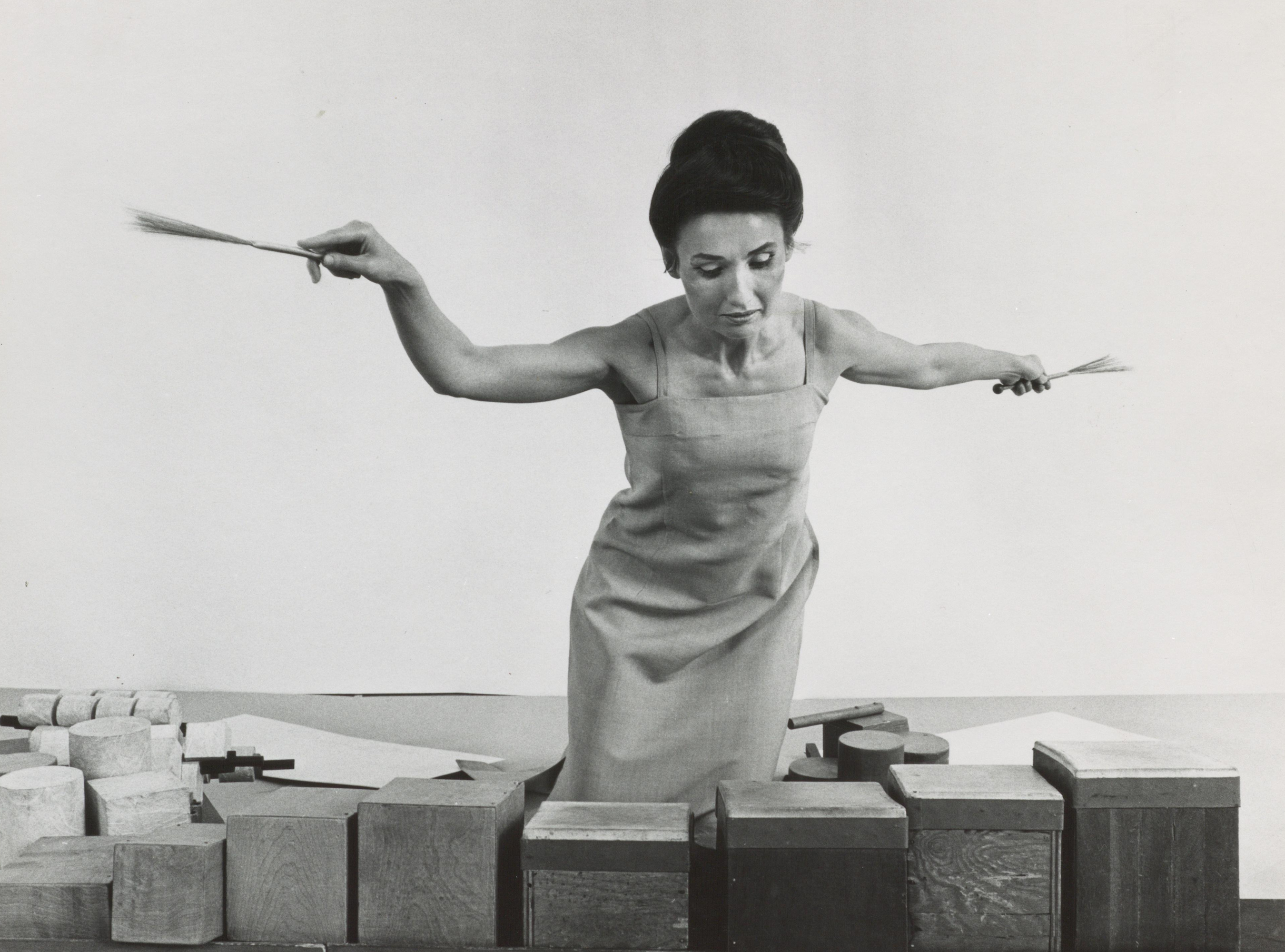
This is the complete program for Pure Lucia – Night 1: Quidditas Suchness, presented by Bowerbird on Friday, May 9, 2025 at FringeArts in Philadelphia, as part of Pure Lucia: The Life and Work of Lucia Dlugoszewski in the composer’s centenary year. It includes the running order and Dustin Hurt’s program notes, with archival documentation alongside the text.
Program
For everyday objects, percussion, and voice; performed by:
– Rachel Beetz
– Dustin Donahue
– Andy Thierauf
a.) for rates of speed
b.) for delicate accidents
For ladder harps and wind bells; performed by:
– Dustin Donahue
– Michelle Purdy
– Andy Thierauf
MARIE MENKEN
Film by Marie Menken; score by Lucia Dlugoszewski (“The Poetry of Natural Sound”)
II. Disconsolate Chimera
III. Ritual of the Descent
Performed by Network for New Music
– Susanna Loewy, flute
– Charlie Abramovic, piano
– Phillip O’Banion, percussion
For brass quintet, performed by:
– Chris Coletti, trumpet
– Peter Evans, trumpet
– Eric Reed, french horn
– Joe Fiedler, tenor trombone
– David Taylor, bass trombone
Intermission
ERICK HAWKINS
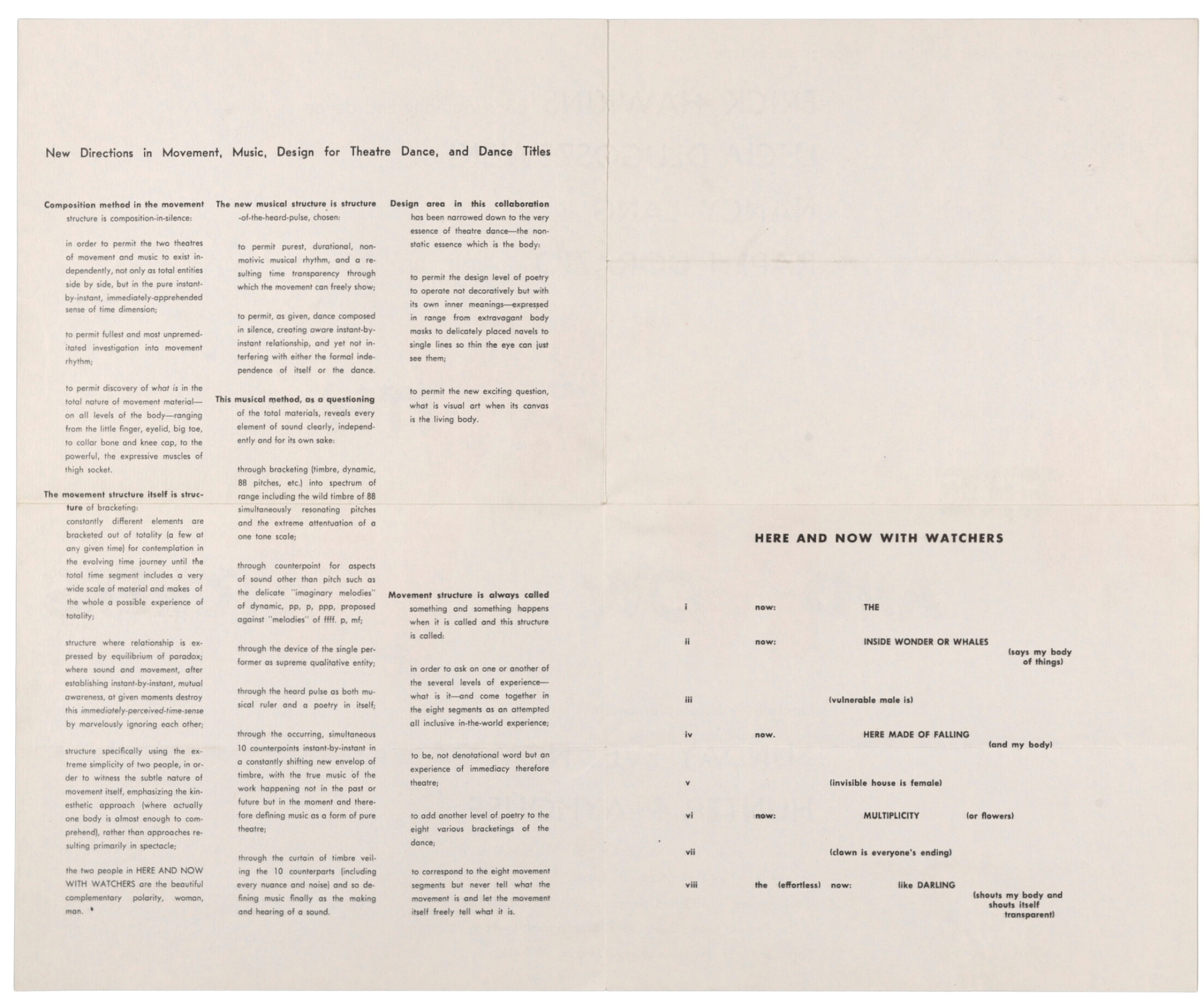
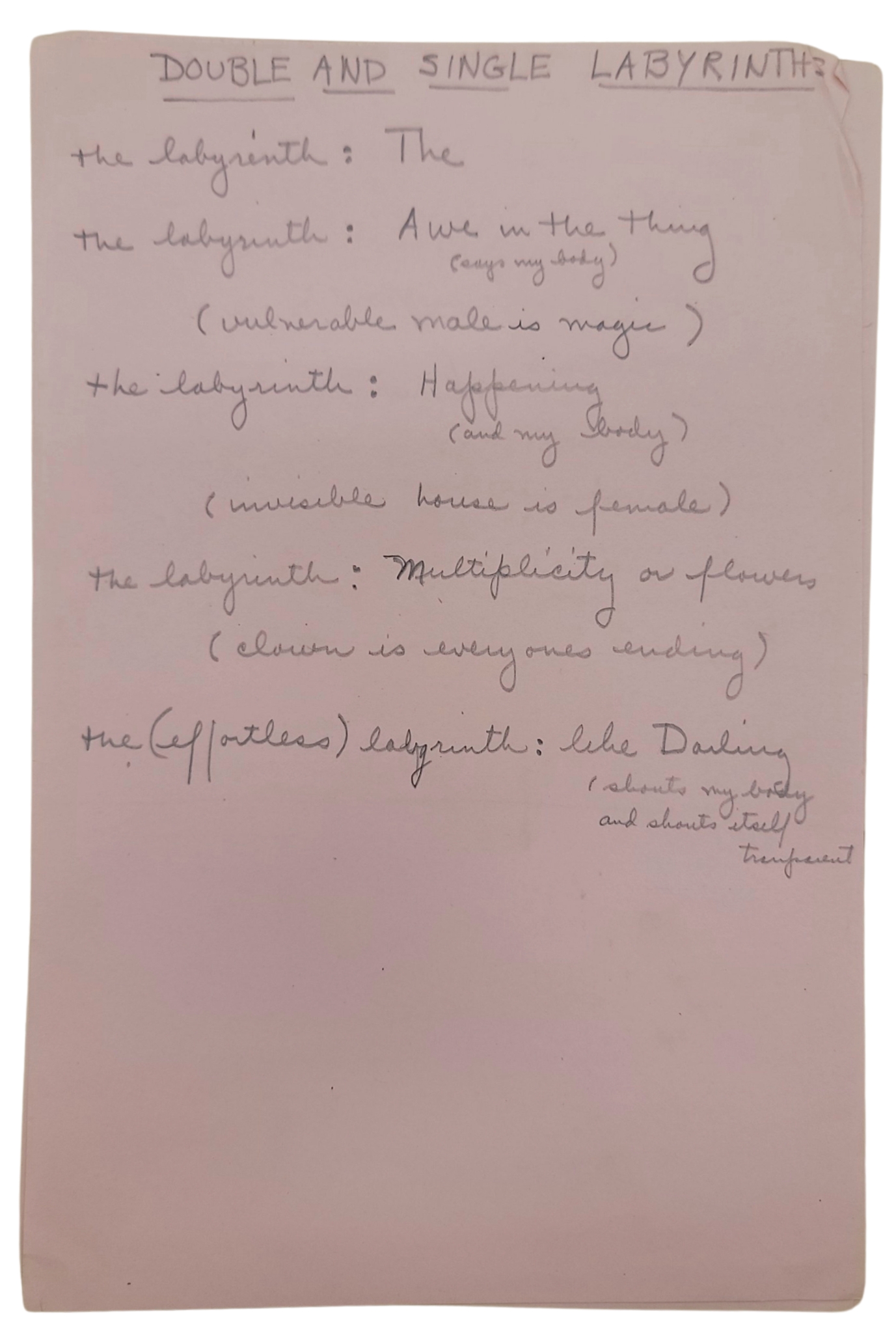
i) now: THE
viii) the (effortless) now: LIKE DARLING (shouts my body and shouts itself transparent)
For solo timbre piano and two dancers; Music by Dlugoszewski (reconstruction by Agnese Toniutti); choreography by Erick Hawkins.
Performed by the Erick Hawkins Dance Company
– Jason Hortin
– Hayley Meier
and
– Agnese Toniutti, timbre piano
ERICK HAWKINS
For solo piano with four dancers; Music by Dlugoszewski (reconstruction by Agnese Toniutti); choreography by Erick Hawkins.
Performed by the Erick Hawkins Dance Company
– Jason Hortin
– Hayley Meier
– JR Gooseberry
– Halie Landers
and
– Agnese Toniutti, piano
Program Notes
Written and annotated by Dustin Hurt.
Lucia Dlugoszewski’s work from the 1950s offers a fascinating glimpse into a moment of radical transformation in American experimental music. Bridging the worlds of poetic abstraction, tactile sonic exploration, and instrument invention, her compositions from this period trace a clear arc—from her use of everyday materials as sound sources to the creation of a unique orchestra of handmade percussion instruments.
Among her earliest forays into this sound world is Song for the Poetry of Everyday Sounds to the poem of e. e. cummings (1952). The score calls for actions such as the tearing of paper (both slow and fast), the pouring of beans and rice, the bubbling of water through a straw, the wobbling of thin cardboard, the bouncing of balls, and the rolling of glasses in a fry pan. These are not treated as novelties but as integral sonic events, precisely notated and choreographed for their timbral variation and textural detail. The poem by cummings, “luminous tendril of celestial wish,” is specified in the score to be both written—by hand, during the performance—and spoken aloud at select moments, creating a layered interplay between language and sound. Rather than setting the text in a conventional manner, Dlugoszewski uses it as a structural and poetic thread that winds through the piece’s rich acoustic fabric.
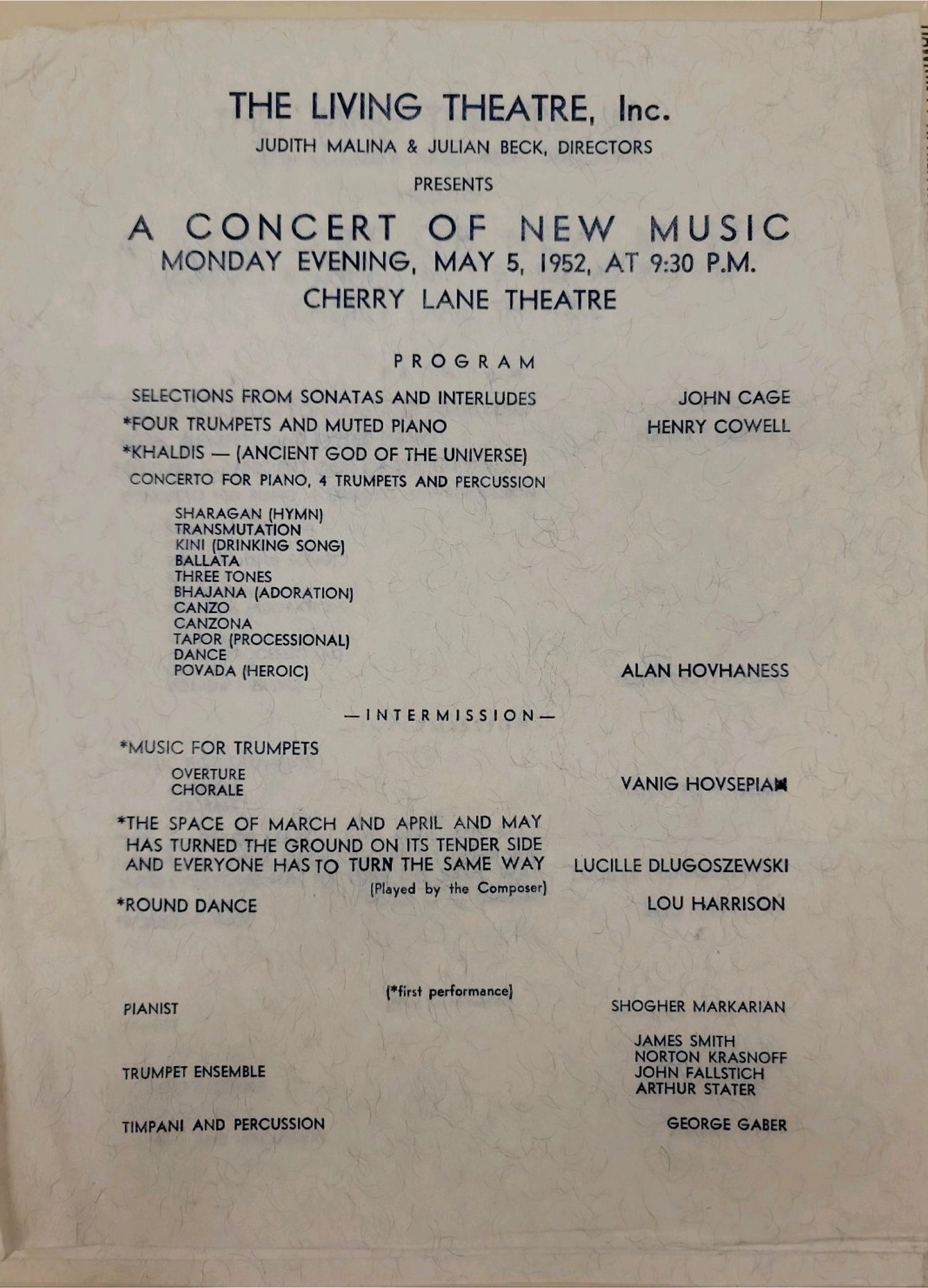
This work is part of a broader constellation of compositions from the early 1950s in which Dlugoszewski pursued what she called “everyday sounds.” These include pieces like Everyday Sounds for [brIght], her setting of cummings’s “,!blac,” and a theatrical score titled Structure for the Poetry of Every Day Sounds (written for Alfred Jarry’s Ubu Roi), created for a production by The Living Theatre under the direction of Judith Malina. The Living Theatre, a pioneering force in avant-garde theater founded in 1947, was known for its politically engaged and experimental productions. Dlugoszewski also composed the soundtrack to Menken’s 1945 film Visual Variations on Noguchi in 1953, titling the music The Poetry of Natural Sound.
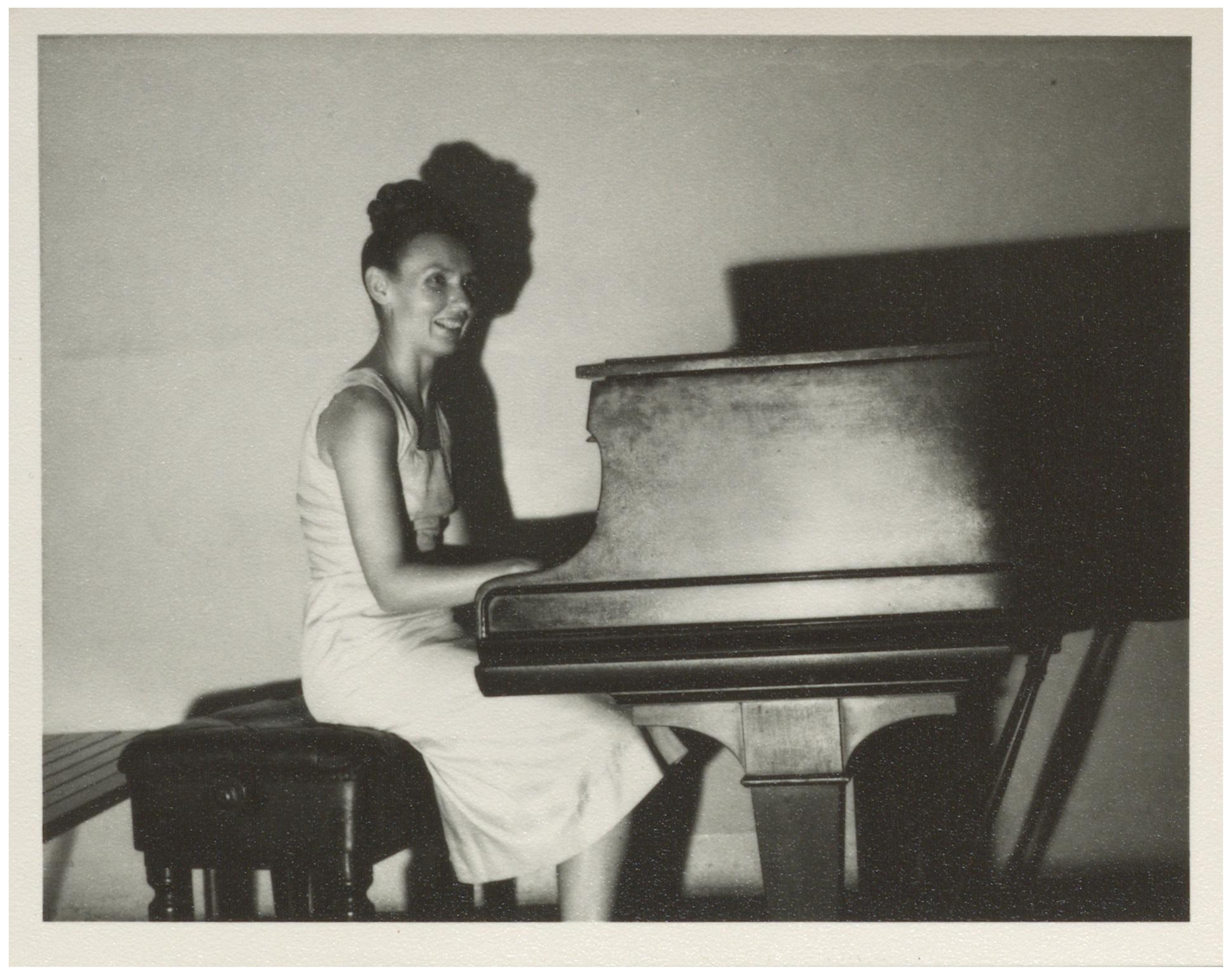
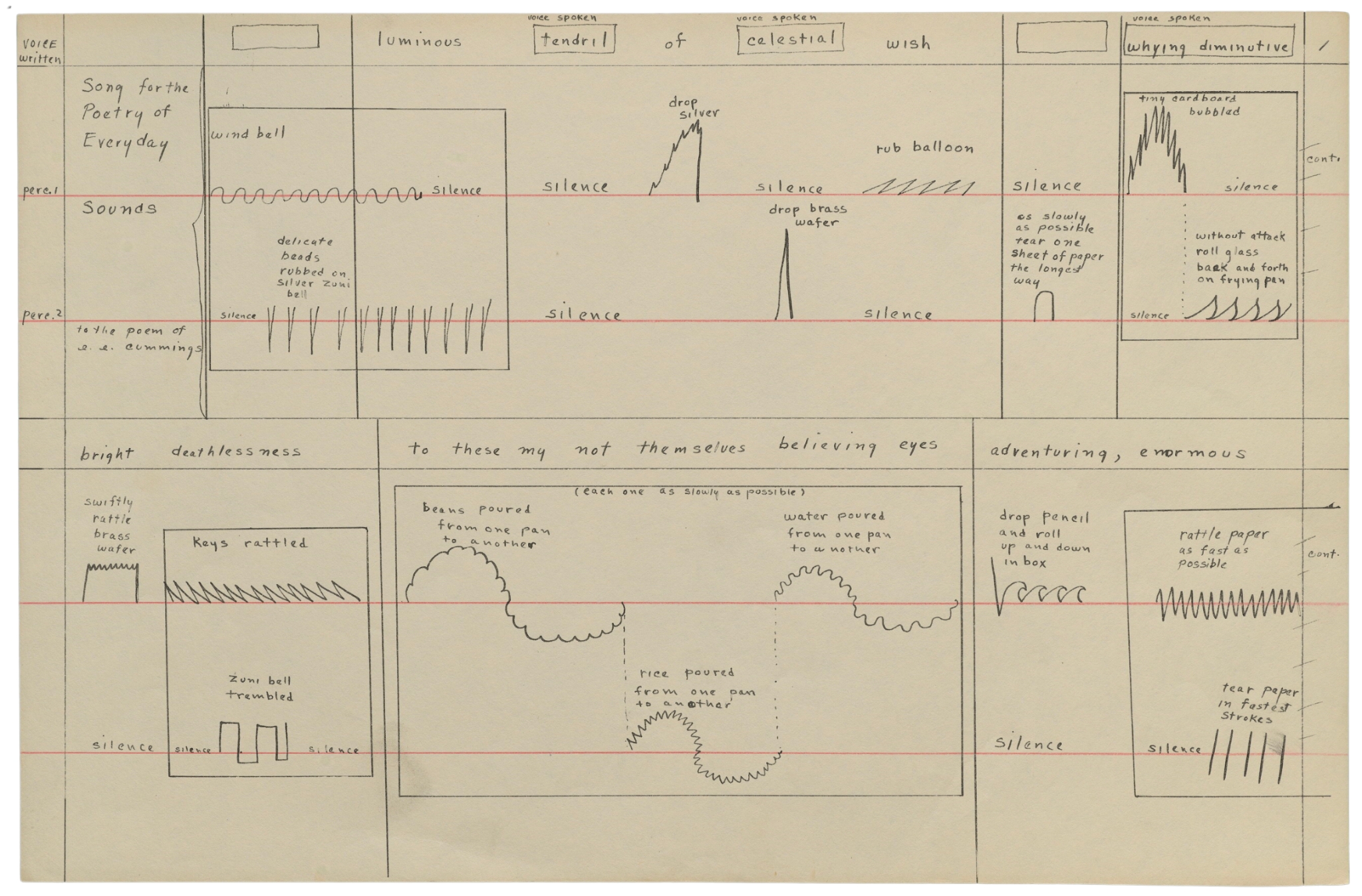
In the early 1950s, Dlugoszewski was an active participant in the New York School loft scene, closely connected with Cage and his circle. Though rarely acknowledged in parallel, her work from this period intersects strikingly with Cage’s, particularly in their shared exploration of nontraditional sound sources. Cage’s Water Music, composed in 1952, employs radios, whistles, and water to challenge conventional ideas of music-making. That same year, Dlugoszewski composed Song for the Poetry of Everyday Sounds to the poem of e. e. cummings, a piece that also turns to unconventional materials—but with a markedly different sensibility.
Her score is obsessively precise, concerned less with theatrical gesture or indeterminacy than with the intimate, textural details of sound. Rather than leaving sonic outcomes to chance, she shaped them through choreographed actions and specific instructions. It’s possible that her work may have influenced Cage’s own explorations, or at the very least, contributed to the vibrant cross-pollination of ideas within their shared artistic milieu. While Cage’s innovations are firmly ensconced in music history, Dlugoszewski’s contributions from this same period remain largely underrecognized—despite their comparable ambition and originality. Influence likely flowed in both directions.

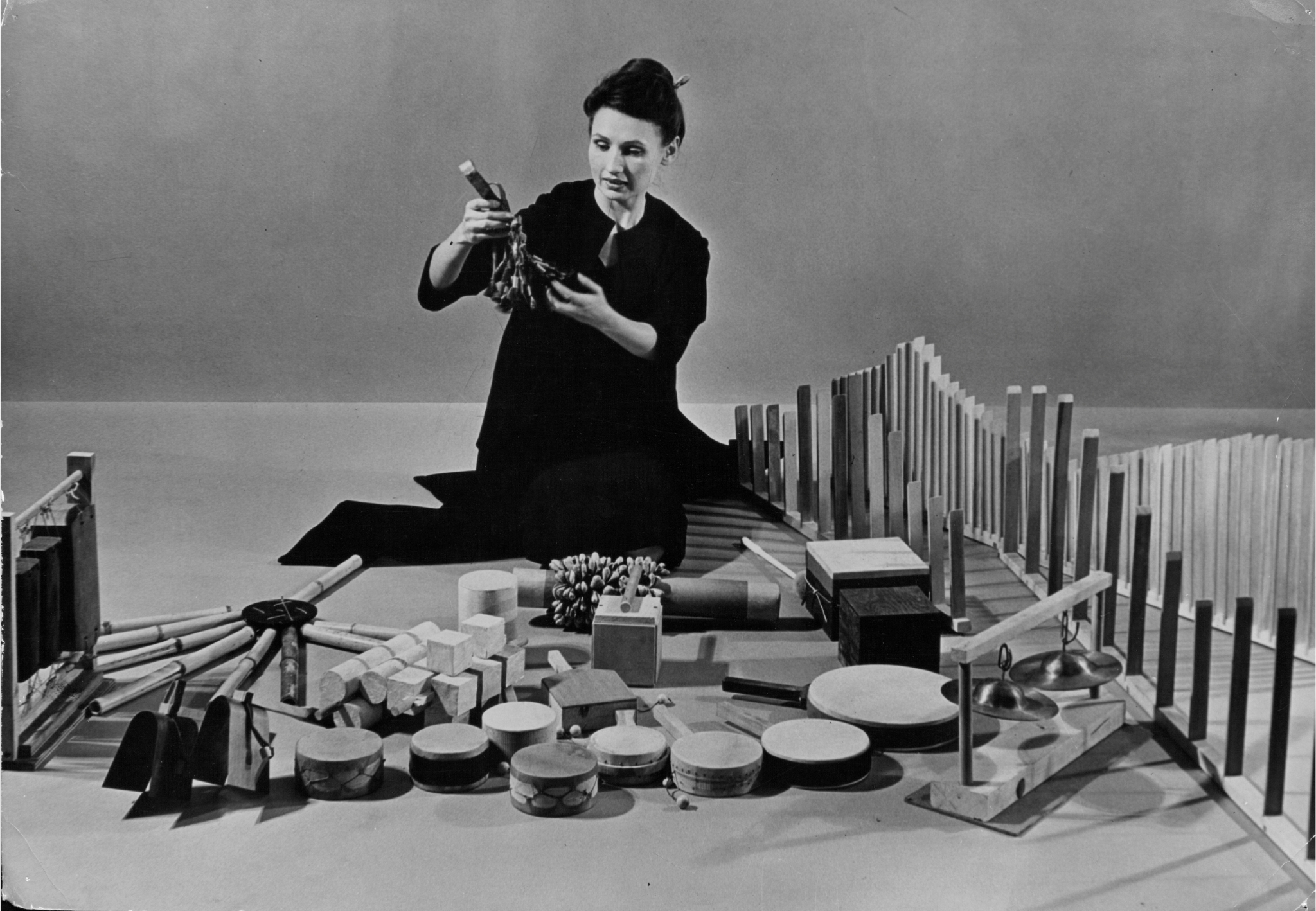
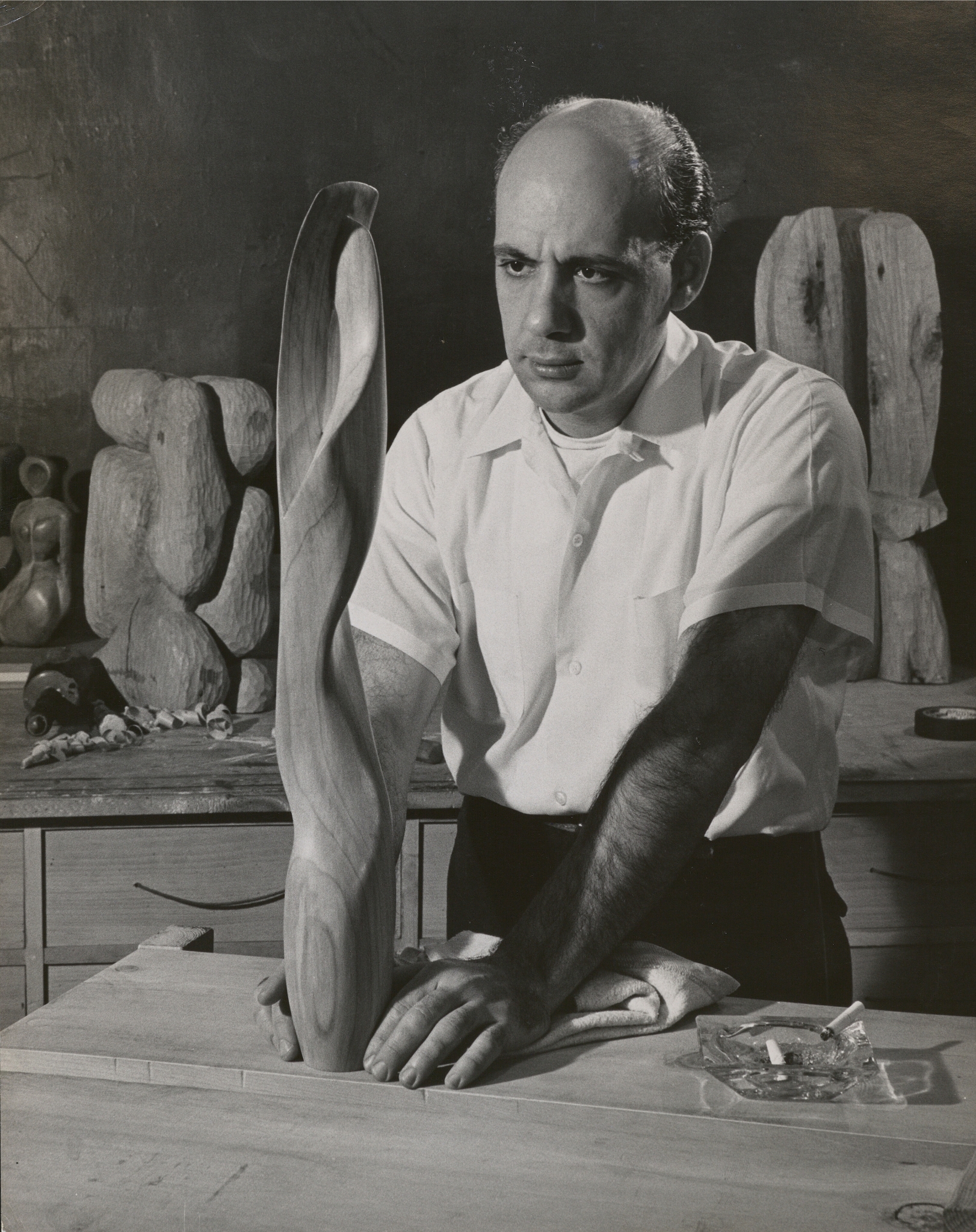
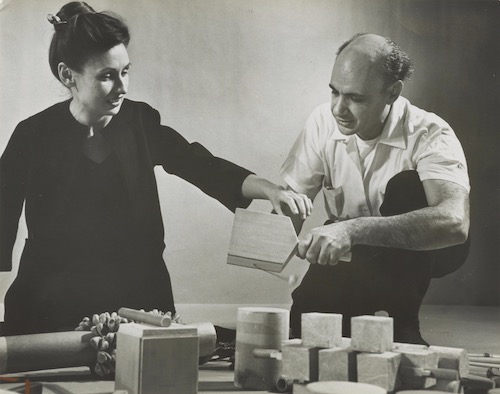
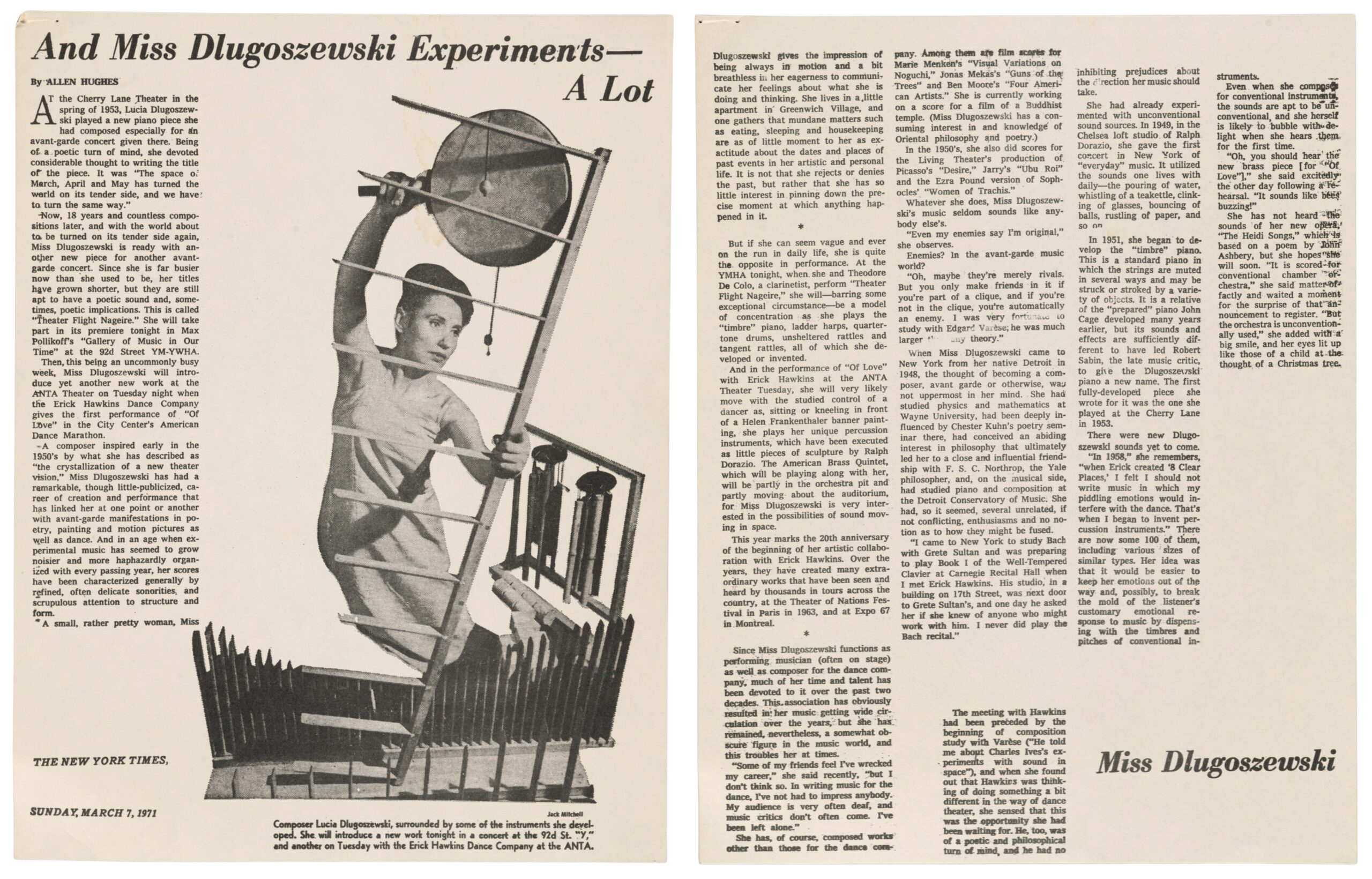
Her fascination with timbre eventually led her to design her own instruments. Around the same time she was developing her so-called “Timbre Piano”—a technique for playing directly on the strings and frame of a grand piano—Dlugoszewski began collaborating with sculptor Dorazio to construct new percussion instruments. This collaboration yielded a family of instruments that included ladder harps, wind bells, tangent rattles, and square drums. Rather than being one-off experiments, these instruments were conceived in large sets, with numerous subtle variations in timbre, pitch range, and dynamic capacity. Dlugoszewski approached their construction systematically, grouping them by material, playing method, and sound behavior to form extensive ensembles of related instruments. This allowed her to compose with intricate gradations of sound, creating a flexible and responsive musical language entirely of her own design.
Two early works for these invented instruments, both from 1958, are grouped under the title Separated Music. The first, for rates of speed, is composed for three pairs of ladder harps. Each ladder harp differs in dimensions and internal spacing, yielding subtle but significant shifts in timbre. The second, for delicate accidents, focuses on wind bells—long wooden dowels suspended in clusters and struck in various ways. Dlugoszewski’s scores for these works suggest not only new sounds but new modes of attention.
Separated Music can be seen as a set of studies leading toward her evening-length work 8 Clear Places (1960), composed as a major score for a Hawkins choreography, in which she deployed her full orchestra of 100 invented instruments. The music from this period embodies a sculptural sensibility, with form arising from gesture, texture, and change over time.
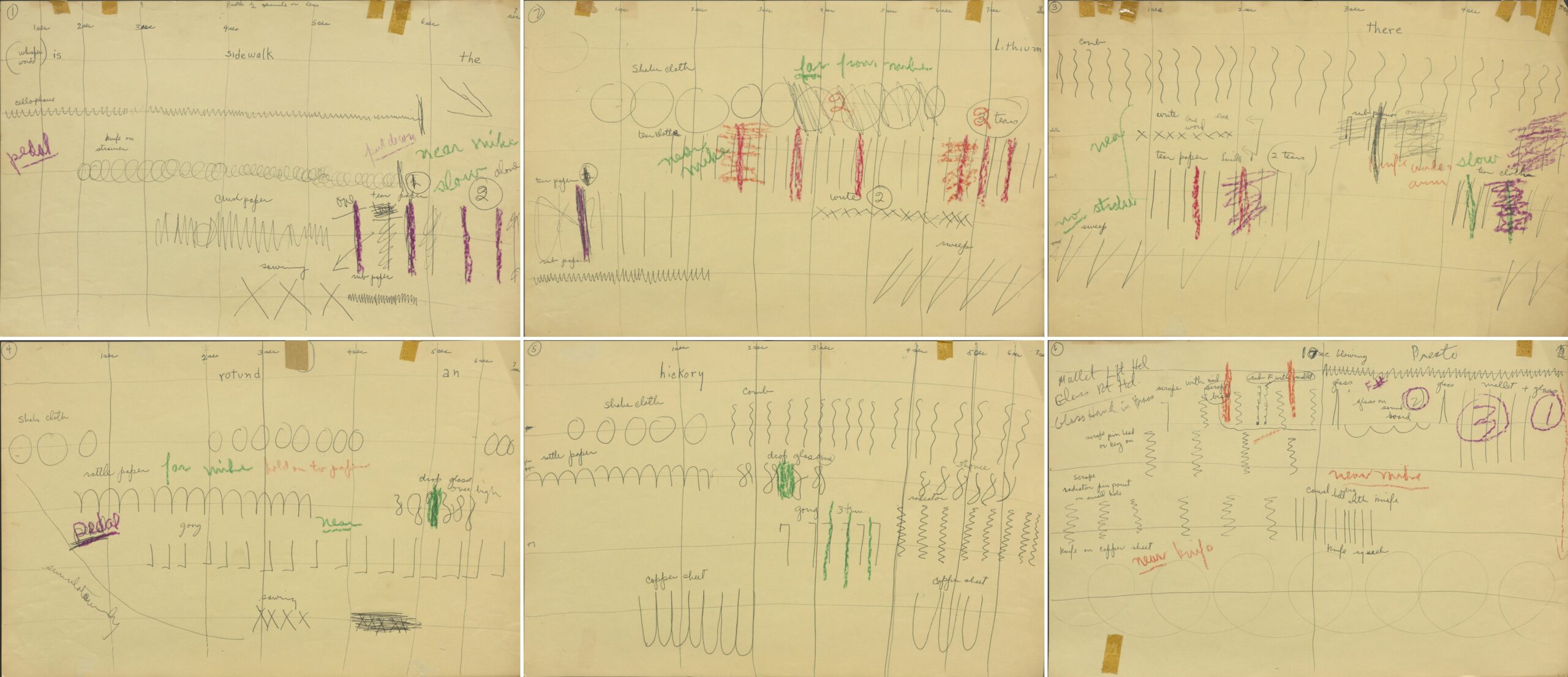
Visual Variations on Noguchi, the film by Menken, offers a complementary view of Dlugoszewski’s aesthetic. Shot in 1945 and scored in 1953, the short black-and-white film captures the play of light and shadow across Isamu Noguchi’s sculptures. Menken’s hand-held camera work, rapid and improvisational, echoes the tactile curiosity that Dlugoszewski brought to her sound world. The score itself, recorded on multitrack tape at the recording studio of Bebe and Louis Barron, stands as Dlugoszewski’s sole foray into musique concrète. Despite her general resistance to electronic music, the resulting piece is a dense, vivid sound collage—comparable in its ambition and method to Cage’s better-known Williams Mix, created at the same studio around the same time.
Though often overlooked in accounts of postwar American music, Dlugoszewski’s contributions during this era should be gaining renewed recognition. Her experiments with natural and everyday sound prefigure later developments in sound art, while her invented instruments and playing techniques remain singular. These works invite a heightened form of listening—one that values the ephemeral, the tactile, and the intricate play of difference.
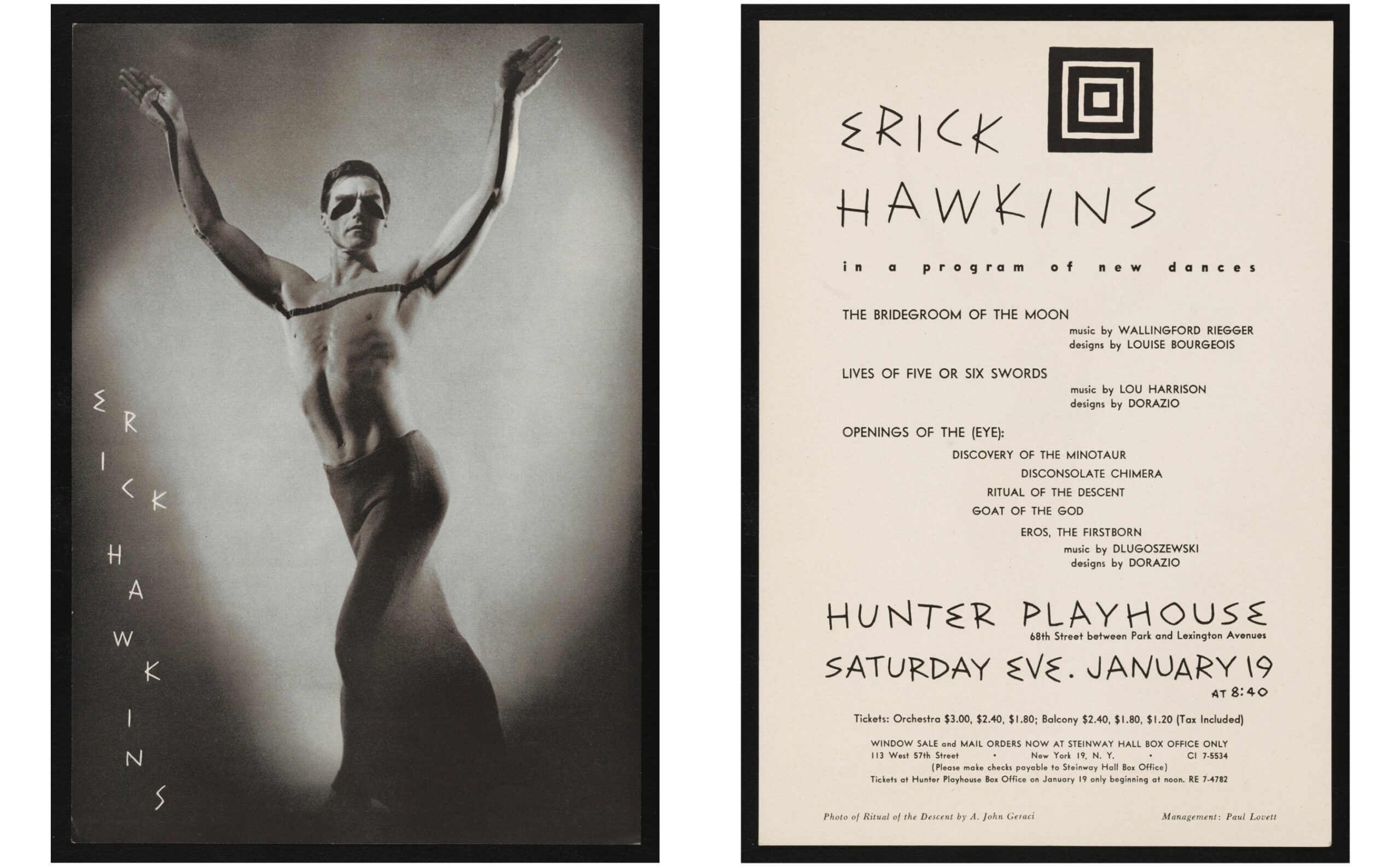
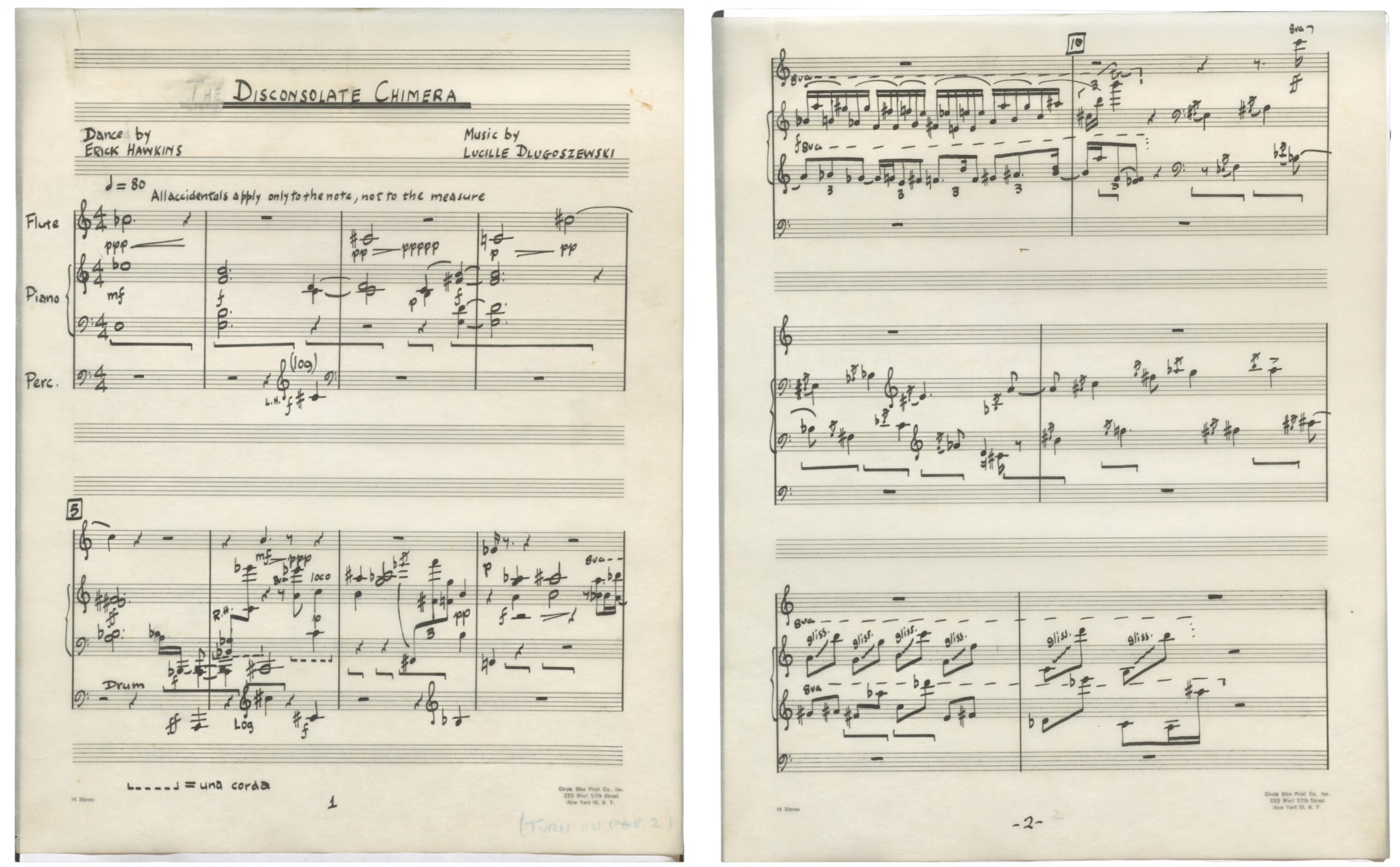
Composed in 1952, Openings of the (Eye) marked the beginning of the long and influential collaboration between composer Dlugoszewski and choreographer Hawkins. Scored for flute, piano, and percussion, the evening-length work accompanied Hawkins’s dance of the same name, which drew on themes from Greek mythology and featured designs by artist Dorazio. Premiered in January 1952, the work toured widely across the United States and helped define the aesthetic of the Hawkins-Dlugoszewski partnership. In addition to its life as a dance score, Openings of the (Eye) was occasionally performed in concert, sometimes excerpted.
The piano writing in Openings of the (Eye) is notably virtuosic, offering a rare glimpse into Dlugoszewski’s exceptional skill as a performer—something often obscured in her later works for timbre piano. She performed the work herself, and archival rehearsal recordings suggest the piano may have been prepared in the Cagean sense, with materials inserted into the strings, though no definitive score instructions have been found to confirm this practice.
Like many of Dlugoszewski’s compositions, the piece exists in a layered and somewhat elusive form. Archival evidence suggests that an entirely different version of the score may once have existed, and early sketches reveal plans for a far more experimental and expansive percussion part than what appears in the final version. These unrealized threads point to the broader, restlessly inventive terrain Dlugoszewski was charting in the early 1950s, anticipating the radical sonic explorations that would characterize her later work.
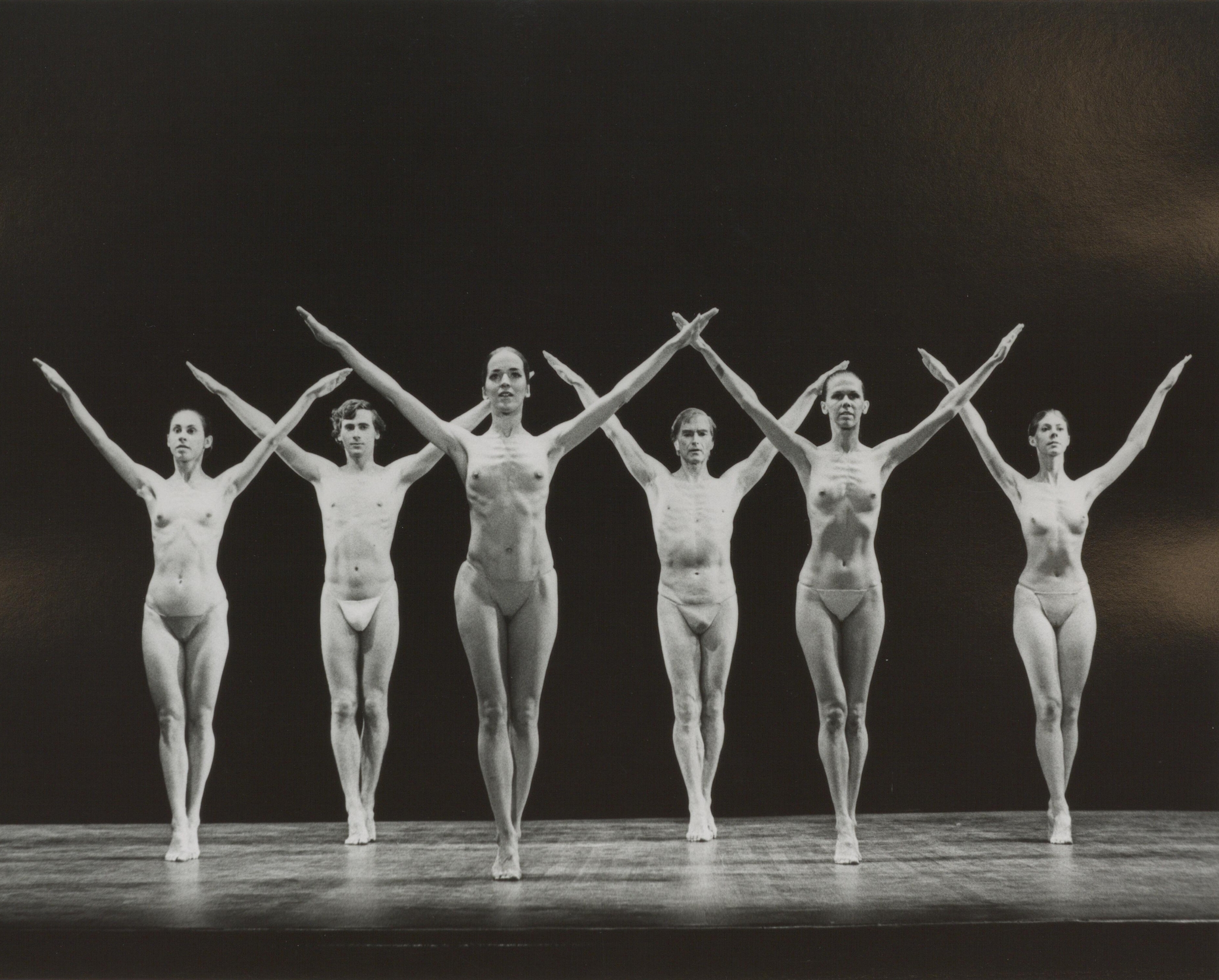
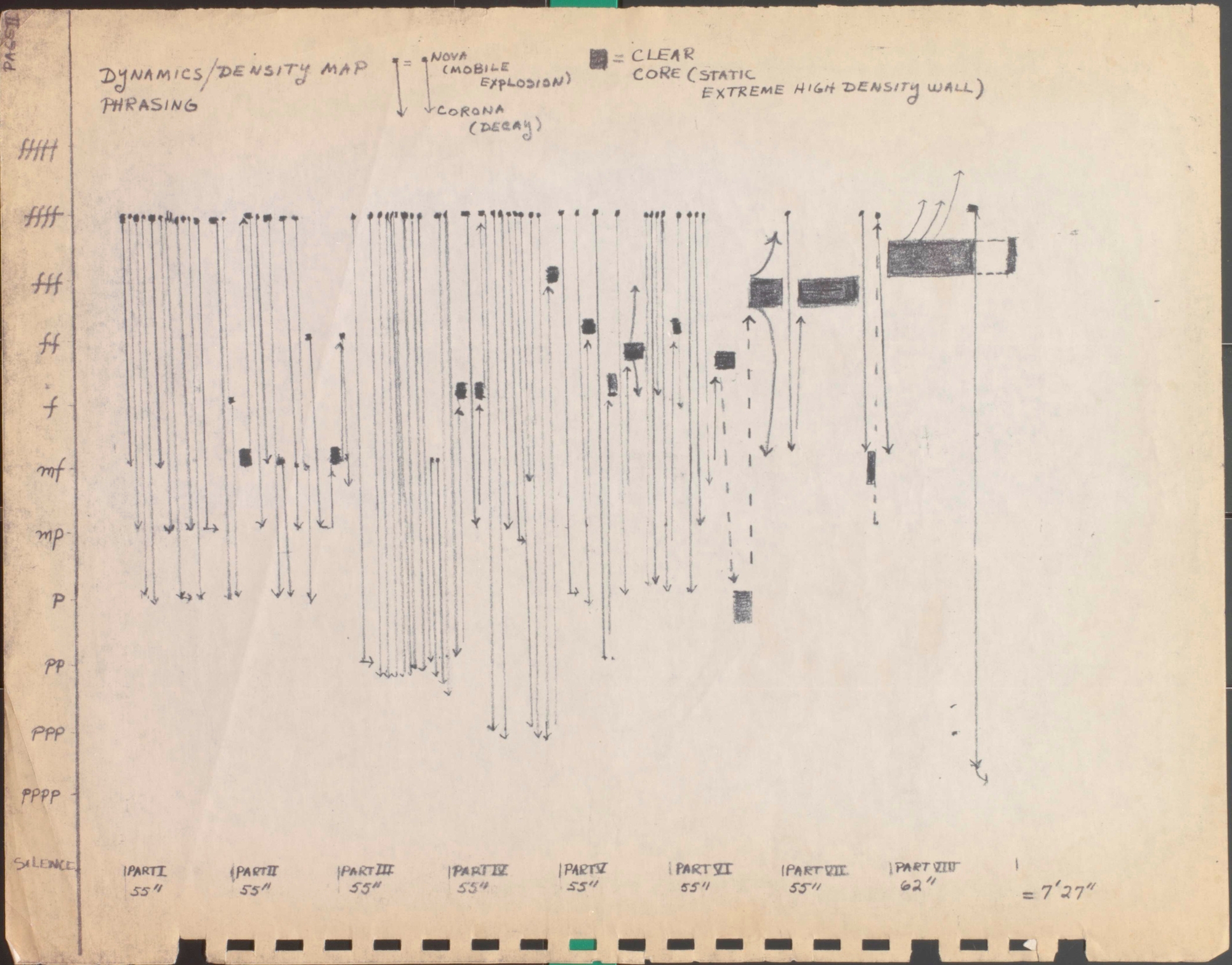
Angels of the Inmost Heaven marks the final major collaboration between composer Dlugoszewski and choreographer Hawkins for more than a decade. Premiered in 1971 in Washington, D.C., the piece appears in Dlugoszewski’s score under the alternate title Densities: Supernova/Corona/Clear Core. The work stands as a stunning exploration of new possibilities for brass quintet. Scored for two trumpets, French horn, tenor trombone, and bass trombone—eschewing the typical tuba—the piece exemplifies Dlugoszewski’s virtuosic imagination and her belief in music as an epiphany of sensation. Originally created in collaboration with Hawkins and choreographed for the stage, Angels of the Inmost Heaven is presented tonight without dance. It remains one of the few Dlugoszewski works to be both published and commercially recorded, with a 1975 release that has served as a vital reference point for performers and scholars alike.
Dlugoszewski’s score is a blueprint of extremes: she replaces traditional phrasing and barline logic with a modular structure—eight continuous segments of 55 seconds each, subtly “curved” and “stretched”—designed to accommodate what she called “epiphanies of density.” While the written notation is largely conventional, the score calls for a vivid and highly original palette of extended techniques—including partial-valve glissandos, quarter-tone trills articulated through precise mute manipulations, and dynamic permutations that stretch the expressive range of each instrument. Many of these techniques build directly on ideas first explored in Dlugoszewski’s 1970 solo trumpet work Space is a Diamond. Throughout, phrases move between three distinct states: the volatile bursts of Nova, the sudden decays of Corona, and the intense, nearly static density of Clear Core. The result is a choreography of sound—fluid, forceful, and richly textural.
The title Angels of the Inmost Heaven references a passage from the 18th-century mystic Emanuel Swedenborg, who described a celestial realm where “the angels of the inmost heaven are not clothed.” In Swedenborg’s cosmology, this highest heaven—closest to the divine—is defined by purity, innocence, and a union of good and truth. Dlugoszewski’s music, with its rarefied textures and sculpted densities, offers a kind of sonic analogue: a domain where structure becomes transparent, and sound itself takes on a form of radiant immediacy.
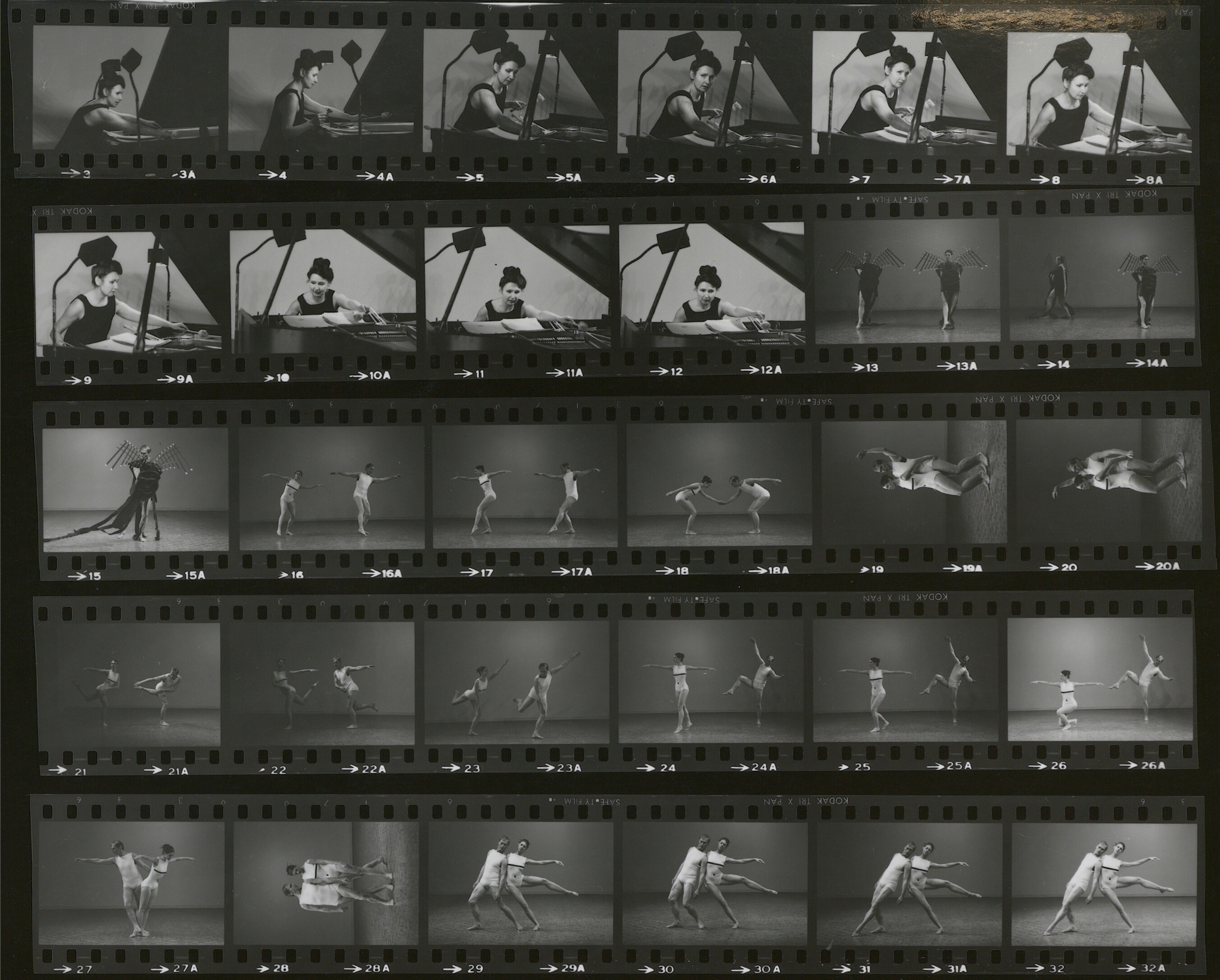
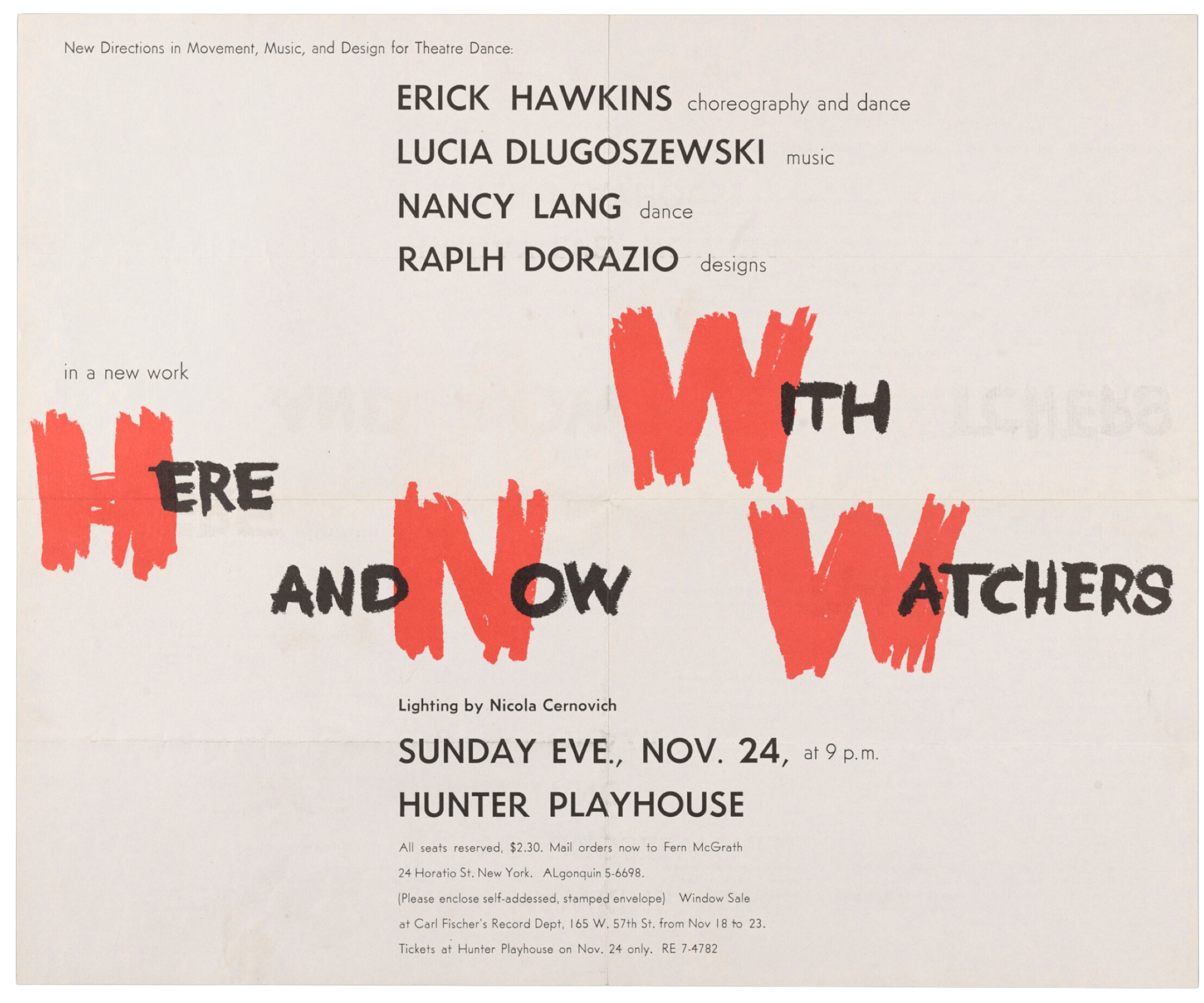
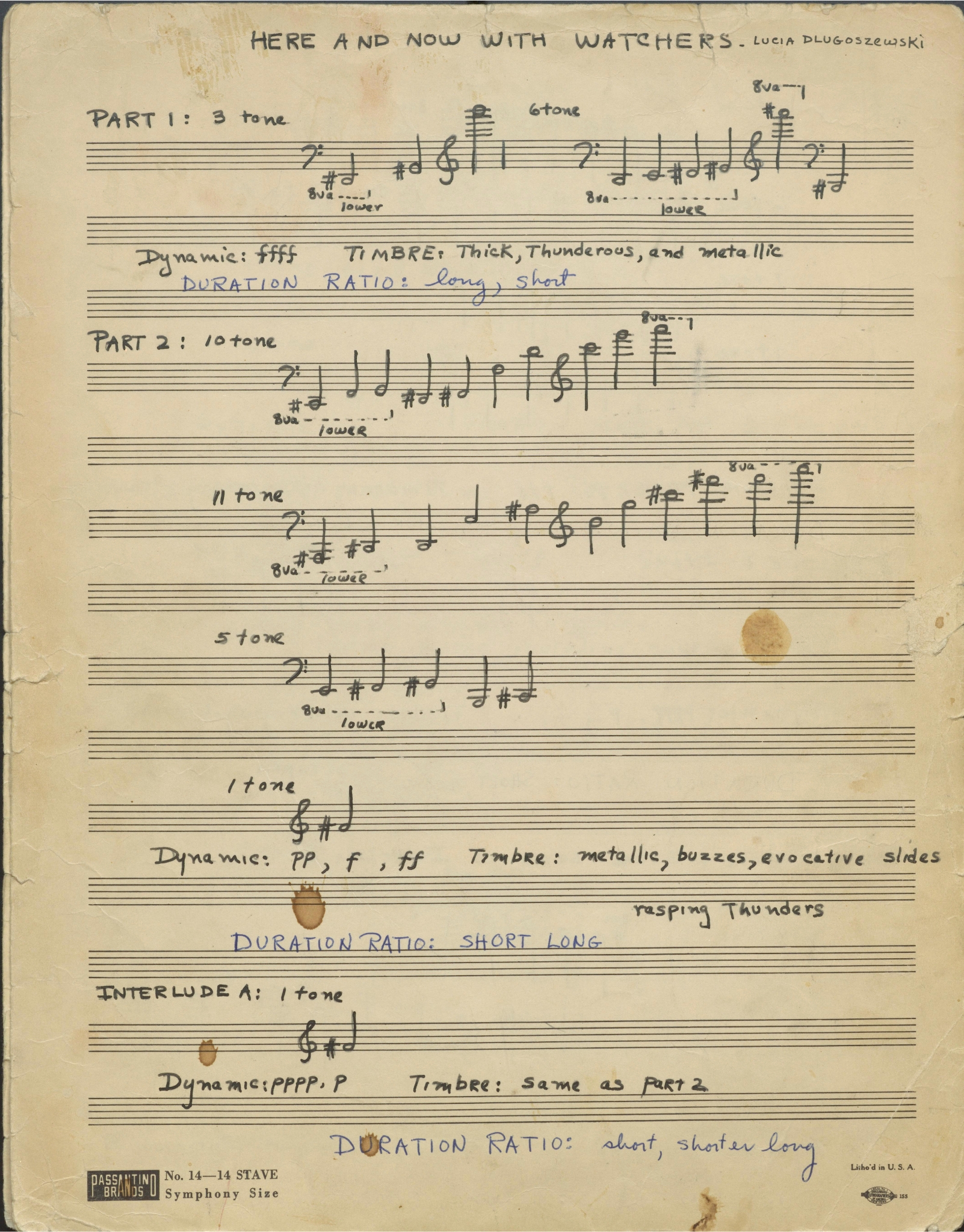
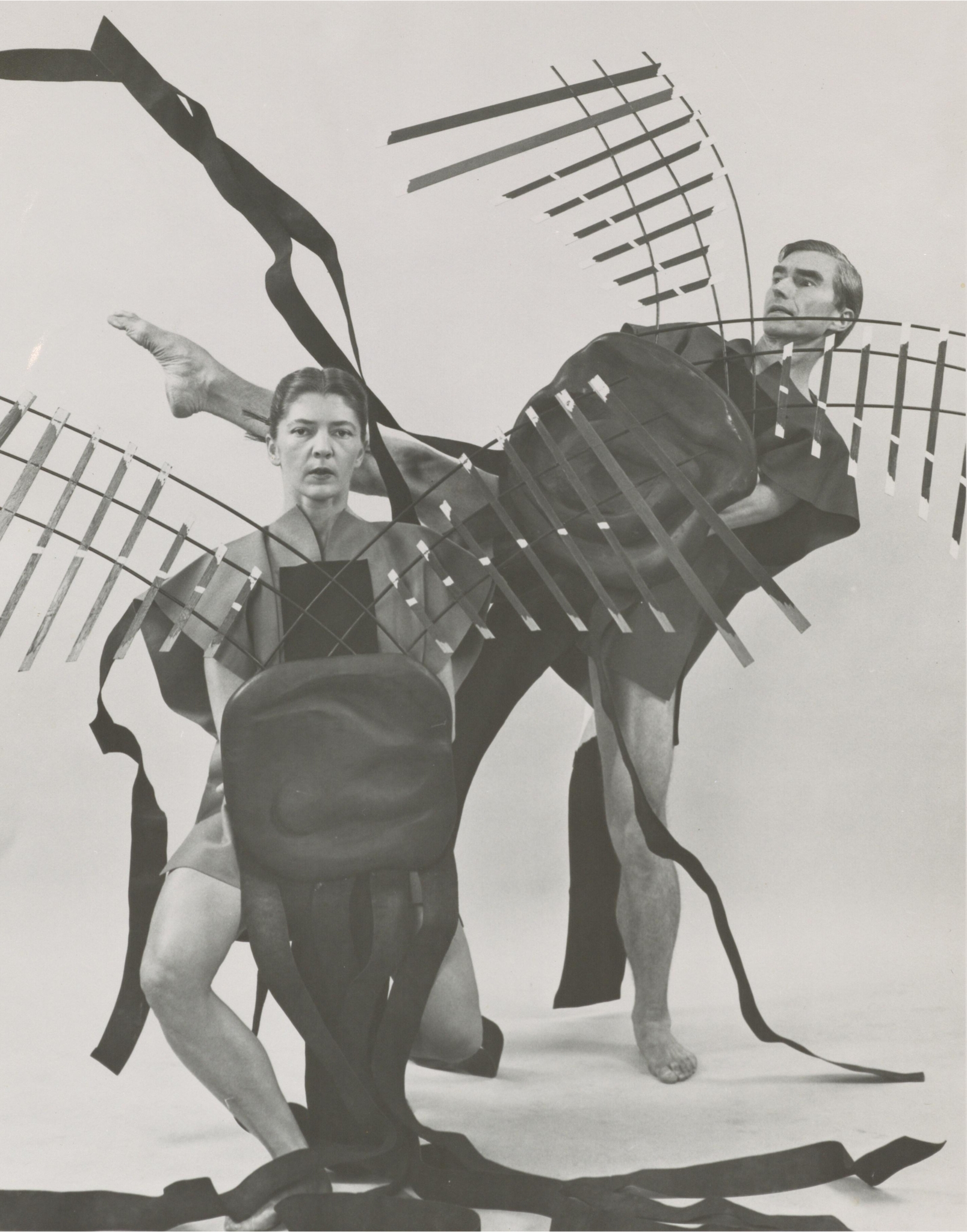
Here and Now with Watchers (1957) was the second collaboration between composer Dlugoszewski and choreographer Hawkins, following Openings of the (Eye) (1952). Dlugoszewski began composing the music in 1954; it was first performed in-progress in 1955 and premiered in full in 1957. The choreography was created and performed by Hawkins alongside dancer Nancy Lang, with early development involving Eva Raining. The work toured extensively across the United States and became a signature piece of the Hawkins/Dlugoszewski partnership. Within the music community, it was regarded by many as a major work. Dlugoszewski titled the score Archaic Timbre Piano Music, though the name was rarely used in performance materials.
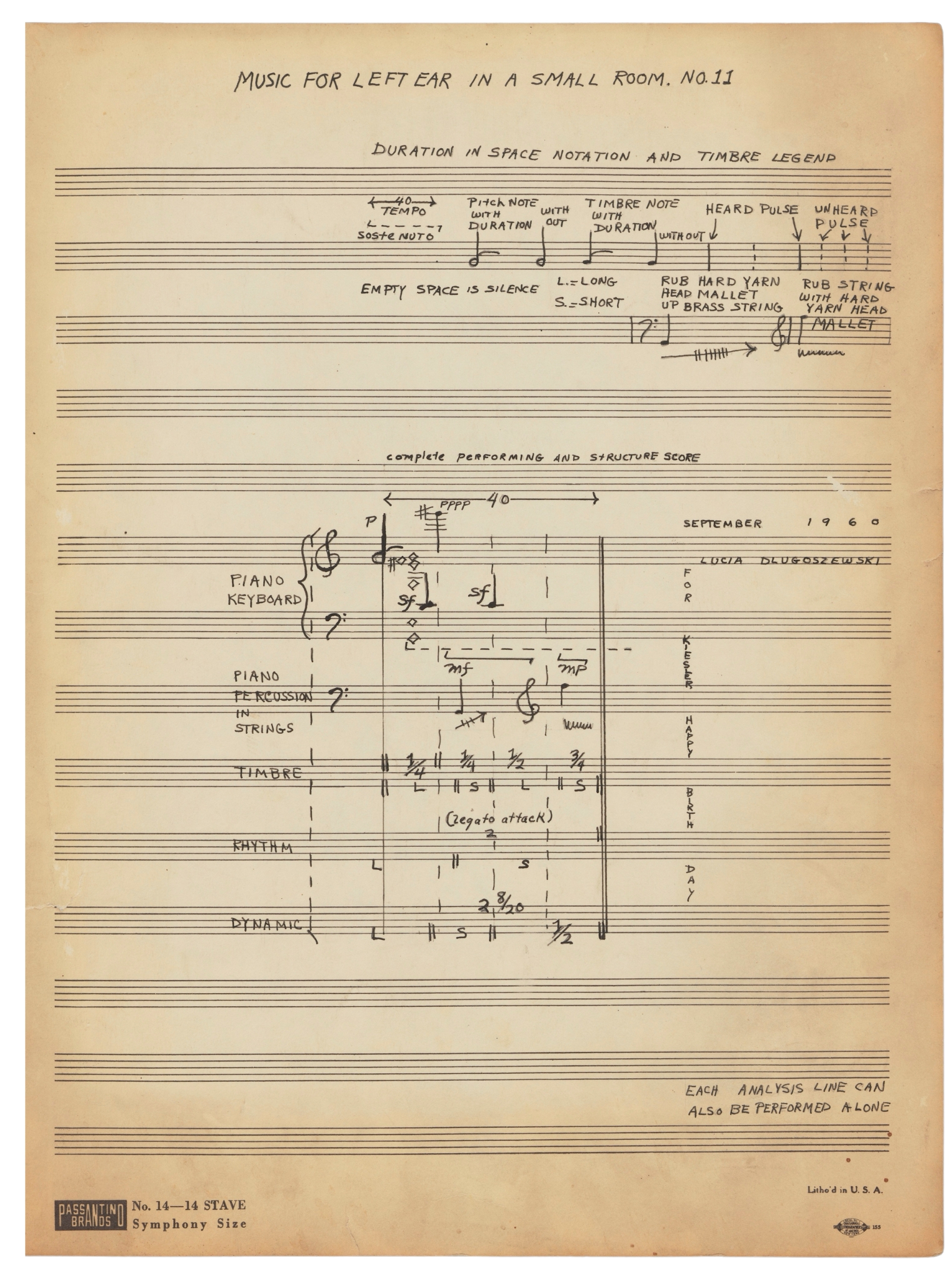
The music is composed for solo timbre piano—a term suggested by music critic Robert Sabin and adopted by Dlugoszewski to describe her performance practice on the grand piano. The technique employs a system of moving plectrums, resonators, and mutes placed inside the piano strings. In a handwritten note, she wrote that this approach was intended “to access an entirely new area of sound—one that is both self-perpetuating and expands the range of percussive timbre.”
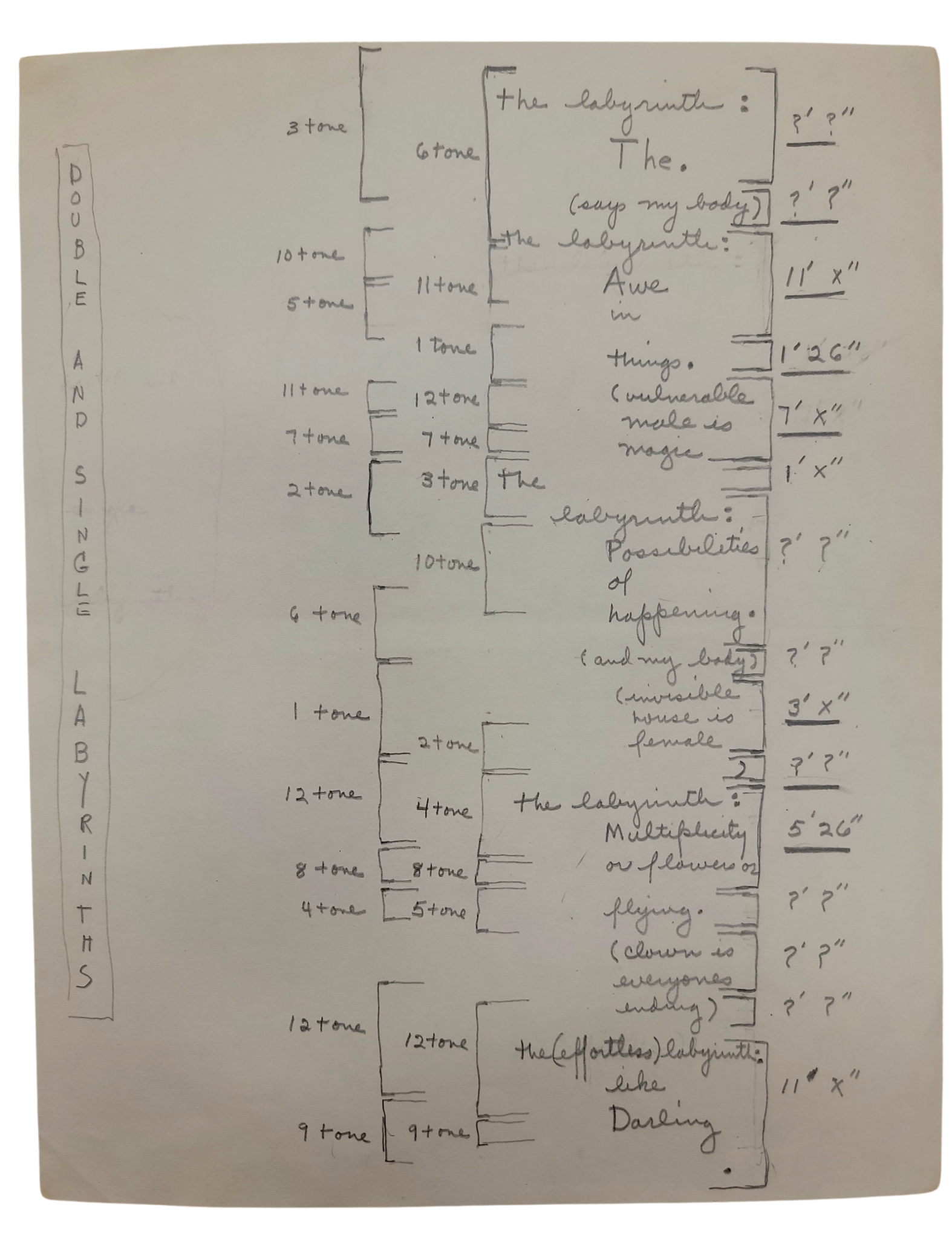
According to a program note by Dlugoszewski, the music was composed after the choreography and was structured to remain moment-by-moment aware of the dance’s durations while maintaining its own temporal identity. The score is built from ten distinct layers, each representing one sonic aspect: pitch, dynamics, durations, or timbre. Within these layers, musical material is “bracketed”—introduced at specific points and never repeated.
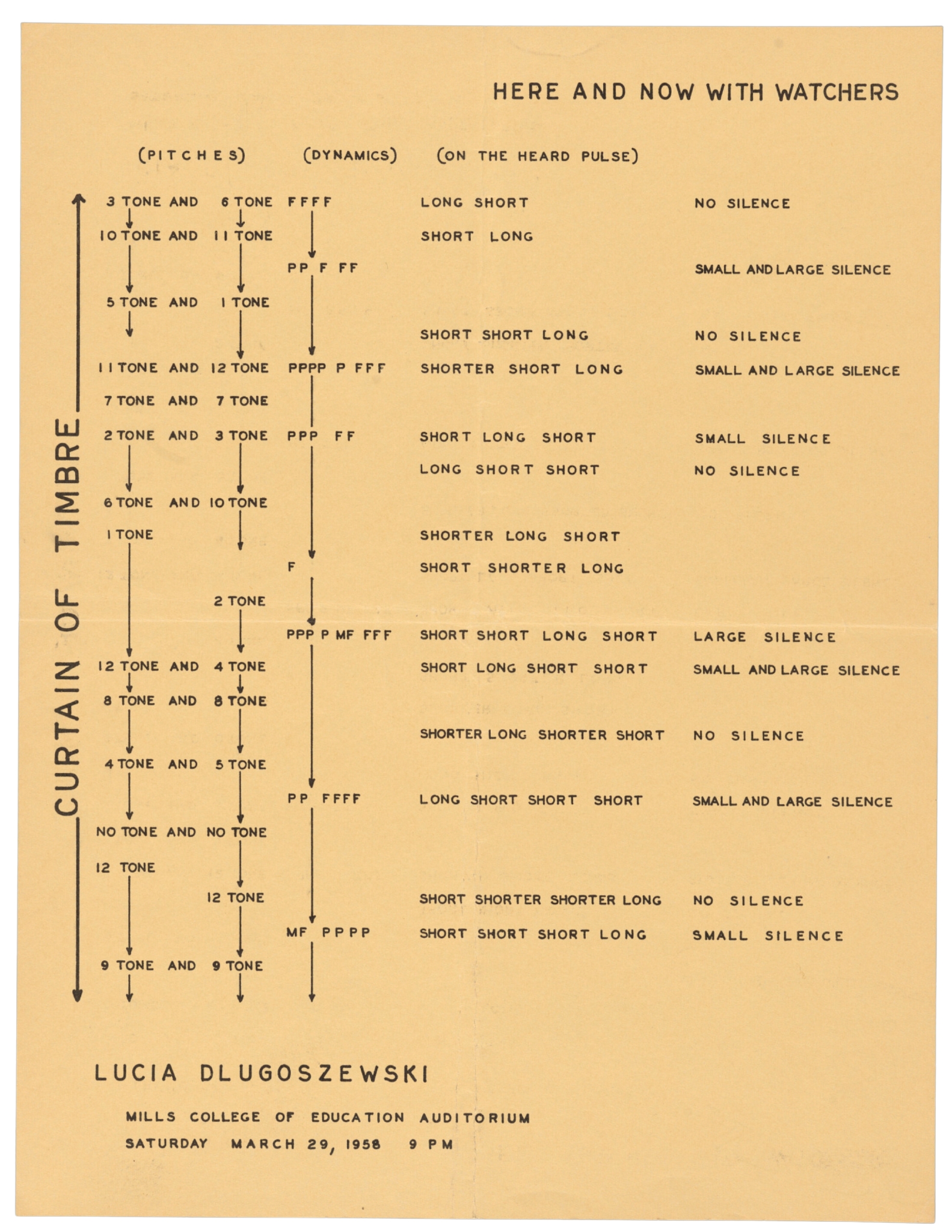
Pitch materials are organized into non-repeating collections ranging from one to twelve tones, selected for their qualitative properties. These groupings, such as 3, 10, 5, and 11, avoid conventional harmonic or serial structures. Rhythmic form is shaped through “heard pulse” patterns like short-short-long, long-short, and long-long-short-short, which function outside traditional motivic development. Dynamic contrasts are used structurally across the layers.
Silence is treated as an active compositional element, defined in three types: small silence, large silence, and no silence. It is the only material that moves freely between the layers. A conceptual chart sometimes included in programs, titled the “Curtain of Timbre,” reflects this framework. Though not a performance score, the chart illustrates Dlugoszewski’s compositional priorities and structural thinking.
The choreography for Here and Now with Watchers departs from psychological or narrative content, instead focusing on movement as sensation and presence. In a 1970s review of a revival performance, critic Anna Kisselgoff noted Hawkins’s rejection of the “psychology-through-movement” approach dominant in modern dance. Instead of seeking meaning in gesture, his work asked audiences to attend to what the movement makes one feel. The result, she wrote, was a kind of clarity and sensuousness that challenged American dance norms, drawing more readily from the aesthetics of Asian performance traditions. The piece, composed of solos and duets, was described as uncluttered and effortful in its calm, with dancers moving through gliding steps and “melting leaps.”
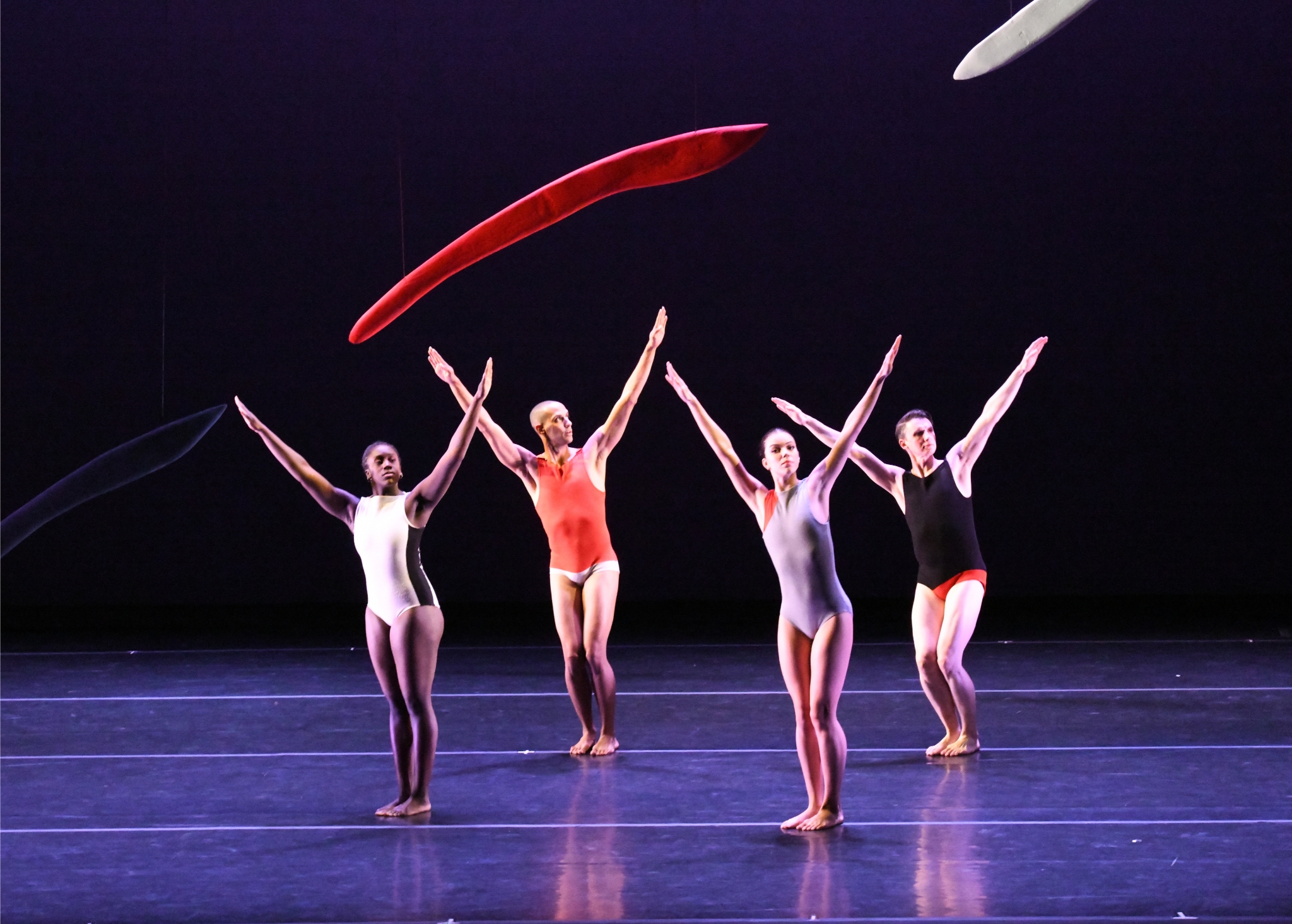
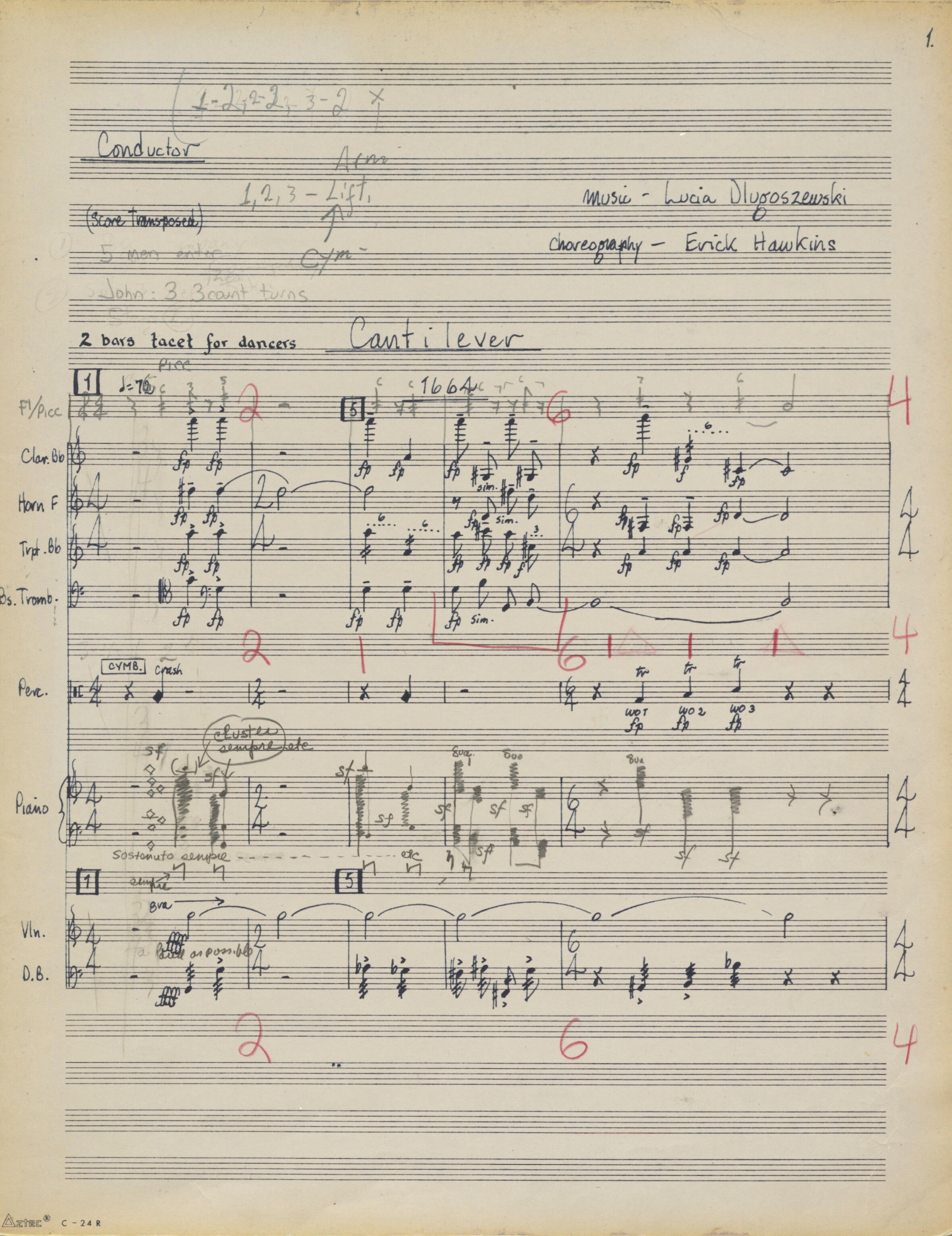
Cantilever premiered in Paris in June 1963 at the Théâtre Récamier during the Théâtre des Nations Festival. Created by Dlugoszewski and Hawkins for four dancers and solo piano, the work became a central part of the Hawkins Dance Company’s touring repertory and was performed widely across the United States throughout the 1960s and 70s. In 1988, Dlugoszewski expanded the score and Hawkins restructured the choreography into a new version titled Cantilever II, for twelve dancers and chamber ensemble. The work is dedicated to Austrian-American architect Frederick Kiesler and was originally presented with a suspended sculptural set by Dorazio.
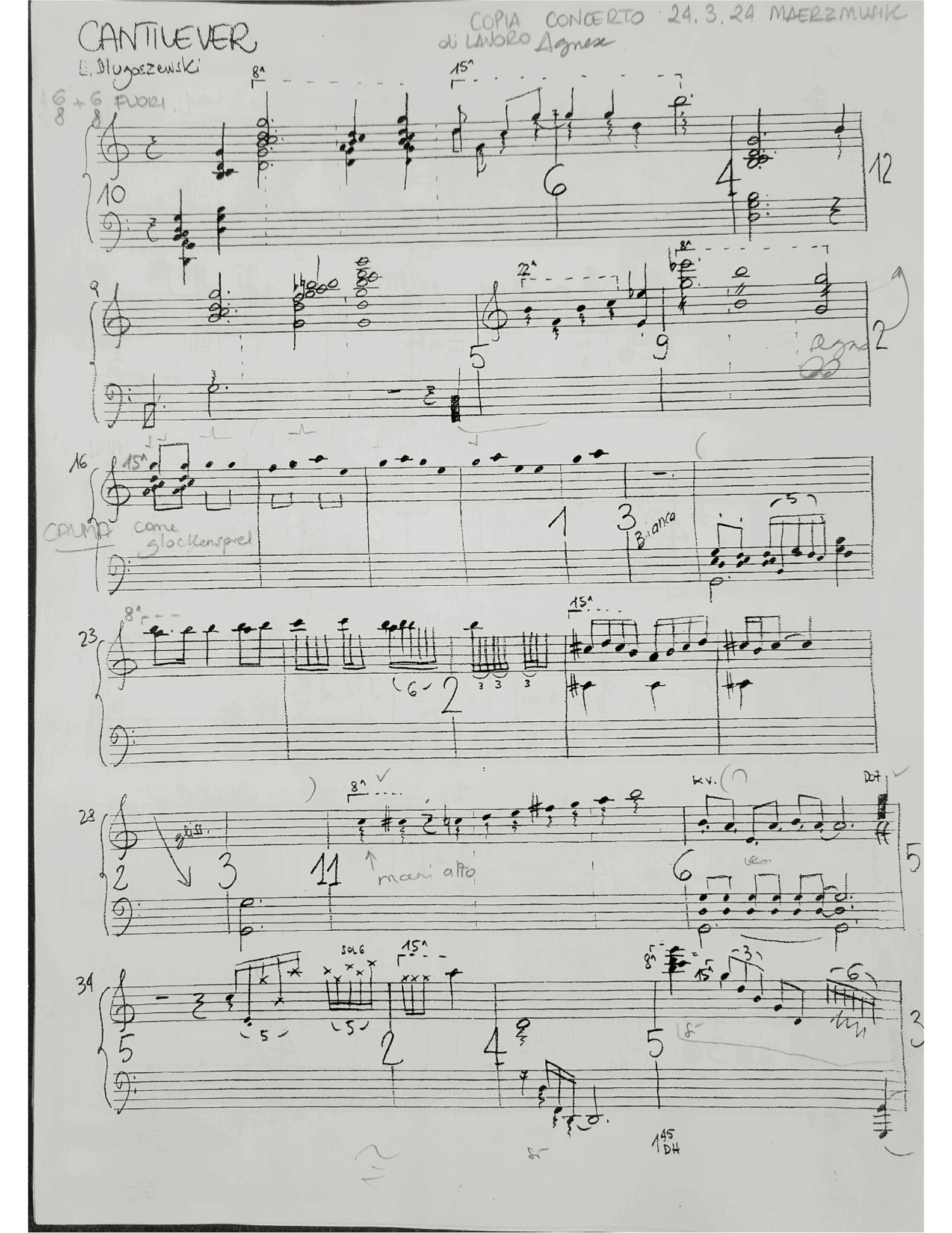
Dlugoszewski wrote the piano part for herself, departing from the extended techniques that became a hallmark of her later “timbre piano” works. Instead, she composed a part that engages primarily with the keyboard, using dense chord clusters, percussive attacks, and abrupt dynamic shifts. These techniques—while inventive—rely on more conventional approaches to the instrument and give Cantilever a distinct place within her catalog. She described the score as an attempt to harness the drive and momentum of baroque music without referencing its melodic or structural forms.
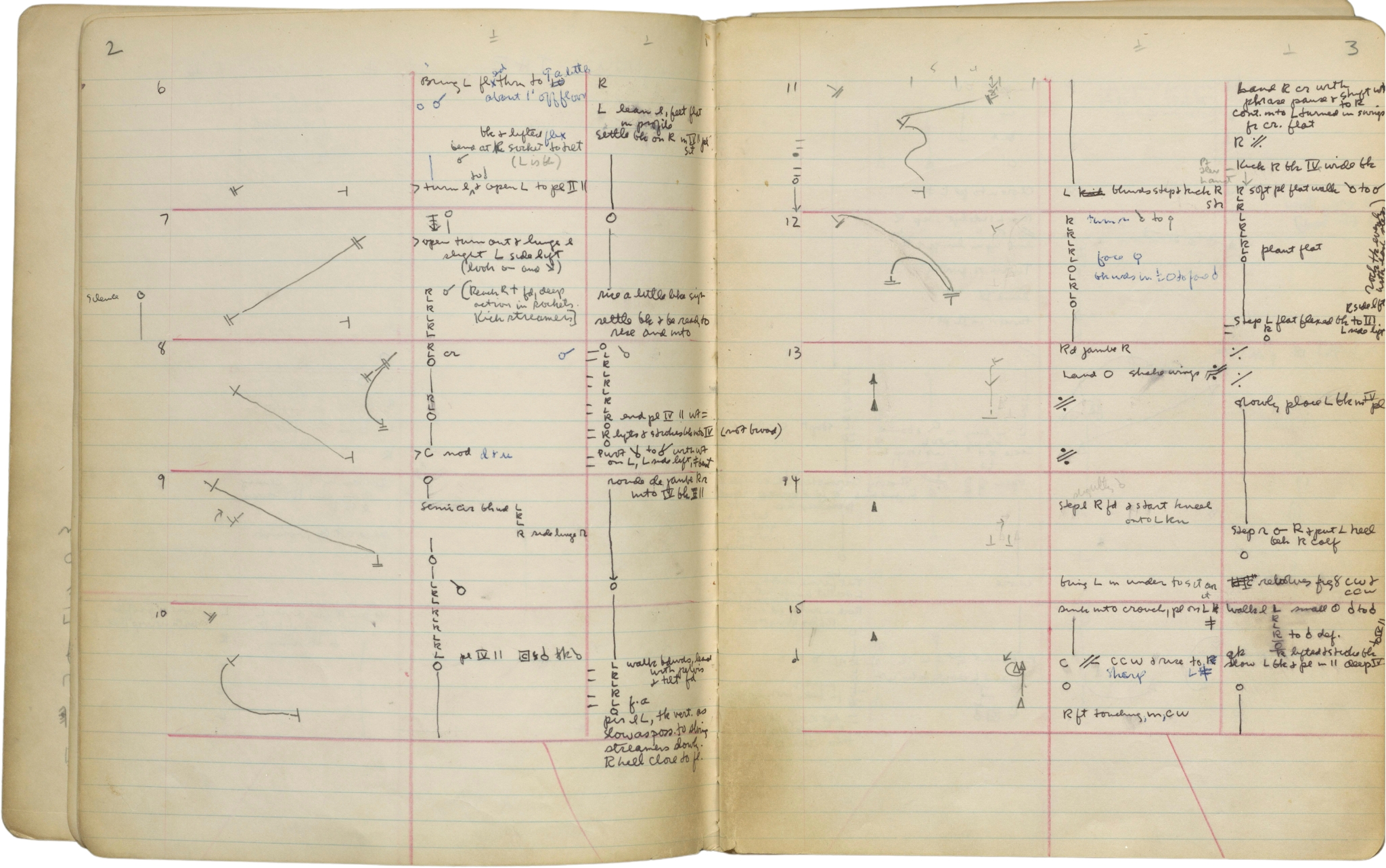
No finalized score exists for the original piano version. Dlugoszewski performed from a combination of shorthand sketches and working notes, which allowed for flexibility in live performance. In the following decade, she developed several expanded versions for ensemble, introducing winds, strings, and percussion. In these versions, the role of the piano shifted: it became more textural and reintroduced aspects of her timbre piano style, while other instruments absorbed much of the material that the solo piano had previously carried.
Hawkins described the dance as inspired by the experience of rising through a skyscraper and suddenly seeing far into the distance. He conceived it as a tribute to American architects and the growing urban landscapes they shaped. Choreographed for two men and two women, the piece reflects Hawkins’s distinctive movement language—fluid, breath-based, and stripped of ornament. The dancers move independently of the music, encountering it as a parallel force rather than responding to it directly. The choreography avoids overt gesture and instead emphasizes sculptural clarity, with a focus on spacing, groupings, and rhythmic flow. While the instrumentation evolved, the dance’s structure remained closely aligned with the musical durations, and the original choreography provided the basis for Cantilever II, which expanded the scale while retaining the same underlying ideas.