Philadelphia, PA 19104
David Tudor’s musical partnership with the Merce Cunningham Dance Company spanned nearly five decades, from the company’s founding in 1953 until Tudor’s death in 1996. As a founding member, Tudor served not only as a virtuoso performer of revolutionary piano works but also as an essential collaborator in shaping the company’s sonic identity. Working alongside John Cage, Gordon Mumma, Christian Wolff, and Takehisa Kosugi, Tudor helped pioneer a radical approach to the relationship between sound and movement—one in which music and dance coexisted independently yet in the same time and space. This screening, the first of two film programs dedicated to Tudor’s work with the Cunningham company, presents “Variations V” (1965) and “RainForest” (1968).
PROGRAM:
Variations V (1966) | 49:05, black & white, sound, 16 mm film on video
Choreography: Merce Cunningham. Director: Arne Arnbom. Music: John Cage, “Variations V.” performed by Cage, David Tudor, and Gordon Mumma. Distortion of TV images: Nam June Paik. Film images: Stan VanDerBeek.
RainForest (1968) | 28 min, color, sound, digital transfer
Filmed by D.A. Pennebaker (Leacock and Pennebaker) as part of the 1968 Buffalo Arts Festival’s program “Who’s Afraid of the Avant-Garde.” Choreography: Merce Cunningham. Music: David Tudor, “Rainforest.” Costumes: Jasper Johns. Sets: Andy Warhol.
ABOUT THE FILMS
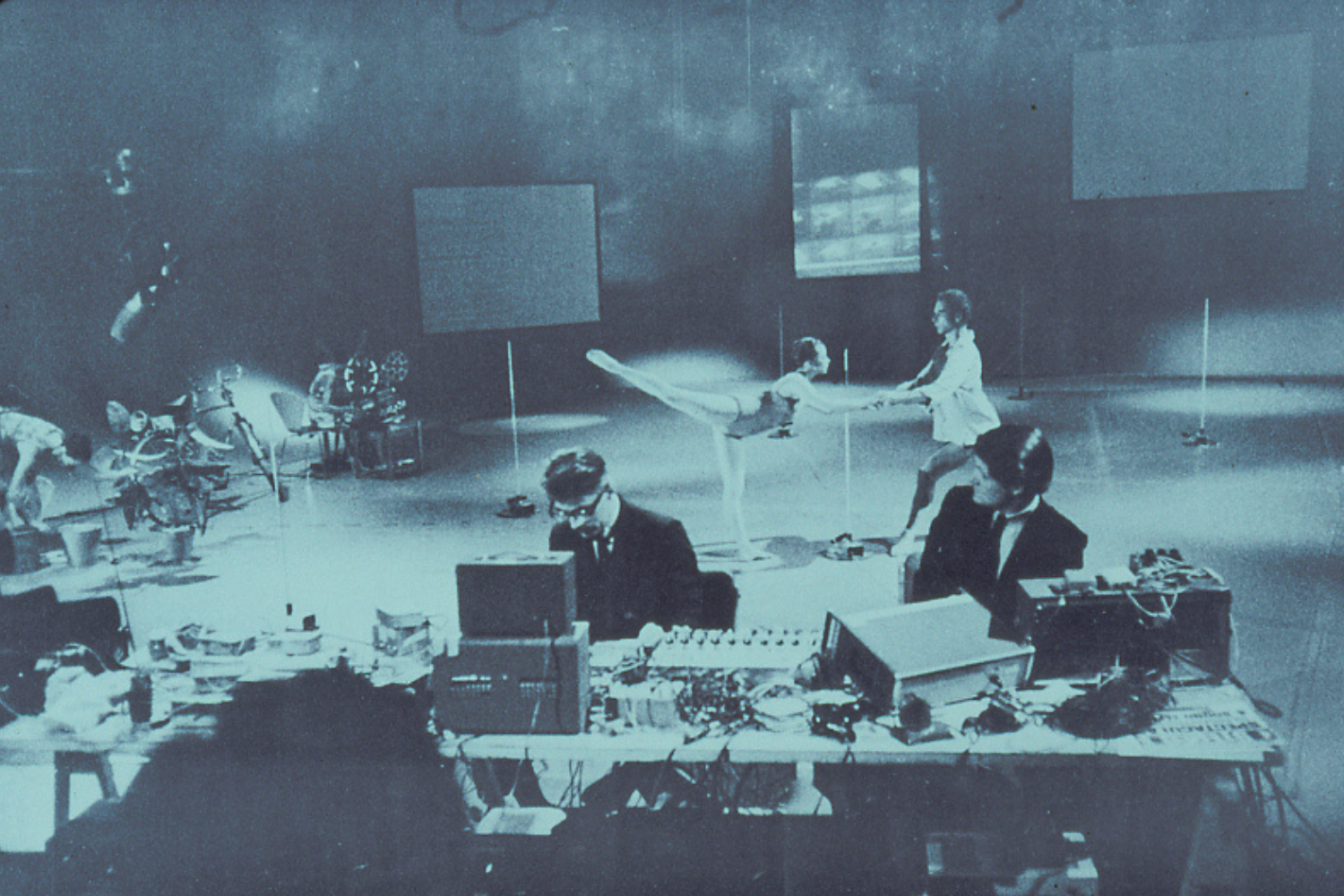
First composed and performed in 1965, Variations V is a true testament to 1960’s experiments with “intermedia”—a coexistence and cutting across of artistic genres that profoundly informed Cunningham’s choreographic practice. Video is materially integrated into the performance, with projections by Stan VanDerBeek and overlaid TV distortions by Nam June Paik enveloping the dancers. Twelve sound-sensitive electronic poles dot the stage; sound is triggered by the dancers’ movements and then altered or delayed by the musicians. Variations V predates Cunningham’s “video-dances,” demonstrating a different moment in his relation to the technology.
A kind of explicit, corporeal engagement with video as medium is reflected in the performance’s sound component. Sound, like video, exists in this dance visually and even kinetically. The viewer of this 1966 archival performance gains access to the locus of sound production, seeing John Cage and David Tudor perched over a wide spread of electronic equipment. Cunningham pays attention to the musicians’ movements in his 1968 book Changes: Notes on Choreography, their “constant scuttling” moving “back and forth on the platform to fix things, wiring that came out, a plug, etc.” The performance moves dialectically between its phenomenological whole and the “varied” elements of sound, video and dance that constitute it.
Unlike most of Cage and Cunningham’s collaborations, sound and movement are more technically codependent than autonomous in Variations V. Cunningham writes in Changes, “John decided to find out if there might not be ways that sound could be affected by movement, and he and David Tudor proceeded to find out that there were.”
This event is part of DAVID TUDOR: A VIEW FROM INSIDE, an exhibition at Drexel’s Pearlstein Gallery from January 15 to March 21, 2026.
Major support for DAVID TUDOR: A VIEW FROM INSIDE has been provided by The Pew Center for Arts & Heritage, with additional support from the Musical Fund Society of Philadelphia.