

Bowerbird is pleased to co-present Gene Coleman’s program Experiments in Neuroaesthetics: Evoking Voices from Biological Systems.
In the music of Giacinto Scelsi, Luigi Nono and Pauline Oliveros, and in the films of Stan Brakhage, there was a desire to reveal the “inner voices”. Working with new biodata technologies and systems, we reach a new reality, where the inner voices of the body, mind, via biological systems, can be Evoked – seen and heard in unprecedented ways. How can we create music and art in this new reality? This program shows three different approaches, which are linked by use of The Source, a Biodata device that can translate electric biorhythms into various media. The program features work by: KAVI (Ilze Briede), The Quantum Global Organoid Orchestra (q.GOO), and The Neuro Music Ensemble Conjure.
PROGRAM
KAVI: Emergent Feedback Loops: Cybernetics and the Human Brain
qGOO (Quantum Global Organoid Orchestra): q.GOO_ PhiladelphiaNeuroMusicAI/42026
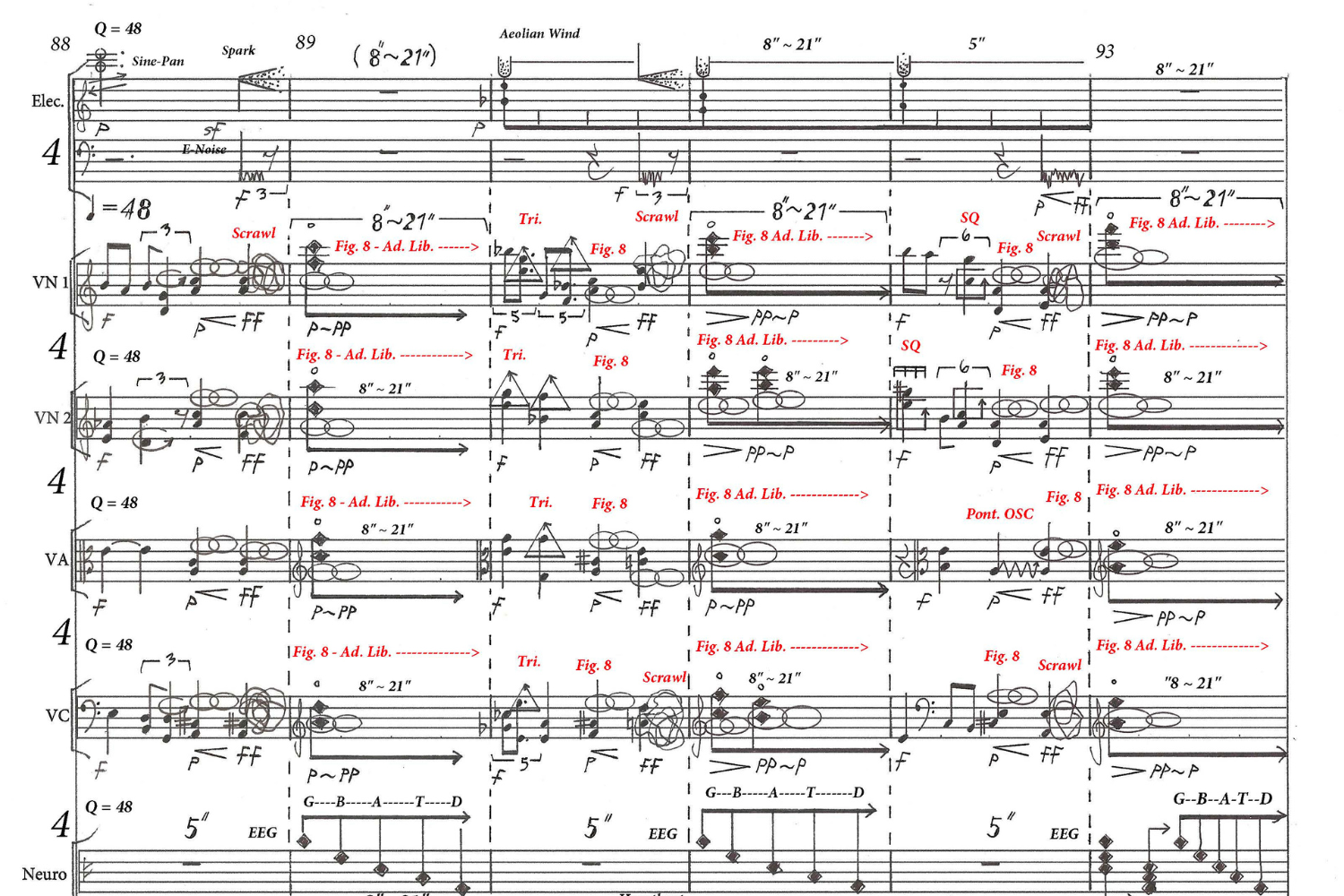
Gene Coleman: EVOCARE (2026) for string quartet and neuro electronics
Conjure Neuro Music Ensemble + Guests
Adam Vidiksis, Neuro electronics
Sam Wells, Neuro electronics
Tom Kraines, Cello
Gene Coleman (Composition and Direction)
With special guests
Melinda Rice and Molly Germer, Violins
Maren Rothfritz, Viola
ABOUT THE PROGRAM
KAVI (Ilze Briede), a Latvian–Canadian artist and researcher working across visual art, digital design, interactive installation, and live audiovisual performance. Her work Emergent Feedback Loops: Cybernetics and the Human Brain, uses her biodata to generate complex visual structures, accompanied by improvisational responses from musicians. Her work examines how physiological data—such as brain activity and other biosignals—can function as generative inputs for artistic systems. This performance presents ongoing dissertation research and a research-creation inquiry within computational arts, exploring the integration of live human brain data into cybernetic systems. Drawing on unprocessed neural signals, the work resists reductionist models of data interpretation and knowledge construction, aiming to create more authentic, unpredictable experiences that foreground emergence, unpredictability, and co-evolution. A feedback loop among performers, the computational system, and spectators forms a dynamic, interdependent ecology in which visual, sonic, and spatial elements continuously evolve in real time. This research is supported by a developing biophysical sensing device from BioMECI called The Source, designed to collect and translate physiological signals into performative outputs. Through this system, brain activity becomes an active agent within a cybernetic environment, enabling new forms of interaction and perception. Positioned at the intersection of art, science, and technology, this work proposes a framework for data-driven performance centered on relationality, embodiment, and collective world-building.
The Quantum Global Organoid Orchestra (q.GOO) presents its composition
q.GOO_PhiladelphiaNeuroMusicAI/42026. This work extends contemporary practice in media art, neuroscience, and AI by making perceptible the hidden rhythms of living neural matter and prompting new questions about perception, agency, and the future of embodied computation.
The Neuro Music Ensemble Conjure performs EVOCARE, a composition by Gene Coleman for string quartet and neuro electronics. Coleman calls this “Neuro Music” – music modeled on the auditory pathways of the brain and nervous system. EVOCARE reveals the inner voices of the body and mind using a new Biodata technology called The Source, which translates our nervous system rhythms into sound. EVOCARE is a dynamic dialog between acoustic music and the Biorhythms of perception, interoception, affect, emotion and thought.
This program is produced by The Institute for Music and Neuroaesthetics, Bowerbird and The Rotunda
ABOUT THE ARTISTS
Ilze Briede (artist name Kavi) is a Latvian–Canadian artist and researcher working across visual art, digital design, interactive installation, and live audiovisual performance. Her creative and pedagogical practice engages with biophysical sensing, creative coding, and projection-based media to explore the aesthetic and epistemological potential of physiological data. Kavi is currently a PhD candidate in Digital Media at York University, Toronto, where her research investigates the design of cybernetic systems for performance and immersive narrative environments driven by real-time biophysical signals. Her work examines how physiological data—such as brain activity and other biosignals—can function as generative inputs for artistic systems, enabling alternative modes of perception, participation, and knowledge production.
www.ka-vi.com/
Gene Coleman is a composer, musician and director. A 2014 Guggenheim Fellow and recipient of the 2013 Berlin Prize for Music, he has created over 70 works for various instrumentation and media. Innovative use of sound, image, space and time allows Coleman to create work that expands our understanding of the world. Since 2001 his work has focused on the global transformation of culture and music’s relationship with other media, such as architecture, video and dance. He studied painting, music and film making at the School of the Art Institute of Chicago, where his principle teachers included legendary experimental film artists Stan Brakhage and Ernie Gehr, as well as Robert Snyder (music) and Barbara Rossi (painting).
Coleman has an extensive record working internationally. He was composer in residence at the American Academy in Berlin (2013), the American Academy in Rome (Fall 2011), Shofuso Japanese House (Philadelphia, 2009), Foundation Kunst Raum Sylt Quelle (Germany, 2008), Westwerk (Hamburg, 2007), Taipei Artists Village (2007), University of Lubeck (Germany, Feb. 2005), The House of World Cultures (Berlin, 2003/2004), Takefu International Music Festival (Japan, 2002) Spritzen Haus (Hamburg, 1995) and ASAP (Maine, 2000/2001). In July 2005, he was a recipient of grants from Meet the Composer and the US State Department for a composer’s residency in Beirut, Lebanon. In 2001, he received a fellowship from the NEA/Japan-US Friendship Commission and lived in Japan for 8 months. He has received 4 fellowships from the Illinois Arts Council and 1 from the New Jersey State Arts Council (2008), as well as grants from the NEA, Arts Midwest, American Music Center, The American Composers Forum, Meet the Composer, The Japan Foundation, Philadelphia Music Project and others. He has received commissions from Chamber Music America, The Crossing, Archer Spade, Tom Buckner, Phace Contemporary Music, Network for New Music, Nexus Gallery, Trio Accanto, Klangforum Wien, Chamber Music Now, Ensemble 01, E-Mex Ensemble and the NRW Culture Foundation, The Renaissance Society, International House Philadelphia, Chicago Cultural Center, The Takefu Festival, HKW Berlin, Konzerthaus Wien and the Ernst Von Siemens Foundation. Coleman has been a guest lecturer at many universities including Chiao-Tung University and Taipei National University of the Arts (Fall 2007) and Hong Kong University (Fall 2009). His paintings, short films and musical scores have been widely exhibited, including shows at the Art Institute of Chicago (1984) and The MCA Chicago (2000). His ongoing projects feature musicians from many parts of the globe. Recent works such as “Kyoto_Naigai” and “Future City” explore music’s relationship with video and architecture. These and other projects have brought Coleman and his work to many audiences in Europe, Asia and North America.
genecolemancomposer.com
The Quantum Global Organoid Orchestra (q.GOO) is an experimental art–science collaboration that brings together living neural tissue, generative media, and networked human participation to explore new forms of emergent, cross-species creativity. The project centers on brain organoids—lab-grown clusters of neural cells cultivated in partnered neurobiology labs—which produce spontaneous electrical activity. This neural activity is captured through microelectrode arrays (MEAs) and translated in real-time into sound, visual structures, and computational behaviors. In this sense, the organoids function as active “performers” within a hybrid ensemble composed of biological, human, and machine processes.
Featuring the following contributors:
transLAB: Marcos Novak (director), Nefeli Manoudaki, Iason Paterakis, Mert Toka and Diarmid Flatley
ATMOS Implementation: Lucian Parisi
n-D::StudioLab: Mark-David Hosale (director) and Ilze [Kavi] Briede
SBCAST: Alan Macy (director)
Scientific collaborators:
The Kosik Neurobiology Lab: Kenneth Kosik (director) and Tjitse van der Molen
Abstract:
Beyond AI models, the constantly and rapidly evolving q.GOO project assembles Superconductivity for Minds: a globally distributed ecology in which actual and artificial brain organoids, bio-inspired algorithmic and quantum computational processes, spectral sound, coupled human-computer collaboration, and networked planetary environments begin to co-compose intelligence through Agentic Media Ecologies and Perforated Systems. This project explores what becomes thinkable when the “emergent possible” of the hybrid natural-artificial environment itself becomes agentive —reciprocally both data-driven and data-driving— when cognition is distributed across heterogeneous Umwelten, and when the path toward Superoptimal AGI/ASI runs not through isolated systems, but through recursively coupled permeable, porous, and perforated outer and inner worlds.
Modelled on complex ecosystems such as coral reefs, rainforests, and the planet itself, and also perception, cognition, civilization, and culture as emergent systems, the project and its variants are structured operationally by the notion of “perforated systems” — systems that, like living cells, consist of an autonomous internal behavior protected by a permeable, porous, or literally perforated “membrane.” This arrangement allows all parts to maintain their integrity but also to send and receive energy and information to and from each other and from the overall environment. Diverse coordinating processes provide algorithmic environmental homeostasis by adjusting the data flowing through the perforations.
This “free-but-perforated” operational strategy is also a statement regarding human collaboration and environmental sustainability. Each participant contributes a “species” that is free to be whatever it needs to be, provided it remains “perforated” and can receive and send data and information that can alter its behavior. The work thus instantiates a “media ecosystem” where the result is ecosystemically regulated by the health of the whole, which is always richer and more interesting than the sum of its parts.
The Quantum Global Organoid Orchestra (q.GOO) is an experimental art–science collaboration that brings together living neural tissue, generative media, and networked human participation to explore new forms of emergent, cross-species creativity. The project centers on brain organoids—lab-grown clusters of neural cells cultivated in partnered neurobiology labs—which produce spontaneous electrical activity. This neural activity is captured through microelectrode arrays (MEAs) and translated in real-time into sound, visual structures, and computational behaviors. In this sense, the organoids function as active “performers” within a hybrid ensemble composed of biological, human, and machine processes.
q.GOO evolves from the SIGGRAPH 2023 Synaptic Time Tunnel project and the Protonoesis series by collaborators at UCSB’s transLAB (directed by Marcos Novak) and the Kosik Neurobiology Lab (directed by Ken Kosik). These works form closed-loop systems in which organoid signals influence generative algorithms, which in turn shape the audiovisual environment surrounding the installation. Audience members encounter an immersive, multi-modal field where neural activity, machine interpretation, and human agency intermingle, suggesting a form of “distributed cognition” that exceeds any one participant.
The project invites reflection on the aesthetic and ethical dimensions of working with living neural material, asking what it means to situate organoids—entities neither fully biological subjects nor inert tools—as participants within artistic systems. q.GOO foregrounds sensation, emergence, and relationality. It proposes a speculative model of collective intelligence, where biological and computational systems co-produce meaning. Through this, the Quantum Global Organoid Orchestra extends contemporary practice in media art, neuroscience, and AI by making perceptible the hidden rhythms of living neural matter and prompting new questions about perception, agency, and the future of embodied computation.