Philadelphia, 19104
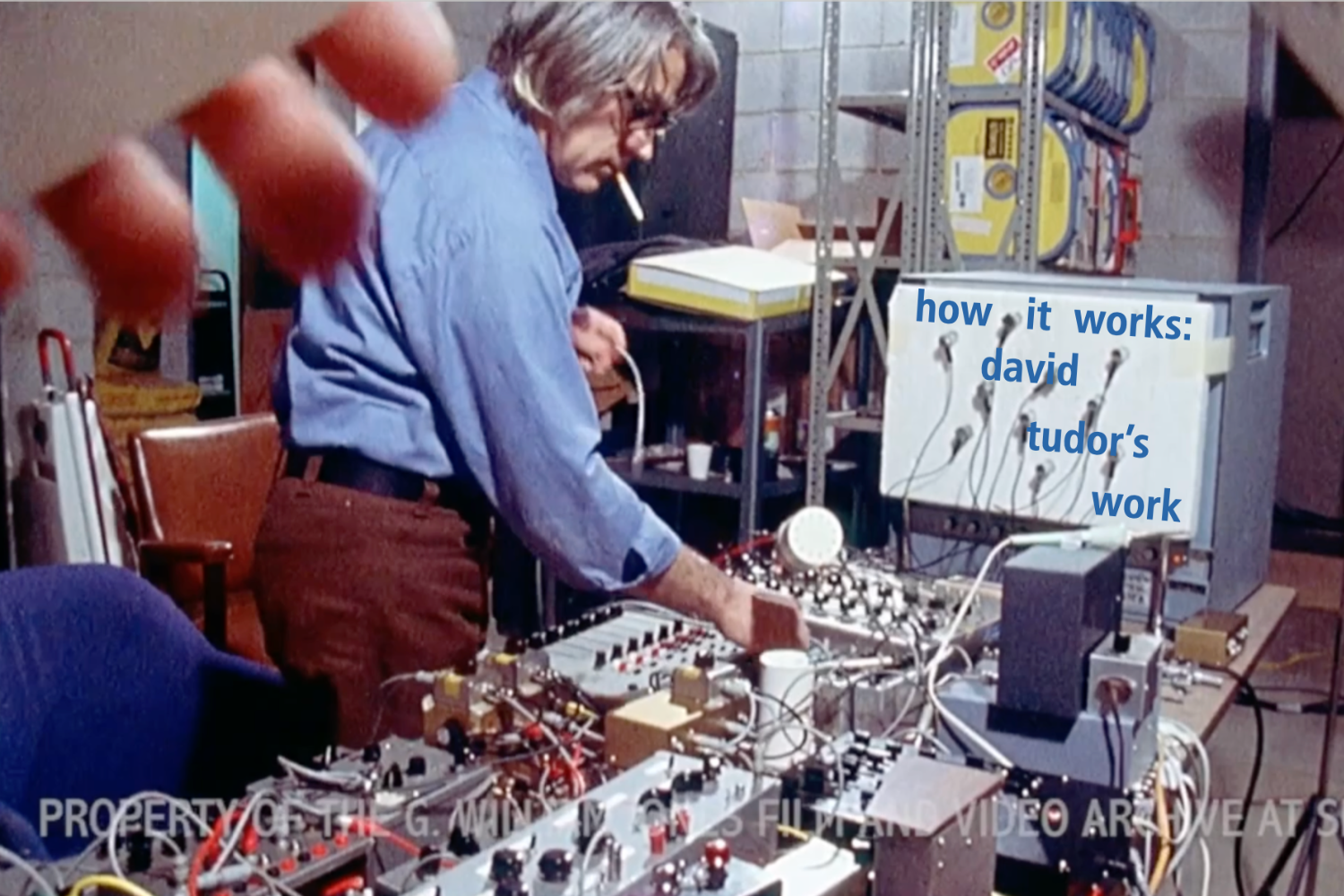
Starting in the mid-1960s, David Tudor made up a homemade electronic music by following his ears and his all-absorbing mind. He wanted new instruments and began a unique self-education which embraced Brazilian hobby mags, engineering journals, and countless trips to junk surplus outlets. His musical methods were as idiosyncratic as the tools he constructed. This talk with Michael Johnsen, noted Tudor scholar and circuit designer, will explain Tudor’s instruments, the way they made his music—and vice versa.
Johnsen’s presentation draws on archival images, sounds, animated graphics, technical history, and object lessons to trace Tudor’s process of invention and discovery. The talk examines how Tudor built his practice through material experimentation and patient listening, creating systems that emerged from the specific behavior of electronic components rather than predetermined compositions.
ABOUT THE ARTIST
Michael Johnsen is a circuit designer, performer, and researcher from Pittsburgh. His recent research concerns the circuit-level understanding of David Tudor’s “folkloric” homemade instruments and related lutherie, resulting in the restoration, cloning, and performance of vintage circuits, as well as publications and lectures. His own performance work is characterized by a relative lack of ideas per se and an intense focus on observation—the way a shepherd watches sheep. As a performer and builder of live electronics, he cultivates an integrated menagerie of custom devices whose idiosyncratic behaviors are revealed through their complex interactions, producing teeming chirps, sudden transients, and charming failure modes, embracing the dirt in pure electronics. He has shown work at Arter (Istanbul), singuhr (Berlin), INA GRM (Paris), the Getty (Los Angeles), MdM Salzburg, Kagurane (Tokyo), MoMA, SF Cinematheque, Radio France, Idiopreneurial Entrephonics (Connecticut), The Kitchen (New York), High Zero (Baltimore), and Musique Action. He co-edits ubu.com/emr, designs synthesizers for Pittsburgh Modular, and may be reached at johnsen.rahbek
Estimated run time: 60 minutes. Free admission. No registration required. This event is immediately followed by a Tudor Exhibition Gallery Tour.
This event is part of DAVID TUDOR: A VIEW FROM INSIDE, an exhibition at Drexel’s Pearlstein Gallery from January 15 to March 21, 2026.
Major support for DAVID TUDOR: A VIEW FROM INSIDE has been provided by The Pew Center for Arts & Heritage, with additional support from the Musical Fund Society of Philadelphia.