

Philadelphia, PA 19103
Bowerbird is pleased to present pianist Amy Williams performing Morton Feldman’s monumental Triadic Memories, one of the towering masterworks of late 20th-century piano literature.
ABOUT THE WORK
Completed in 1981 and jointly dedicated to pianists Roger Woodward and Aki Takahashi, Triadic Memories is Feldman’s longest solo piano composition, lasting approximately 90 minutes. Following its first German performance, Feldman described the work as the “biggest butterfly in captivity”—a characteristically poetic phrase that captures both its delicacy and vast scale.
The work represents a profound meditation on memory and perception. The entire score is written in triple piano, at times even quintuple piano, creating an intimate sonic landscape where subtle gradations of touch and color become paramount. Feldman described his compositional method as “a conscious attempt at formalizing a disorientation of memory,” where chords are repeated without discernible pattern. The listener experiences what Feldman compared to walking through Berlin, where buildings appear similar yet distinct—a regularity that suggests direction but ultimately reveals itself as illusion.
Feldman regarded Triadic Memories as a spatial landscape through which one moves, where lengths of time, rests, and silences increase, constantly testing the listener’s musical memory. Materials are continually recontextualized through different voicings and registers, with subtle shifts in harmony and texture creating a work that is simultaneously static and constantly evolving. The piece invites deep concentration and reflection, transforming our experience of musical time itself.
This rarely performed work stands among Feldman’s great late compositions—pieces that sought to make music into an experience of life-changing force, a transcendent art form that wipes everything else away.
ABOUT THE ARTIST
Amy Williams is a composer of music that is “simultaneously demanding, rewarding and fascinating” (Buffalo News), “fresh, daring and incisive” (Fanfare). Her compositions have been presented at renowned contemporary music venues on four continents by many of the leading contemporary music soloists and ensembles, including the Pittsburgh Symphony Orchestra, Buffalo Philharmonic Orchestra, JACK Quartet, Ensemble Aleph, Dal Niente, Wet Ink, Talujon, International Contemporary Ensemble, and pianist Ursula Oppens. Her pieces appear on the Albany, Parma, VDM (Italy), Blue Griffin, Centaur and New Ariel labels.
Williams has a particularly deep connection to Feldman’s music—her father and Feldman were close colleagues at the University at Buffalo, giving her a lifelong relationship with the composer’s work. As a member of the Bugallo-Williams Piano Duo, Ms. Williams has performed at important new music festivals and series worldwide and recorded six critically-acclaimed CDs for Wergo (works of Nancarrow, Stravinsky, Varèse/Feldman and Kurtág).
She has taught at Bennington College and Northwestern University and is currently Associate Professor of Composition at the University of Pittsburgh.
ABOUT THE COMPOSER
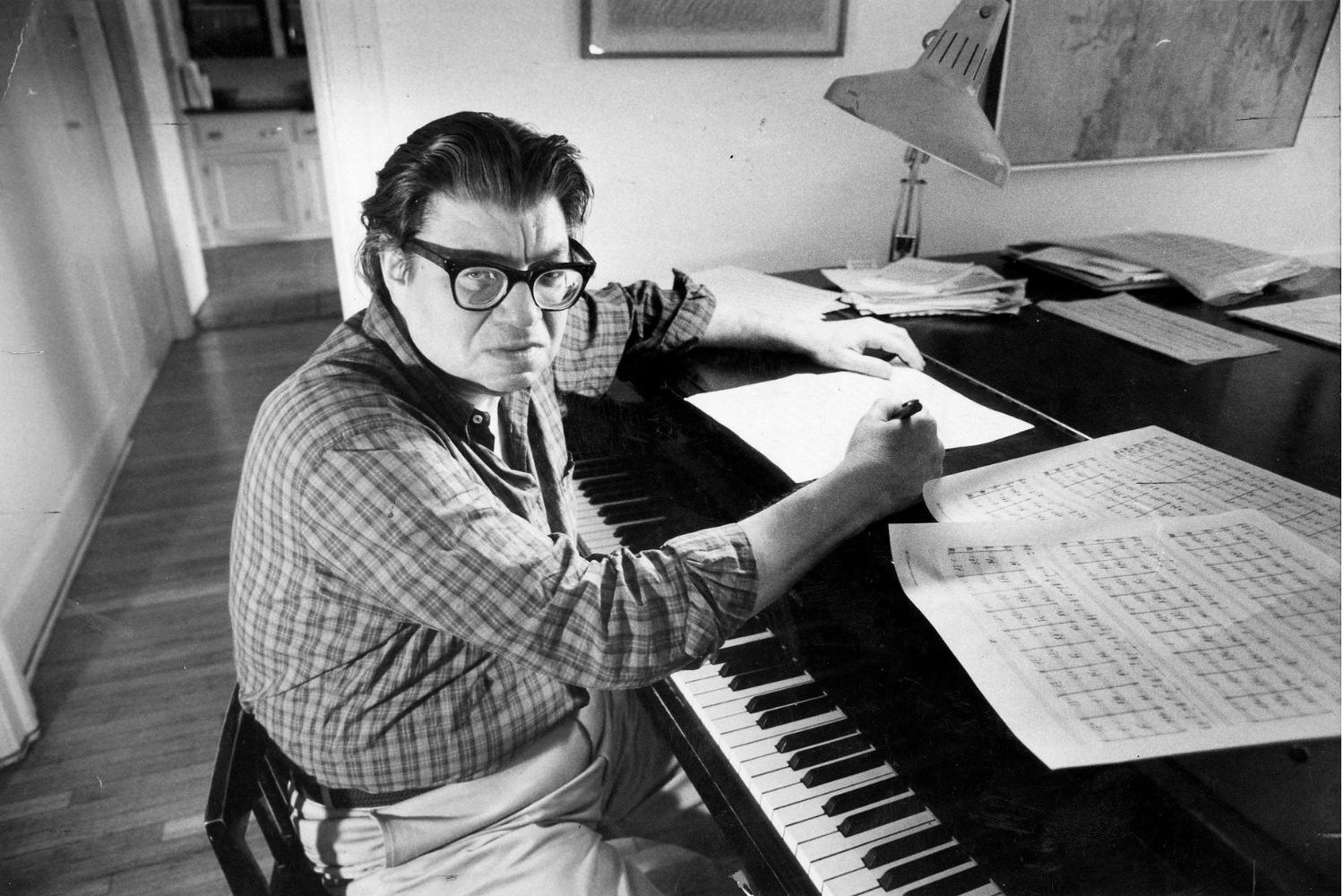
Morton Feldman was born in New York in 1926. He studied music and piano with several teachers at a young age before becoming a student of Stefan Wolpe after graduating from high school in 1944. Although Feldman mastered atonality, the pair spent much of their time together simply arguing about music and Feldman struggled to find an artistic voice when composing music.
Feldman’s artistic development took shape in 1949 when Feldman met composer John Cage, commencing a lifelong artistic association of crucial importance to American music in the 1950s. Cage was instrumental in encouraging Feldman to have confidence in his instincts, which resulted in totally intuitive compositions. From then on, Feldman never worked with any systems that anyone has been able to identify, working from moment to moment, from one sound to the next. During this vital time of his musical career, his friends during the 1950s in New York included the composers Earle Brown and Christian Wolff; painters Mark Rothko, Philip Guston, Franz Kline, Jackson Pollock and Robert Rauschenberg; and pianist David Tudor.
The painters in particular influenced Feldman to search for his “physical sound-world,” one that was more immediate and direct than had existed before. It is said that his use of repetition of individual elements creates a vast field of shimmering colors and textures. He rejected standard notation which resulted in his experimentation with graph notation; Projection 2 was one of his earliest scores using this highly visual system. In these scores, the players have some input in the overall structure as they select their notes from within a given register and time. These led to a series of groundbreaking works, often considered controversial in regard to their inaccessibility to the general public. However, Feldman was not happy with the amount of improvisation and freedom given to the performer, so he returned to more precise forms of notation. It was at this time that many would say he created his most “visual” pieces, including Rothko Chapel, Why Patterns?, and For Philip Guston.
After partially rejecting the use of graph notation and aleatory music, his works of the late 70s and 80s grew longer: his compositions expanded in length to such a degree that allowed him to focus on the passage of time and the movement of blocks of sound through musical space. The scale of these works allowed Feldman to have control over the piece he wrote. Nine of Feldman’s one-movement compositions last for over one and a half hours each. His infrequently played String Quartet No. 2 can last up to six hours, with no break for the performers.
In 1973, the University of New York at Buffalo asked Feldman to become the “Edgard Varèse Professor,” a post he held for the rest of his life. In June 1987, Morton Feldman married the composer Barbara Monk. On September 3, 1987, he died at his home in Buffalo at age 61.