Philadelphia, PA 19104
David Tudor’s musical partnership with the Merce Cunningham Dance Company spanned nearly five decades, from the company’s founding in 1953 until Tudor’s death in 1996. As a founding member, Tudor served not only as a virtuoso performer of revolutionary piano works but also as an essential collaborator in shaping the company’s sonic identity. Working alongside John Cage, Gordon Mumma, Christian Wolff, and Takehisa Kosugi, Tudor helped pioneer a radical approach to the relationship between sound and movement—one in which music and dance coexisted independently yet in the same time and space. This screening, the second of two film programs dedicated to Tudor’s work with the Cunningham company, presents “Cunningham Ballett” (1958) and “Channels/Inserts” (1982).
PROGRAM:
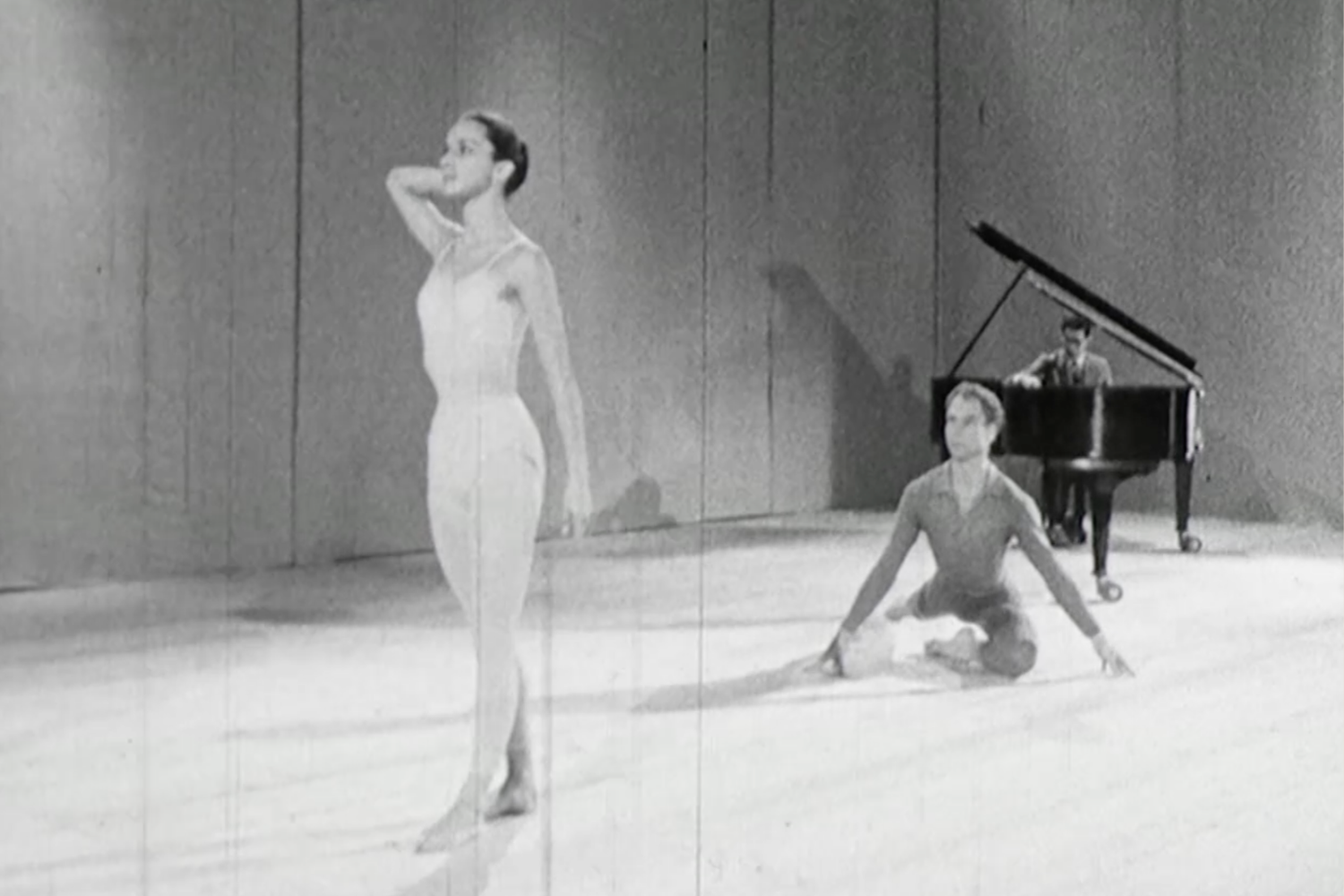
Cunningham Ballett (1958) | 24 min, black & white, sound, digital transfer
Performance for Camera: Brussels, Belgium, 1958. This film for television includes “Changeling” (1957), “Suite for Two” (1956), and “Springweather and People” (1955). Dancers: Carolyn Brown and Merce Cunningham. Musicians: John Cage and David Tudor.
Channels/Inserts (1982) | 31:40 min, color, sound, 16 mm film on HD video
Choreography: Merce Cunningham. Direction/Editing: Charles Atlas. Music: David Tudor, “Phonemes”
ABOUT THE FILMS
To create Channels/Inserts, Cunningham and Atlas divided the Cunningham Dance Company’s Westbeth studio into sixteen possible areas for dancing and used chance methods based on the I Ching to determine the order in which these spaces would be used, the number of dancers to be seen, and the events that would occur in each space. Atlas employed cross-cutting and animated mattes or wipes to indicate a simultaneity of dance events occurring in different spaces, as well as to allow for diversity in the continuity of the image. The sound score is a recording of David Tudor’s PHONEMES.
Dancers are dressed in everyday clothing and at times stop dancing to congregate casually. This cessation, of course, is legible neither as dance nor “not-dance,” but is in-between and liminal, pointing to Cunningham’s persistent interest in “pedestrian” movement. Movement, the choreographer seems to indicate, exists in a continual tension—the everyday appears in the dance phrase and the dance phrase appears in the everyday, or bear each other’s traces. The dancing body is always-already an everyday body and in turn, the everyday body always-already contains the potential for movement read as dance.
This event is part of DAVID TUDOR: A VIEW FROM INSIDE, an exhibition at Drexel’s Pearlstein Gallery from January 15 to March 21, 2026.
Major support for DAVID TUDOR: A VIEW FROM INSIDE has been provided by The Pew Center for Arts & Heritage, with additional support from the Musical Fund Society of Philadelphia.