Philadelphia, PA 19104
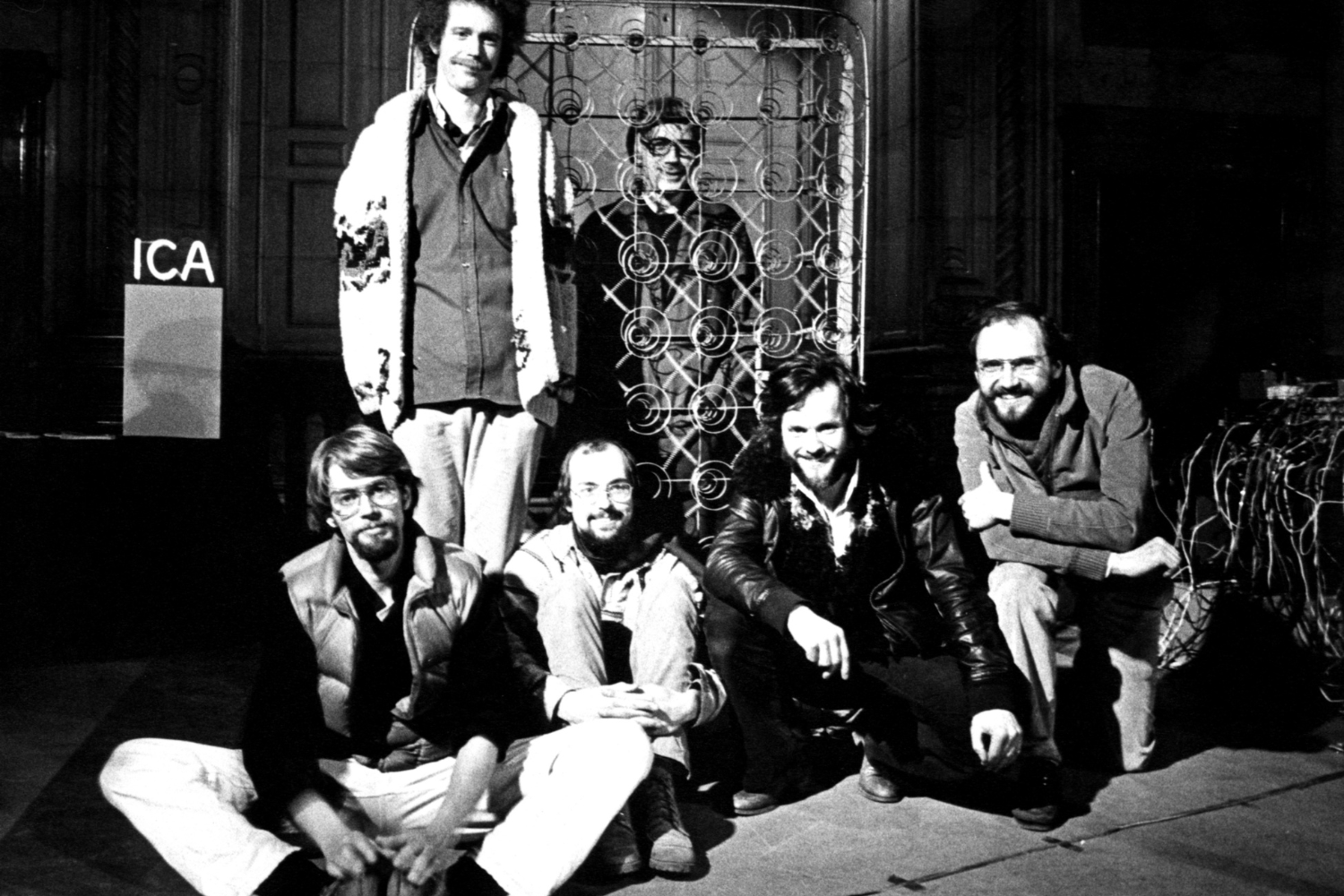
Bowerbird is pleased to present Composers Inside Electronics—Phil Edelstein, Ron Kuivila, and Michael Johnsen, with Daniel Fishkin—performing works by David Tudor.
Composers Inside Electronics (CIE), formed in 1973 with David Tudor, pioneered a collaborative approach to live electronic music that treated circuits and components as instruments in themselves rather than as tools. This closing concert of A View from Inside: David Tudor at 100 features an evening of Tudor’s electronic compositions spanning 1970 to 1984.
The program opens with Pepscillator, one of Tudor’s sound environments created for the Pepsi Pavilion at Expo ’70 in Osaka, Japan. Using chains of audio processors creating multiple self-oscillating feedback loops, Pepscillator exemplifies Tudor’s approach to designing systems of electronic components whose interconnections define both the work’s structure and its real-time performance. Pulsers (1976) explores rhythms created electronically by analog circuitry, with time-bases that can be varied and destabilized by the performer. Dialects (1984) transforms vowel-like and fricative sound sources—the beating of insects’ wings and modulated alpha waves—through vocoder circuits and percussion generators triggered by Jackie Matisse’s vibrating wire flower sculptures.
The concert offers a rare opportunity to experience Tudor’s electronic works performed by artists who worked directly with him and who continue to realize and evolve his vision through their own research and performance practice.
PROGRAM
David Tudor: Pepscillator (1970)
Phil Edelstein and Daniel Fishkin, electronics
David Tudor: Pulsers (1976)
Michael Johnsen, electronics
David Tudor: Dialects (1984)
Ron Kuivila, electronics and sculpture by Jackie Matisse
This event is part of DAVID TUDOR: A VIEW FROM INSIDE, an exhibition at Drexel’s Pearlstein Gallery from January 15 to March 21, 2026.
ARTIST BIOS
Phil Edelstein in the early 1970s co-founded Electronic Body Arts (EBA), a collaboration between choreography, music, and engineering, and is a founding member of Composers Inside Electronics (CIE). He has collaborated on Rainforest IV and CIE projects since their inception in 1973 and on the evolution of the automated installation version Rainforest V, principally with John Driscoll. Another recent project with Driscoll is their installation Cluster Fields. His work includes compositions, performances, software, and sound installations for architectural spaces and focused sound fields. Recent focus is the development of compositional and orchestration tools for constructing sound fields for installation and performance. Current projects include updates to Impulsion, where synthetic and encoded reverberant spaces are folded upon themselves and acoustically rendered, and performances and new realizations of works by David Tudor such as Pepscillator.
Daniel Fishkin’s ears are ringing. His lifework investigating the aesthetics of hearing damage has received international press (Nature Journal, 2014), and he has been named a “tinnitus ambassador” by the Deutsche Tinnitus-Stiftung. He is the only luthier to have studied directly with daxophone inventor Hans Reichel. His instruments have toured internationally, including Canada, Norway, Germany, France, Japan, Kazakhstan, and Australia. He is the first USA-based artist to receive the P.I.G. Prize (2021) from Henrik Vibskov. He holds an MA in Music Composition from Wesleyan University and a PhD in Composition and Computer Music from the University of Virginia. He is Assistant Professor of Music Production at Ramapo College of New Jersey. His current favorite wood is Gymnanthes lucida (Oysterwood).
Michael Johnsen is a circuit designer, performer, and researcher from Pittsburgh. His recent research concerns circuit-level understanding of David Tudor’s “folkloric” homemade instruments and related lutherie, resulting in restoration, cloning, and performance of vintage circuits, along with publications and lectures. His performance work is characterized by a relative lack of ideas per se and an intense focus on observation—the way a shepherd watches sheep. As a performer and builder of live electronics, he cultivates an integrated menagerie of custom devices whose idiosyncratic behaviors are revealed through complex interactions, producing teeming chirps, sudden transients, and charming failure modes, embracing the dirt in pure electronics. He has shown work at Arter (Istanbul), singuhr (Berlin), INA GRM (Paris), the Getty (Los Angeles), MdM Salzburg, Kagurane (Tokyo), MoMA, SF Cinematheque, Radio France, Idiopreneurial Entrephonics (Connecticut), The Kitchen (New York), High Zero (Baltimore), and Musique Action. He co-edits ubu.com/emr, designs synthesizers for Pittsburgh Modular, and may be reached at johnsen.rahbek gmail.com.
Ronald Kuivila composes music and designs sound installations involving homemade and home-modified electronics, software, and household objects. Homemade devices of his own design pioneered the use of ultrasound (In Appreciation) and sound sampling (Alphabet) in live performance. Other works explore compositional algorithms (Loose Canons), speech synthesis (The Linear Predictive Zoo), and high-voltage phenomena (Pythagorean Puppet Theatre). Many of his works are sound installations. Radial Arcs, commissioned by Ars Electronica, coordinates 96 stun guns; Sparks on Paper uses strings activated by low-power static fields to resonate vellum. Long-term installations have included Visitations at Mass MoCA and Weather at Six at Wesleyan University. Making the World Safe for Piezoelectricity organizes commonplace objects into large-scale time structures. Bellona Times combined telephones and wavefield diffusion with a fragmented presentation of the FBI interrogation of January 6 rioter Danny Rodriguez. His first professional New York performance was in 1978 in two studio events with the Merce Cunningham Dance Company at the invitation of David Tudor.
Major support for DAVID TUDOR: A VIEW FROM INSIDE has been provided by The Pew Center for Arts & Heritage, with additional support from the Musical Fund Society of Philadelphia.