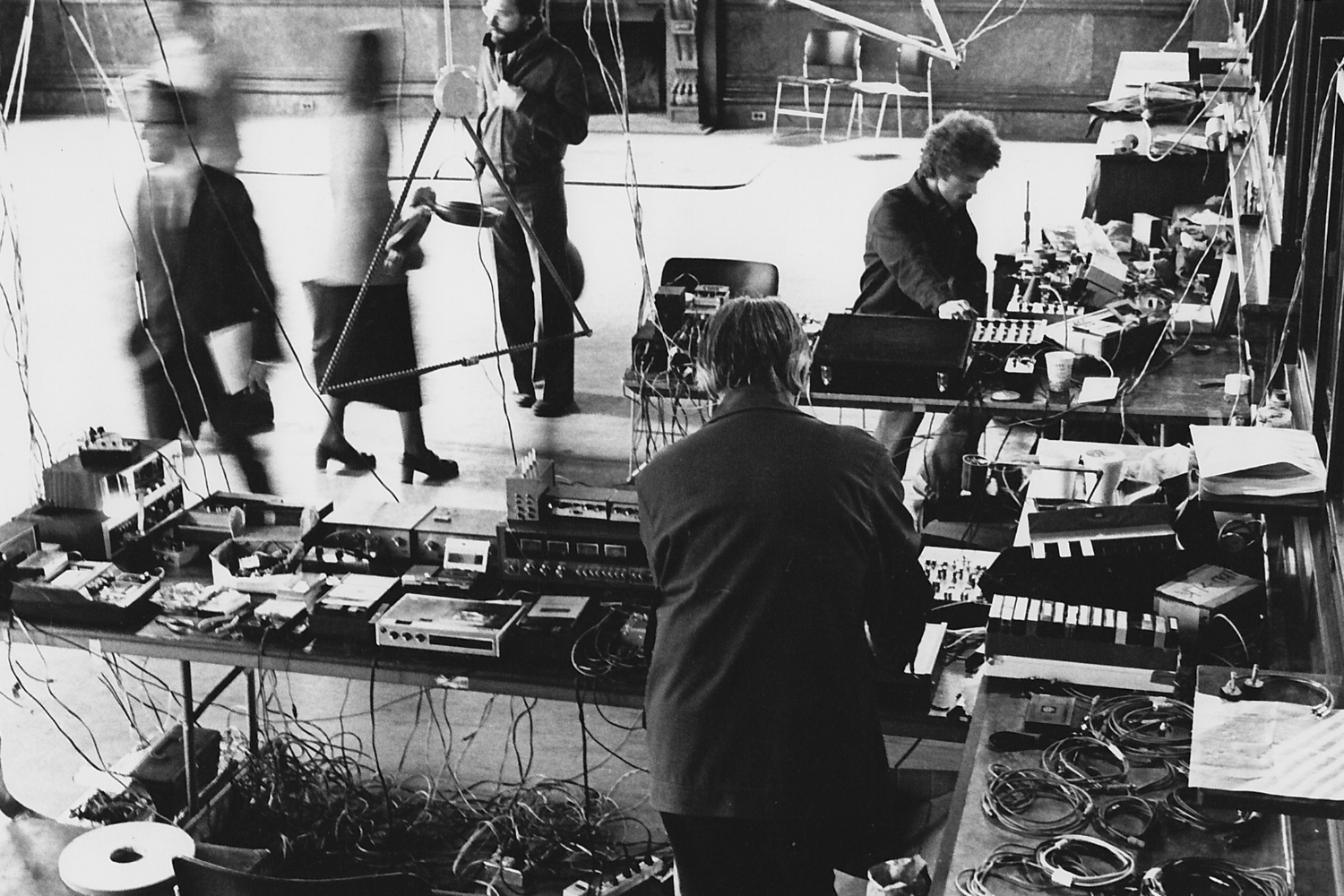
Forest Speech and Piano
Bowerbird is pleased to present pianist Amy Williams and a performance of David Tudor’s Forest Speech led by Composer Inside Electronic’s Phil Edelstein with Daniel Fishkin, Michael Johnsen, Victoria Keddie, Eugene Lew, and Gianna Santucci.
This concert celebrates David Tudor’s dual legacy as both a revolutionary pianist and electronic music pioneer. The program opens with Amy Williams performing works by Morton Feldman, John Cage, and Earle Brown that were written for and premiered by Tudor in the 1950s. As one of the most sought-after interpreters of piano music in his generation, Tudor’s performances transformed indeterminate scores into vivid sonic experiences, establishing new possibilities for what piano performance could be. Williams, a composer and pianist known for her deep engagement with contemporary repertoire and her acclaimed recordings of Morton Feldman and other experimental composers, brings her own interpretive insight to these historically significant works.
Michael Johnsen performs Tudor’s Untitled (1972), a seminal work of live-electronic music in which modular electronic components are configured to form feedback loops that generate sounds without exterior input. Composed for simultaneous performance with John Cage’s vocalization of his Mesostics Re Merce Cunningham, Untitled represents Tudor’s pioneering experiments in creating electronic sound without oscillators, tone generators, or recorded natural sound materials.
The evening concludes with Forest Speech (1976), a rarely performed work from Tudor’s Rainforest family that uses amplified objects as “instrumental loudspeakers.” Developed in 1976 and expanded as a group version in 1978, Forest Speech transforms sound into vocal-like illusions through formant resonances and vocoder-like circuit networks. This performance version utilizes everyday objects fitted with sonic transducers—metal barrels, plastic tubing, found materials—that resonate and shape electronic sound, creating a dense acoustic environment where physical materials become active participants in the composition.
PROGRAM
Morton Feldman: Intermission 6 (version 1) (1953)
Earle Brown: Four Systems (1953)
Morton Feldman: Extensions 3 (1952)
John Cage: Water Music (1952)
Morton Feldman: Intermission 6 (version 2) (1953)
Amy Williams, piano
David Tudor: Untitled (1972)
Michael Johnsen, electronics
David Tudor: Forest Speech (1976)
with Phil Edelstein, Daniel Fishkin, Michael Johnsen, Victoria Keddie, Eugene Lew, Gianna Santucci
This event is part of DAVID TUDOR: A VIEW FROM INSIDE, an exhibition at Drexel’s Pearlstein Gallery from January 15 to March 21, 2026.
ARTIST BIOS
Phil Edelstein in the early 1970s co-founded Electronic Body Arts (EBA), a collaboration between choreography, music, and engineering, and is a founding member of Composers Inside Electronics (CIE). He has collaborated on Rainforest IV and CIE projects since their inception in 1973 and on the evolution of the automated installation version Rainforest V, principally with John Driscoll. Another recent project with Driscoll is their installation Cluster Fields. His work includes compositions, performances, software, and sound installations for architectural spaces and focused sound fields. Recent focus is the development of compositional and orchestration tools for constructing sound fields for installation and performance. Current projects include updates to Impulsion, where synthetic and encoded reverberant spaces are folded upon themselves and acoustically rendered, and performances and new realizations of works by David Tudor such as Pepscillator.
Daniel Fishkin’s ears are ringing. His lifework investigating the aesthetics of hearing damage has received international press (Nature Journal, 2014), and he has been named a “tinnitus ambassador” by the Deutsche Tinnitus-Stiftung. He is the only luthier to have studied directly with daxophone inventor Hans Reichel. His instruments have toured internationally, including Canada, Norway, Germany, France, Japan, Kazakhstan, and Australia. He is the first USA-based artist to receive the P.I.G. Prize (2021) from Henrik Vibskov. He holds an MA in Music Composition from Wesleyan University and a PhD in Composition and Computer Music from the University of Virginia. He is Assistant Professor of Music Production at Ramapo College of New Jersey. His current favorite wood is Gymnanthes lucida (Oysterwood).
Michael Johnsen is a circuit designer, performer, and researcher from Pittsburgh. His recent research concerns circuit-level understanding of David Tudor’s “folkloric” homemade instruments and related lutherie, resulting in restoration, cloning, and performance of vintage circuits, along with publications and lectures. His performance work is characterized by a relative lack of ideas per se and an intense focus on observation—the way a shepherd watches sheep. As a performer and builder of live electronics, he cultivates an integrated menagerie of custom devices whose idiosyncratic behaviors are revealed through complex interactions, producing teeming chirps, sudden transients, and charming failure modes, embracing the dirt in pure electronics. He has shown work at Arter (Istanbul), singuhr (Berlin), INA GRM (Paris), the Getty (Los Angeles), MdM Salzburg, Kagurane (Tokyo), MoMA, SF Cinematheque, Radio France, Idiopreneurial Entrephonics (Connecticut), The Kitchen (New York), High Zero (Baltimore), and Musique Action. He co-edits ubu.com/emr, designs synthesizers for Pittsburgh Modular, and may be reached at johnsen.rahbek gmail.com.
Victoria Keddie is an interdisciplinary artist working across sound, video, installation, performance, and research. Her practice investigates architectures of communication—acoustic, spatial, and technological—and how gesture, noise, and interference shape experience. For over a decade she co-directed E.S.P. TV, a mobile platform for hybrid media and broadcast performance. She teaches at the University of Pennsylvania, where she designed a spatial sound studio for Fine Arts, and directs the Spatial Sound Consortium with Harvestworks, linking international studios. She has performed and exhibited at the Whitney Museum of American Art, Pioneer Works, Fridman Gallery (US), the Barbican (UK), Berghain (DE), Goethe-Institut (NY/CO), and MAPS (DK). Fellowships include NYSCA/NYFA (2022), Max Planck Institute for Empirical Aesthetics (2023), and the Bemis Center (2024). In 2025 she was Composer-in-Residence at EMS, Stockholm.
Eugene Lew is a Philadelphia-based guide, producer, educator, and organizer engaged in performance, design, access, management, transformation, (attempted) capture, storage, and playback of shared IRL experiences, with a sound/music bias. His practice centers on fleeting moments, aggregate independent decision-making, and stochastic phenomena. He values serendipitous collaborations and long-term partnerships exploring cycles of remembering, learning, forgetting, and reconstructing.
Gianna Santucci is an interdisciplinary artist and percussionist from Merritt Island, FL, based in Philadelphia. She received an MFA in Painting (University Fellowship) from Tyler School of Art and a BFA in Fine Arts and BM in Music Performance from Florida Southern College. Her work has been exhibited at Icebox Project Space, Vox Populi, and Cherry Street Pier in Philadelphia. Recent performances include New Ear::SPATIAL at Fridman Gallery, the Low Tech Electronics Faire at the Charles Library, and Chilladelphia at Thunderbird Hall. Through multimedia installations, her work engages militarized sound, subculture, transmission, and rhythm.
Amy Williams is a composer of music described as “simultaneously demanding, rewarding and fascinating” (Buffalo News) and “fresh, daring and incisive” (Fanfare). Her works have been presented internationally by leading soloists and ensembles including the Pittsburgh Symphony Orchestra, Buffalo Philharmonic Orchestra, JACK Quartet, Ensemble Aleph, Dal Niente, Wet Ink, Talujon, International Contemporary Ensemble, and pianist Ursula Oppens. Recordings appear on Albany, Parma, VDM (Italy), Blue Griffin, Centaur, and New Ariel. She has a deep connection to Morton Feldman—her father and Feldman were close colleagues at the University at Buffalo. As half of the Bugallo-Williams Piano Duo, she has performed worldwide and recorded six CDs for Wergo (Nancarrow, Stravinsky, Varèse/Feldman, Kurtág). She has taught at Bennington College and Northwestern University and is currently Associate Professor of Composition at the University of Pittsburgh.
Major support for DAVID TUDOR: A VIEW FROM INSIDE has been provided by The Pew Center for Arts & Heritage, with additional support from the Musical Fund Society of Philadelphia.