+ Google Map
$15 – $25
Get Tickets
Bowerbird is pleased to present the Arcana New Music Ensemble performing works by Earle Brown and Morton Feldman celebrating their centenary this year. The performance is part of Icebox Project Space’s Light and Sound Series.
PROGRAM
Earle Brown: Four Systems (1954)
Earle Brown: December 1952 from Folio I (1952)
Earle Brown: One Through Five from Folio II (1970)
Morton Feldman: Only (1947)
Morton Feldman: A Very Short Piece for Trumpet (1986)
Morton Feldman: King of Denmark (1964)
ABOUT THE ARTISTS
Founded in 2015, the Arcana New Music Ensemble is a group of Philadelphia-based musicians dedicated to presenting interesting, beautiful, and unconventional music in interesting, beautiful, and unconventional places.
The Arcana New Music Ensemble is a Philadelphia-based chamber ensemble dedicated to contemporary classical music. Its mission is to perform works by living composers and to reexamine music from the past, often focusing on composers whose work has been overlooked. A hallmark of Arcana’s programming is its frequent use of portrait concerts, which allow the ensemble to explore a composer’s work in depth. These programs balance music by widely recognized composers with works by those who are less well known or historically underrepresented.
Founded in 2015 by musicologist Thomas Patterson, harpist Elizabeth Huston, and curator Dustin Hurt, Arcana was created to provide a platform for Philadelphia’s many skilled performers interested in exploring both new works and important compositions from the past hundred years. Since 2020, the ensemble has been co-directed by Andy Thierauf and Dustin Hurt.
In 2016, Arcana partnered with Pig Iron Theatre Company to present Samuel Beckett, Words and Music by Morton Feldman and began a multi-year project devoted to the music of Moondog (Louis Hardin). The following year included a portrait concert of Galina Ustvolskaya, collaborations with Variant 6 and Prometheus Chamber Orchestra, and performances of works by Julius Eastman, including Stay On It, Femenine, and Thruway.
In 2018, Arcana presented rare works by Pauline Oliveros and portrait concerts of Tom Johnson, James Tenney, and Ben Patterson, along with a second Moondog program. In 2019, the ensemble presented concerts focused on Claude Vivier and Johanna Beyer and participated in a program of George Crumb’s chamber works. From 2020 onward, the ensemble’s programming has included a retrospective of David First, collaborations with the Wildflowers Composer Festival, and concerts highlighting Iranian and Iranian-American composers. Recent seasons have featured portrait concerts of Sarah Hennies, Raven Chacon, and George Walker, the launch of the annual Postal Pieces project, and performances of Pauline Oliveros’s The Well and the Gentle and Lucia Dlugoszewski’s Black Lake.
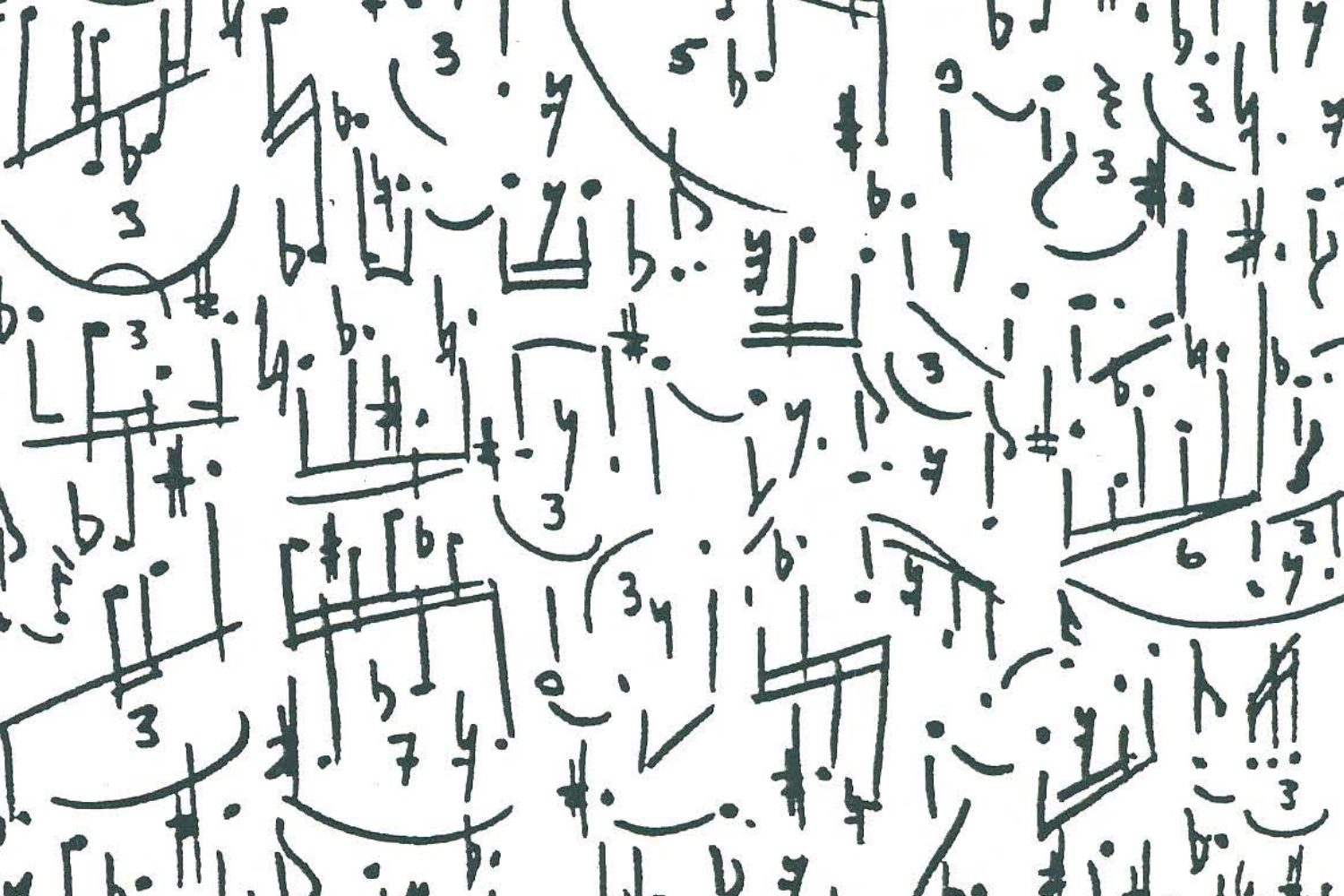
EARLE BROWN (1926–2002) was an American experimental composer whose works in graphic notation and open form were seminal to the history of postwar music. He explored the limits of traditional staff notation to the point of abstraction in Folio and 4 Systems (1952–54) and prompted performers to make their own determinations about pitch, time, intensity, timbre and attack—an approach that contrasted sharply with the composer-controlled treatment of sound implicit in serialism and total organization. Brown used graphic notation sparingly after 1960 when he began writing large-scale open form works for orchestra. He had composed 25 Pages (1953) for piano in open form, but to achieve collective mobility among 18 musicians and conductor in Available Forms 1 (1961), and 98 musicians and 2 conductors in Available Forms 2 (1962), Brown wrote predominantly through-composed events and devised a cueing system for conductors to signal in-performance decisions about the order and phrasing of these events. This cueing system appears in over a dozen open form works across his career. Brown described his sound ideal as spontaneous, warm and responsive to the moment. Unbeholden to the stylistic boundaries that dictated new music during his time, Brown embraced a wide range of influences including jazz improvisation, twelve-tone technique, the Schillinger system, the indeterminacy of his New York School colleagues (John Cage, Morton Feldman, Christian Wolff), electroacoustics, action painting, collage and the mobile sculptures of Alexander Calder.
MORTON FELDMAN was born in New York in 1926. He studied music and piano with several teachers at a young age before becoming a student of Stefan Wolpe after graduating from high school in 1944. Although Feldman mastered atonality, the pair spent much of their time together simply arguing about music and Feldman struggled to find an artistic voice when composing music.
Feldman’s artistic development took shape in 1949 when Feldman met composer John Cage, commencing a lifelong artistic association of crucial importance to American music in the 1950s. Cage was instrumental in encouraging Feldman to have confidence in his instincts, which resulted in totally intuitive compositions. From then on, Feldman never worked with any systems that anyone has been able to identify, working from moment to moment, from one sound to the next. During this vital time of his musical career, his friends during the 1950s in New York included the composers Earle Brown and Christian Wolff; painters Mark Rothko, Philip Guston, Franz Kline, Jackson Pollock and Robert Rauschenberg; and pianist David Tudor.
The painters in particular influenced Feldman to search for his “physical sound-world,” one that was more immediate and direct than had existed before. It is said that his use of repetition of individual elements creates a vast field of shimmering colors and textures. He rejected standard notation which resulted in his experimentation with graph notation; Projection 2 was one of his earliest scores using this highly visual system. In these scores, the players have some input in the overall structure as they select their notes from within a given register and time. These led to a series of groundbreaking works, often considered controversial in regard to their inaccessibility to the general public. However, Feldman was not happy with the amount of improvisation and freedom given to the performer, so he returned to more precise forms of notation. It was at this time that many would say he created his most “visual” pieces, including Rothko Chapel, Why Patterns?, and For Philip Guston.
After partially rejecting the use of graph notation and aleatory music, his works of the late 70s and 80s grew longer: his compositions expanded in length to such a degree that allowed him to focus on the passage of time and the movement of blocks of sound through musical space. The scale of these works allowed Feldman to have control over the piece he wrote. Nine of Feldman’s one-movement compositions last for over one and a half hours each. His infrequently played String Quartet No. 2 can last up to six hours, with no break for the performers.
In 1973, the University of New York at Buffalo asked Feldman to become the “Edgard Varèse Professor,” a post he held for the rest of his life. In June 1987, Morton Feldman married the composer Barbara Monk. On September 3, 1987, he died at his home in Buffalo at age 61.